Conclusion. Doosan Fuel Cell has won more than half of Korea’s hydrogen power bidding market (CHPS) with its mainstay phosphoric acid fuel cell (PAFC), but with the government cutting this year’s CHPS auction volume by 30.2%, from 179MW to 125MW, the PAFC-centred business structure itself is at a crossroads. The company is seeking a way forward through its solid oxide fuel cell (SOFC) production base in Saemangeum, into which it has invested KRW 143.7 billion, but it is a latecomer in overseas markets, so building a track record is the key. For power generation operators, this is a phase in which they must decide whether to allocate capital expenditure to the stability of long-term PAFC contracts or to the efficiency advantage of switching to SOFC, while watching both the pace of CHPS policy cuts and SOFC overseas order results.
The judgement that “CHPS alone is not enough” shows that when policy risk concentrates on a specific fuel cell type, it can shake the business portfolio itself.
Where SOFC wins, where it doesn’t
Where it wins. Current condition: a site with no heat consumer nearby, where electricity itself is the product. After switching: at a site where recovered heat has no value, the CHP strength of PAFC does not turn into revenue, while SOFC draws more electricity from the same fuel through its efficiency. Connecting logic: the fewer heat buyers there are, the more the valuation narrows to electrical output alone, and on that axis SOFC leads.
Where it doesn’t. Current condition: a site with a steady heat consumer attached and long-term PAFC contracts running. After switching: moving to SOFC means redesigning how heat is used and taking on the operating-record risk of a latecomer’s product. Connecting logic: where heat is already part of revenue, the efficiency advantage struggles to outweigh the switching cost and track-record risk.
PAFC vs SOFC: what is different
Doosan Fuel Cell took 62%, 73% and 60% of CHPS awarded volume in 2023, 2024 and 2025 respectively, effectively leading the PAFC market. But because CHPS is a scheme in which the government creates a market by requiring a set amount of hydrogen-generated electricity to be purchased, a smaller auction volume shrinks new orders directly. In the second quarter of this year Doosan Fuel Cell recorded revenue of KRW 44.3 billion (down 65.5% year on year) and an operating loss of KRW 51 billion (up 2559% year on year). PAFC and SOFC differ from the operating principle up.
| Item | PAFC (phosphoric acid) | SOFC (solid oxide) |
|---|---|---|
| Electrolyte | Phosphoric acid (liquid) | Ceramic solid oxide (YSZ) |
| Operating temperature | About 200°C (low temperature) | 600-1000°C (high temperature) |
| Electrical efficiency | Relatively low | Highest among fuel cells (60% or more) |
| Strengths | Stability and durability, heat use in CHP | Electrical efficiency, can use natural gas directly |
| Doosan Fuel Cell business status | 60-73% of CHPS awards (2023-2025), this year’s auction volume down 30.2% | First commercial supply to Hy Changwon (39.8MW) in 2025, KRW 108.7 billion export contract with Germany’s Rebellion in August 2026 |
| Policy risk | Directly exposed to CHPS auction volume cuts | Unrelated to CHPS, depends on overseas order results |
What this table says is that the CHPS cut is a structural change that shrinks the very base of new PAFC orders: power generation operators and EPCs need to protect the residual value of existing long-term PAFC contracts while separately reviewing when to switch to SOFC.
What the two technologies mean for plant equipment
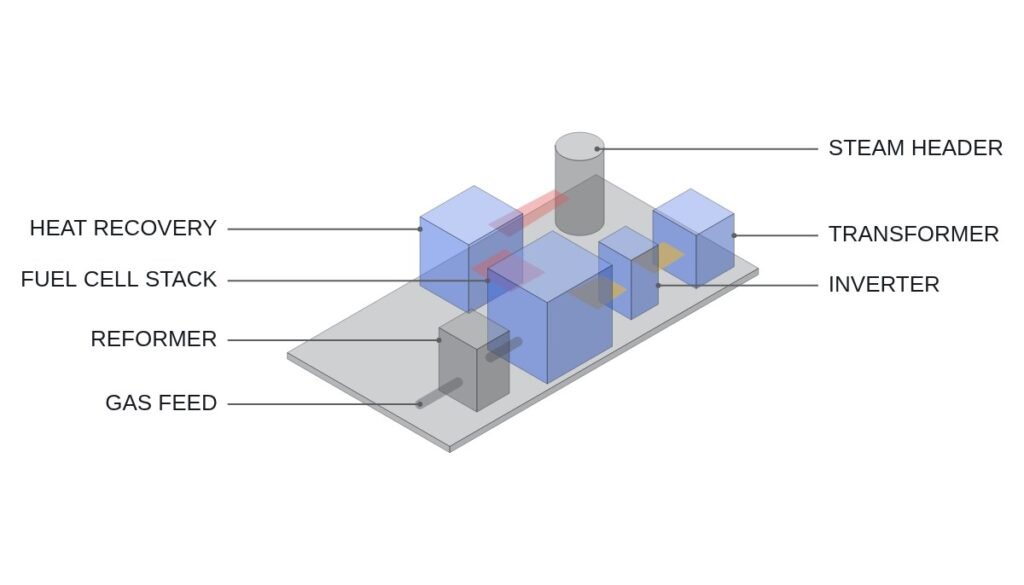
From the power system side, PAFC and SOFC are not interchangeable boxes that simply produce kilowatts. The operating temperature in the table changes almost everything around the stack. A low-temperature PAFC plant is built around recovering usable heat, which is why the table lists heat use in CHP as its strength. A high-temperature SOFC plant is built around converting as much fuel as possible into electricity, and its thermal management is aimed at holding the stack at temperature rather than exporting heat to a user.
That difference shows up in how each plant fits into a site. A PAFC installation makes the most sense where there is a steady heat consumer nearby, because the recovered heat is part of the value. An SOFC installation leans on electrical output alone, which suits a site where electricity is the product and heat has no buyer. The table’s note that SOFC can use natural gas directly also matters here: fuel supply arrangements, not just the stack, shape what the balance of plant looks like.
For an operator, then, switching from PAFC to SOFC is not a like-for-like replacement. It changes which sites are suitable, what the heat side of the plant does, and how the plant earns its revenue. The policy change in CHPS only accelerates a decision that was already a question of site conditions.
How the two paths differ in character
| Aspect | Staying with PAFC | Moving to SOFC |
|---|---|---|
| Revenue basis | Existing long-term contracts, CHPS awards | Electrical output, overseas and private demand |
| Main exposure | Domestic policy volume | Unproven track record as a latecomer |
| Best-fit site | Steady heat consumer nearby | Electricity-driven site with no heat buyer |
| What to protect | Residual value of running units | Delivery and reliability of first units |
The table shows that the two paths carry different risks rather than one being safe and the other risky. PAFC risk sits in domestic policy, which has already moved against it; SOFC risk sits in execution and track record, which has not yet been proven either way. An operator choosing between them is choosing which kind of uncertainty to hold.
Order of judgement for operators and EPCs
- Separate running assets from new investment. Existing PAFC units under long-term contracts keep their value regardless of new auction volume; protect their availability first.
- Check the site’s heat demand. If a steady heat consumer exists, the PAFC strength in CHP still applies; if not, the SOFC efficiency advantage weighs more.
- Track the CHPS volume trend, not a single year. One cut is a signal; the direction over several auctions decides whether new PAFC orders have a base.
- Track SOFC delivery records after the first contracts. Commercial supply and export contracts show demand exists; continued orders and operating results show the product holds up.
- Review protection and interlock design for any high-temperature plant before committing. A different stack temperature means different start-up, shutdown and fault sequences; confirm these with the manufacturer rather than assuming PAFC practice carries over.
Boundary conditions: where the advantage flips
- If the SOFC overseas order track record does not continue beyond the Rebellion contract: proof of price and performance competitiveness as a latecomer is delayed.
- If demand for power generation for large data centres, SOFC’s main target market, opens later than expected: SOFC’s efficiency advantage over PAFC does not turn into revenue.
In this case, the single criterion that decides capital expenditure priority is whether the SOFC overseas track record continues. The trend of fewer new PAFC orders as CHPS shrinks is already all but settled, but whether SOFC can fill that gap remains an unverified variable.
References: Newspim, “PAFC alone is not enough… Doosan Fuel Cell stakes everything on SOFC” (2026-08-07) (Korean). Patent KR20130073370A – Korea University Industry-Academic Cooperation Foundation, “Support structure for optimising the performance of a solid oxide fuel cell stack” (filed 2011-12-23, published 2013-07-03; legal status per Google Patents: Rejected/Ceased – cited only as background on SOFC stack structure efficiency research; note that this is an unregistered application).