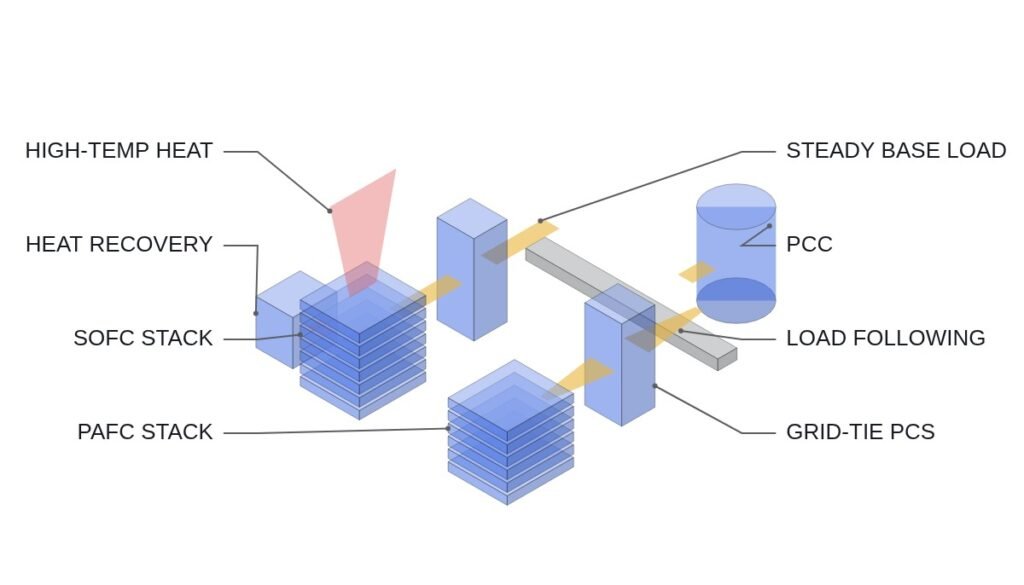
Bottom line first. If you pick a stationary fuel cell among PAFC, MCFC and SOFC by ranking electrical efficiency, you start from the wrong question. The first thing to pin down is the temperature grade of heat the site can actually absorb. A site that only consumes hot water at around 100 °C is the natural home for PAFC. A site with process steam demand, or equipment that can reuse high-temperature exhaust, brings MCFC and SOFC into play. A site with no heat demand at all leaves only SOFC, on electrical efficiency alone. MCFC carries one extra condition: the cathode needs a continuous CO2 supply, which ties the fuel system to reformed natural gas or biogas.
Where the three split — electrolyte and operating temperature
These three are not just different names; a different ion moves through each electrolyte. That difference sets the operating temperature, and the operating temperature sets the grade of the exhaust heat, the reforming arrangement and the start-up time. In a generation project review, “which one is better” turns into “which temperature of heat goes where.”
| Item | PAFC | MCFC | SOFC |
|---|---|---|---|
| Electrolyte | Phosphoric acid | Molten carbonate | Ceramic (oxide) |
| Mobile ion | H+ | CO3 2- | O 2- |
| Operating temp. | approx. 200 °C | approx. 650 °C | approx. 600-1,000 °C |
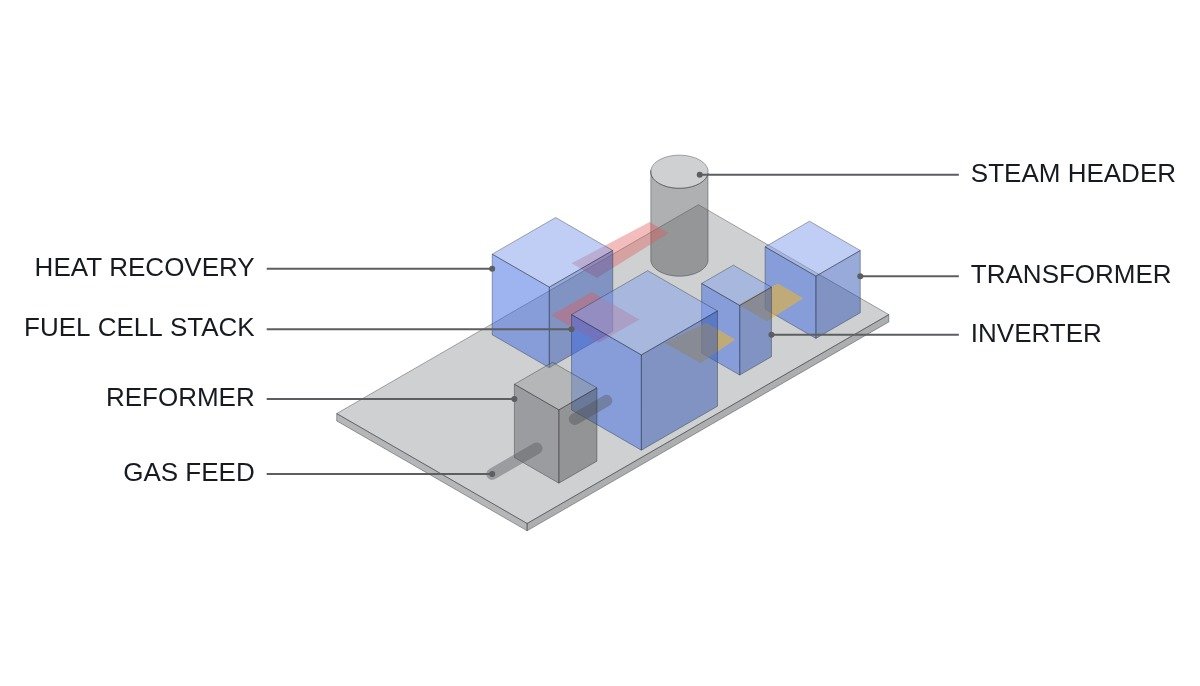
| Reforming | External + CO clean-up | Internal possible | Internal possible |
| Recovered heat | Mainly hot water | High-temp exhaust | High-temp exhaust |
| Typical elec. eff. (LHV) | around 40% | around 50% | 50-60% |
| Specific constraint | Limited CO tolerance | Cathode CO2 supply | Weak to thermal cycling |
Read only the efficiency row and SOFC wins every column. Read the recovered-heat row alongside it and the answer changes. On a hot-water-only site, SOFC’s high-temperature exhaust is heat you have to downgrade before use; on a steam site, PAFC’s hot water is heat that falls short of the required grade. The efficiency figures are typical literature ranges; rated and degraded efficiency must be checked against manufacturer data.
Where it wins, where it doesn’t
PAFC — sites with year-round hot water demand
Current condition: a site with year-round demand for heat around 100 °C, such as a district heating network, a large building cluster or a hot-water process. After deployment: heat recovered from the stack coolant goes straight into the hot water loop with few heat exchange stages, and combined electrical plus thermal efficiency rises. Connecting logic: PAFC’s lower electrical efficiency is only offset on a site that uses all of its heat. If heat demand drops out seasonally, the logic breaks for that period.
MCFC — sites with both steam demand and a CO2 source
Current condition: an industrial complex using process steam, or a wastewater or waste treatment plant producing biogas. After deployment: exhaust at about 650 °C can drive a waste-heat boiler for steam, and internal reforming simplifies the reformer train. Connecting logic: MCFC only carries current when CO2 and oxygen meet at the cathode to form carbonate ions. Anode exhaust CO2 is normally recycled to the cathode, so this is the type that runs most naturally on a carbon-containing fuel.
SOFC — sites with no heat demand, or with a use for high-temperature heat
Current condition: a site like a data center that needs electricity and almost no heat, or a site where exhaust heat can drive another power cycle. After deployment: the most electricity per unit of fuel, and steam as well if the heat is used. Connecting logic: SOFC loses the least when heat is thrown away. The catch is that ceramic stacks dislike repeated heat-up and cool-down, so the advantage shrinks on sites that need frequent starts and stops.
Re-reading by heat grade — first candidate per site condition
Compare electrical output alone for the same 1,000 kW (LHV) fuel input. Assumption: PAFC electrical efficiency 42%, SOFC 55%. PAFC delivers 420 kW and SOFC 550 kW, a 130 kW gap. The only way PAFC closes that gap is by selling heat, and that heat only has value as hot water. If the site needs steam instead, PAFC’s hot water cannot enter that demand, so the share that heat sales could recover shrinks.
| Site heat condition | First candidate | Reason |
|---|---|---|
| Year-round hot water | PAFC | Heat grade matches demand |
| Process steam | MCFC / SOFC | Hot exhaust drives waste-heat boiler |
| No heat demand | SOFC | Competes on electrical efficiency |
| Biogas fuel | MCFC | Fits CO2-bearing fuel |
| Planned pure H2 firing | PAFC / SOFC | MCFC loses its CO2 source |
The row that filters first is the last one. On a site planning a future switch to pure hydrogen, MCFC ends up needing a separate CO2 supply to the cathode from the day of conversion. It is safer to keep MCFC on the list only where the fuel plan is fixed on natural gas or biogas for ten years or more.
Decision sequence
- Break the site heat demand down by temperature grade: hot water (around 100 °C), low-pressure steam, reuse of high-temperature exhaust. Record the monthly minimum.
- Fix the fuel plan: natural gas only, biogas blend, or a future hydrogen switch. This decides whether MCFC stays a candidate.
- Check start/stop frequency. If dispatch commands will force frequent shutdowns, assess the thermal-cycling burden on high-temperature stacks separately.
- Calculate whether heat sales can cover the electrical efficiency gap. Heat price and annual heat utilization are site contract terms and cannot be set in this article.
- Compare again on net exported power, after grid interconnection conditions and auxiliary loads (pumps, blowers, dump radiators).
Items to verify
- Rated electrical efficiency per product and the efficiency degradation curve over operating years
- Recovered heat grade of the PAFC product (hot water supply temperature, low-pressure steam capability)
- MCFC cathode CO2 supply arrangement and when external CO2 make-up is needed
- Allowable thermal cycles and hot standby auxiliary power for the SOFC product
Boundary conditions
Three conditions reverse this selection rule. First, strongly seasonal heat demand. On a site that needs hot water only in winter, PAFC competes on electrical efficiency alone through the summer, and on an annual average SOFC can come out ahead. Second, an operating pattern that is not continuous baseload. If output has to follow dispatch commands or stop frequently, heat-up time and thermal-cycling degradation turn into costs before the efficiency advantage of the high-temperature types pays off.
Third, a case where MCFC’s CO2 requirement becomes an advantage. With combustion exhaust nearby, routing that exhaust to the cathode to concentrate CO2 becomes an option worth reviewing, and MCFC then acts as both a generator and a carbon-capture pre-treatment unit. How well this works depends on exhaust composition and impurities, so it must be confirmed against demonstration data.
The single selection rule: first fix the temperature grade of heat the site can absorb all year, pick the type whose exhaust heat matches that grade, and if there is no heat to absorb, pick the type with the highest electrical efficiency.