On August 5, 2026, Doosan Fuel Cell disclosed an SOFC (solid oxide fuel cell) stack supply contract worth about KRW 108.7 billion with the German energy company Reverion GmbH. It is the largest overseas export contract since the company’s founding, with a contract period from August 4, 2026 to December 31, 2027. In the same month in Korea, a KRW 89.4 billion contract with YH Power followed for fuel cell system supply and long-term service (LTSA); Doosan Fuel Cell’s domestic power-generation fuel cells have traditionally been PAFC (phosphoric acid fuel cell) products. The conclusion first: SOFC and PAFC are grouped together as “fuel cells,” but from a grid-interconnection standpoint their advantages split according to load-following requirements — SOFC is better for continuous power with little load variation, while PAFC still holds the advantage for distributed generation that needs frequent starts and stops.
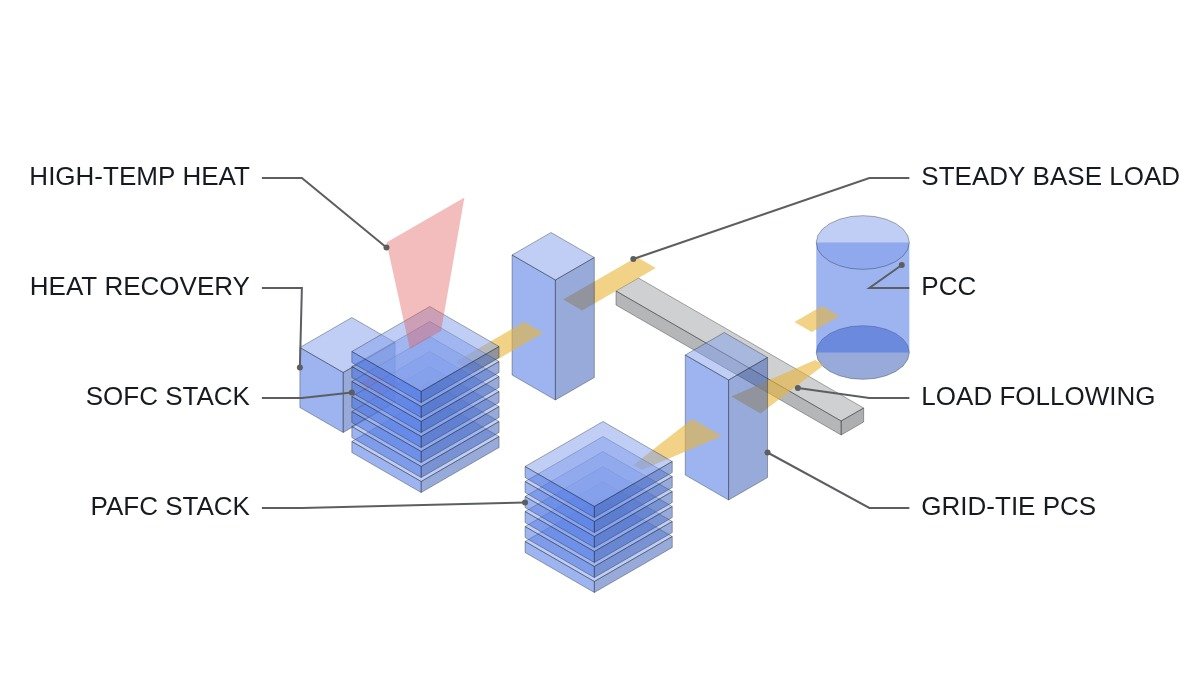
The contest between SOFC and PAFC is not decided by electrical efficiency, but by how much load-following speed the grid-interconnection interface can withstand.
Doosan Fuel Cell disclosed the SOFC stack supply contract with Reverion on August 5, 2026; it amounts to about 23.9% of the company’s consolidated revenue at the end of 2025 and is the largest overseas export in the company’s history. Around the same time in Korea, a KRW 89.4 billion fuel cell supply and maintenance contract with YH Power was reported, and since Doosan Fuel Cell holds exclusive license rights to PAFC technology for the Asia and Oceania region, it is understood to be a contract in that product line.
Where it wins — continuous power with little load variation (SOFC)
SOFC is a solid oxide fuel cell operating at high temperatures of 700–1000℃, and it is known to reach stack efficiencies in the 50% range, and electrical efficiencies in the 60% range in combined configurations with heat recovery. Kyocera’s patent on SOFC grid interconnection (EP2773007A1) shows that an SOFC system applies different power-abnormality detection conditions in grid-connected mode and in stand-alone (self-generation) mode — detection thresholds are set strictly when grid-connected, matching the stable DC output characteristics of steady-state operation, and relaxed in stand-alone operation. Under stable operating conditions, such as continuous power for data centers and industrial complexes with little load variation, this kind of design works in its favor.
Where it doesn’t — distributed generation that needs frequent starts and stops (PAFC)
PAFC, by contrast, operates at a relatively low 150–200℃, has shorter start-up and shutdown times than SOFC, and has already accumulated numerous LTSA references in Korea. SOFC is known to be vulnerable to rapid temperature changes and frequent start-stop cycles because of the thermal-stress characteristics of its ceramic electrolyte, which can accelerate stack degradation. Under distributed-generation conditions such as commercial facilities and hospitals, where load changes often and stops and restarts repeat, PAFC still holds the advantage.
SOFC-PAFC comparison
| Item | SOFC | PAFC |
|---|---|---|
| Operating temperature | 700–1000℃ | 150–200℃ |
| Start/stop time | Relatively long (thermal stress must be managed) | Relatively short |
| Efficiency (stack alone / combined) | 50% range / 60% range (combined) | 40% range |
| Grid-interconnection PCS characteristics | Stable DC output, strict abnormality detection thresholds (in normal operation) | Must handle relatively frequent output changes |
| Representative contract, August 2026 | Doosan Fuel Cell–Reverion (Germany), about KRW 108.7 billion, SOFC stack export | Doosan Fuel Cell–YH Power (Korea), about KRW 89.4 billion, fuel cell supply and LTSA |
The implication of the table is that the very fact that one company signed two contracts in the same month in two different markets (export-type SOFC vs. domestic LTSA-type PAFC) shows the two technologies are not substitutes for each other, but parallel tracks with different load-following requirements.
Boundary conditions
The detailed electrical specifications of the two contracts (rated voltage, inverter THD, response speed, etc.) were not specifically given in public releases as of August 2026, and are separated as items to verify. In addition, EP2773007A1 is a patent application published in 2014 whose current legal status is “Withdrawn,” and it cannot be asserted to be identical to Kyocera’s current SOFC PCS design — it should be referred to only as a conceptual example of differentiating abnormality detection conditions between grid-connected and stand-alone operation. The selection criterion narrows to one: is the target load in continuous steady-state operation, or does it require frequent starts and stops?
References
Newspim, “Doosan Fuel Cell makes first export of SOFC core component… stepping up as a global company” (2026.08.05)
eFocus, “Doosan Fuel Cell’s largest export at KRW 108.7 billion; its stack technology was licensed from the UK” (2026.08.05)
4th Journal, “Doosan Fuel Cell expands ‘phosphoric acid fuel cell’ business rights to Asia and Oceania“
EP2773007A1, Kyocera Corp, “Power supply system, distributed power source system, administration device, and power supply control method” (Google Patents, legal status: Withdrawn)