On 14 August 2026, Korea South-East Power signed a comprehensive memorandum of understanding (MOU) with the Saemangeum Development and Investment Agency to build the “Saemangeum Green Energy Complex.” It is Korea’s first “solar-green hydrogen-hydrogen power” carbon-free power ecosystem project, bringing together 1,000 MW (1 GW) of onshore solar, 320 MW of electrolysis-based green hydrogen production and 100 MW of hydrogen-only (100% hydrogen-fired) power generation on a site of about 3.05 million pyeong in Zone 3 of the Saemangeum project area in Buan, North Jeolla. The conclusion first: this facility is not a single power plant but a system in which the solar inverters, electrolysis rectifiers and hydrogen turbine generator are linked in sequence, so its interlocks must be designed to monitor the voltage and frequency stability of the point of common coupling (PCC) as the top priority, above the self-protection of the electrolysers or turbine.
The purpose of the complex is not to tie solar, electrolysis and hydrogen power into a single self-sufficient grid, but to supply carbon-free power while maintaining grid connection stability. The interlock priorities must be designed backwards from that purpose.
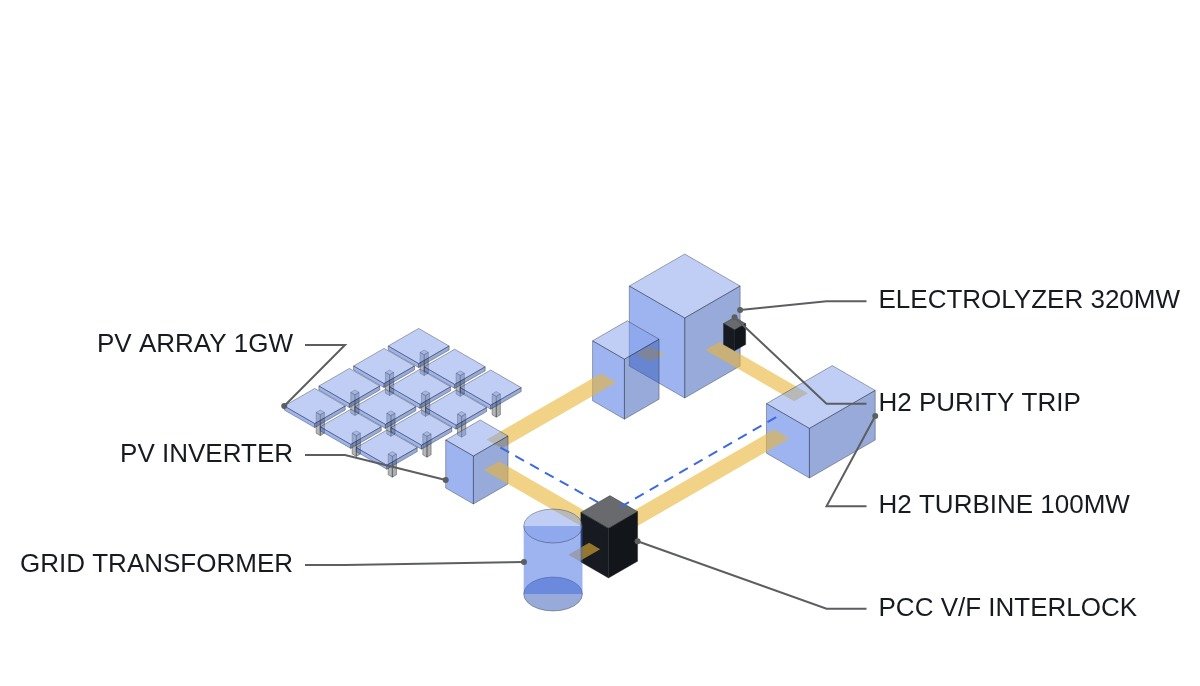
Preconditions: This MOU, signed on 14 August 2026, is at the comprehensive agreement stage, and the actual control interfaces and drive sequences between the solar inverters, electrolysis rectifiers and hydrogen turbine generator have not yet been published. The checklist below is not the actual logic of any specific facility; it is developed from grid connection principles generally applied to renewable-electrolysis-hydrogen turbine complexes.
Safety interlock check order (top priority)
- PCC (point of common coupling) voltage and frequency interlock — when a grid abnormality (voltage or frequency excursion) is detected, disconnect all solar inverters and the hydrogen turbine generator from the grid first (anti-islanding)
- Solar output ramp interlock — when solar inverter output exceeds the set rate of change, limit electrolysis rectifier input power to prevent damage to electrolyser cells
- Electrolysis hydrogen purity and pressure interlock — shut off hydrogen supply immediately when the purity of the produced hydrogen falls short or piping pressure is abnormal (prevents impurities and overpressure from reaching the hydrogen turbine combustor)
- Hydrogen turbine generator protection interlock — open the circuit breaker according to standard generator protective relaying logic, such as generator overcurrent and overheating
- EMO (emergency stop) — the principle is a configuration in which hardware wiring directly cuts the power output stage of each unit (PV inverters, electrolyser rectifiers, hydrogen turbine); designs that replace or bypass the EMO function with software logic alone are not covered on this site.
Complex interlock checklist (I/O map)
| Signal | I/O address | Type | Operating condition |
|---|---|---|---|
| PCC voltage | AI101 | Analog In 4-20mA | All units disconnected from grid on excursion beyond limits |
| PCC frequency | AI102 | Analog In 4-20mA | All units disconnected from grid on excursion beyond limits |
| Solar inverter output rate of change | AI103 | Analog In 4-20mA | Electrolyser input limited when set rate is exceeded |
| Electrolysis hydrogen purity | AI201 | Analog In 4-20mA | Hydrogen supply shut off when purity falls short |
| Electrolysis piping pressure | AI202 | Analog In 4-20mA | Hydrogen supply shut off above upper limit |
| Hydrogen turbine generator protection | DI201 | Digital In | 1 = detected → generator breaker opens |
| Grid connection breaker enable | DO101 | Digital Out | Outputs 1 only when all interlocks are normal |
The implication of this checklist is clear: AI101 and AI102 (PCC voltage and frequency) must be placed as higher-level interlocks than AI201 and AI202 (electrolysis hydrogen purity and pressure). This is because the purpose of the complex is not to tie solar, electrolysis and hydrogen power into a single independent grid, but to supply carbon-free power while maintaining grid connection stability.
PLC logic snippet (IEC 61131-3 Structured Text pseudocode, general concept example)
(* Solar-electrolysis-hydrogen turbine complex grid connection interlock logic, concept example *)
(* AI101: PCC voltage (%), AI102: PCC frequency (Hz), AI103: PV inverter output rate of change (%/s) *)
(* AI201: electrolysis hydrogen purity (%), AI202: electrolysis piping pressure (barg), DI201: hydrogen turbine generator protection *)
IF AI101 > 106.0 OR AI101 < 94.0 OR AI102 > 60.5 OR AI102 < 59.5 THEN
 DO_GRID_BREAKER_ENABLE := FALSE; (* PCC voltage/frequency excursion, disconnect all units first *)
ELSIF DI201 = 1 THEN
 DO_GRID_BREAKER_ENABLE := FALSE; (* hydrogen turbine generator protection signal confirmed *)
ELSIF AI201 < 99.0 OR AI202 > 35.0 THEN
 DO_ELECTROLYZER_H2_SUPPLY_ENABLE := FALSE; (* purity short or piping overpressure, shut off hydrogen supply *)
ELSIF AI103 > 20.0 THEN
 DO_ELECTROLYZER_INPUT_LIMIT_REQUEST := TRUE; (* PV output ramp, request electrolyser input limit *)
ELSE
 DO_GRID_BREAKER_ENABLE := TRUE;
END_IF;
Boundary conditions: responding to field variables
As of 14 August 2026, the Saemangeum Green Energy Complex is at the comprehensive MOU stage, and the actual ratings of the PCS, rectifiers and hydrogen turbine generator, as well as the grid connection protection settings, have not yet been finalised and announced. If rapid weather-driven changes in solar output (such as passing clouds) outpace the response speed of the electrolyser rectifier input-limiting logic, this could lead to electrolyser cell damage or lost hydrogen production — requires waveform analysis and field measurement. The selection criterion comes down to one question: have the EMS and the grid connection protective relays placed the PCC interlocks (AI101, AI102) above the electrolyser interlocks (AI201, AI202)?
References
Bridge Economy, “Korea South-East Power signs agreement to build ‘Saemangeum Green Energy Complex'” (2026.08.14)
Energy Daily, “South-East Power to build Korea‘s first ‘solar, green hydrogen and hydrogen power’ carbon-free power ecosystem” (2026.08.14)
EP4437164A1, Electric Hydrogen Co, “Electrolyzer control” (Google Patents, legal status: Pending)