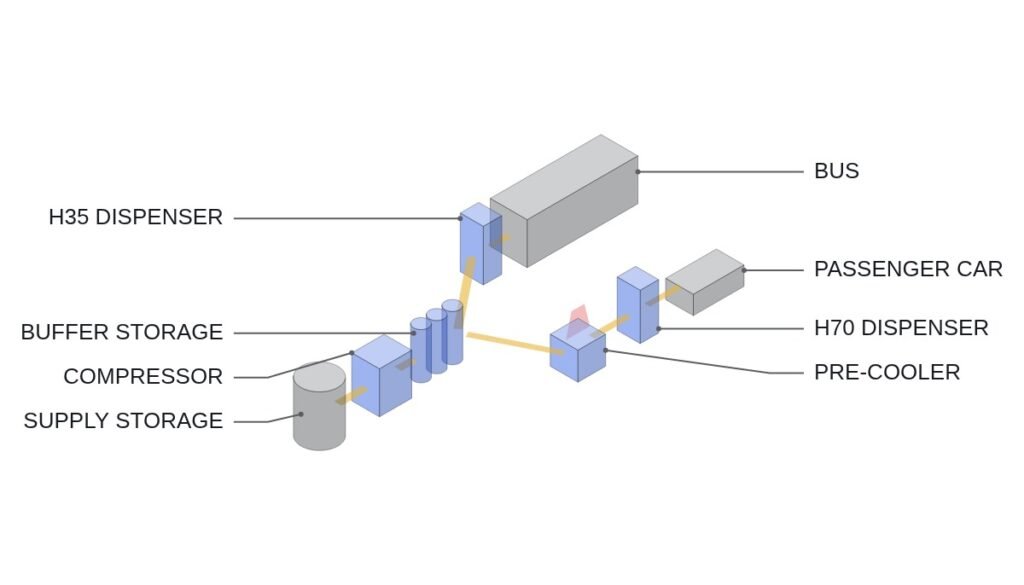
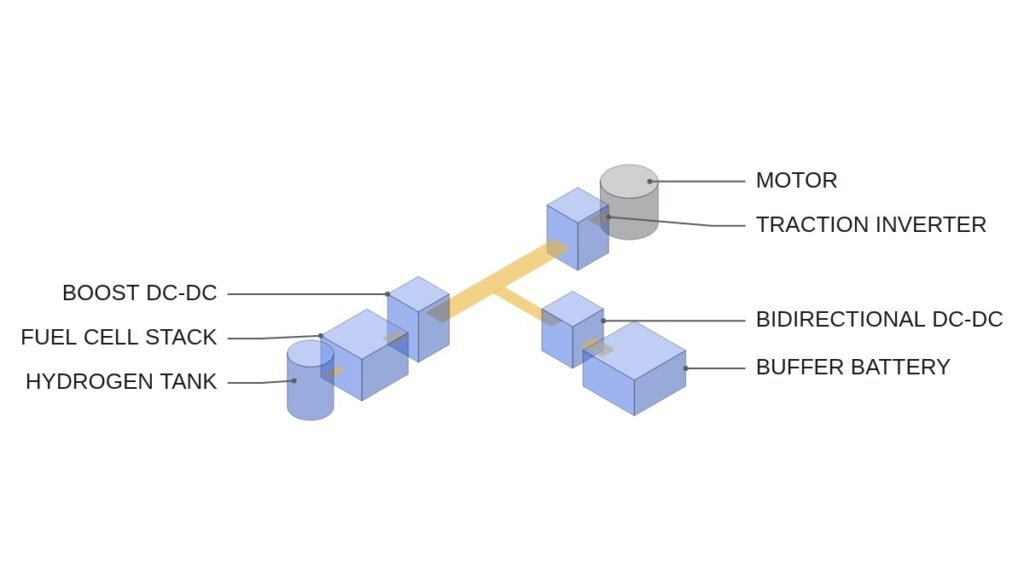
Bottom line first. The choice between a hydrogen truck and a battery-electric truck is not decided by daily mileage. The deciding variable is whether the energy (kWh) a charger can deliver during the stops that already exist in the route covers the gap between daily energy demand and usable battery capacity. If the duty cycle lets you close that gap, the battery truck wins on energy cost and plant simplicity. Hydrogen only earns its place where stops are too short or too irregular to close it. Treat this as a depot power-supply and scheduling problem, not a vehicle spec comparison.
Where it wins, where it doesn’t
Start with the current state. A diesel truck refuels in 5 to 10 minutes for a full day of driving, and dispatch schedules are built almost without regard to refuelling. That is why electrification discussions so often open as a “battery or hydrogen” spec sheet comparison: the diesel schedule is held fixed and only the power source is swapped.
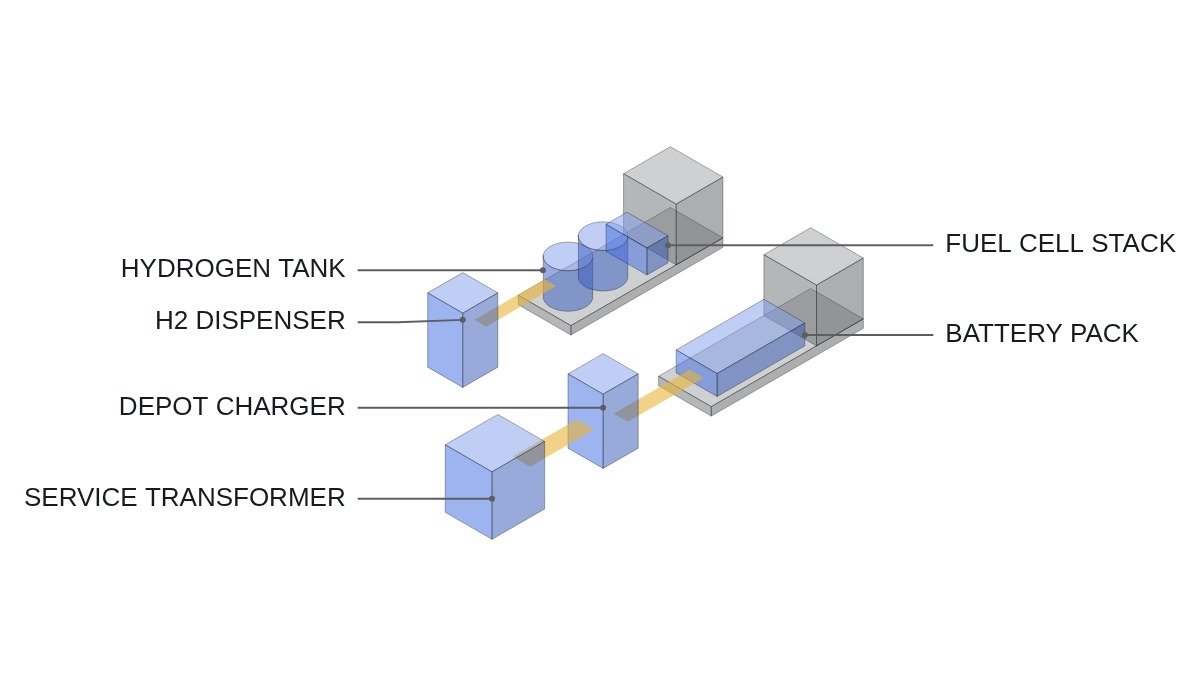
With a battery truck, the change shows up at the depot before it shows up in the vehicle. Routes whose daily energy fits into overnight depot charging are solved by installing one charger per truck and raising the service capacity. Routes whose daily energy exceeds usable pack capacity need daytime top-up, and that top-up has to fit inside existing stops such as loading, unloading and rest breaks. If it does not fit, vehicle utilisation drops.
With a hydrogen truck, refuelling time returns to roughly diesel levels, so the existing schedule can stay almost untouched. In exchange, every kWh delivered to the wheels carries the double conversion loss of electricity to hydrogen to electricity, and a new constraint appears: station location. If the station is not on the route, the detour itself eats into driving time.
The connecting logic is this. The weakness of the battery truck is not “charging is slow” but “the stops don’t cover the shortfall”. The strength of the hydrogen truck is not “refuelling is fast” but “the schedule doesn’t have to change”. So the thing to compare is not the spec sheet but the distribution of stop times in the operating log.
Sizing the shortfall from stop time
To get a feel for the numbers, run a calculation with assumed values. Assumptions: heavy battery truck consumption 1.3 kWh/km, usable pack capacity after the SOC window 450 kWh, daily distance 600 km. Daily energy is 1.3 × 600 = 780 kWh, so even leaving the depot fully charged, the shortfall is 780 − 450 = 330 kWh.
Those 330 kWh must go in during daytime stops. Assumptions: charger rating 350 kW, average effective charging power 70% of rating, or 245 kW, after taper and battery temperature limits. Required charging time is 330 ÷ 245 ≈ 1.35 hours, about 81 minutes. If mandated rest breaks and loading waits spent in front of a charger add up to 81 minutes or more, the route works on batteries. If not, either the working day gets longer or another truck is needed.
Run the same route on hydrogen. Assumptions: hydrogen lower heating value 33.3 kWh/kg, stack system efficiency 50% including balance-of-plant losses, driveline efficiency equal to the battery truck. The vehicle needs 780 kWh of electricity, so the hydrogen energy required is 780 ÷ 0.5 = 1,560 kWh, or 1,560 ÷ 33.3 ≈ 47 kg. Refuelling is quick, but the electricity used to produce those 47 kg, once electrolysis and compression losses are added, is well over twice the battery truck’s 780 kWh.
Comparison by duty cycle
| Duty cycle | Stop profile | Battery truck | Hydrogen truck |
|---|---|---|---|
| Urban delivery (~200 km/day) | Long overnight depot stop | Wins. Overnight slow/medium charging covers it | Loses. Carries double conversion loss for nothing |
| Hub-to-hub shuttle (2 rounds/day) | Loading waits at both hubs | Wins. Hub chargers close the gap | Neutral. Depends on station location |
| Long-haul trunk (continuous) | Short, irregular breaks | Loses. Shortfall exceeds stop time | Wins. Runs without schedule change |
| Multi-shift shared vehicle | Tens of minutes at shift change | Loses. Utilisation drops | Wins. Refuel between shifts |
| Weight-limited cargo (bulk) | Pattern-independent | Loses. Pack mass reduces payload | Relative win. Lighter storage |
There is one way to read this table. Every row where the battery truck loses is a pattern with short stops or a vehicle that never rests, and hydrogen’s advantage comes from that single fact. The weight-limited row is the exception because it does not depend on stop time, so for parcel freight that fills up by volume before weight, drop that row from the comparison.
What the depot power supply reveals
From an electrical engineer’s seat, the hidden variable in this comparison is depot service capacity. Fast-charging 20 battery trucks at the same time during a short shift change means 350 kW × 20 = 7,000 kW, a 7 MW coincident demand. At that scale you need a service upgrade and a grid connection study, and the lead time frequently runs longer than the vehicle delivery schedule.
Spread the same energy over an 8-hour night and the peak falls sharply. Assumption: 450 kWh per truck charged evenly over 8 hours is about 56 kW per truck, about 1.1 MW for 20 trucks. Same trucks, same energy, and the schedule alone changes the service peak by more than six times. If the hydrogen discussion started from a lack of depot capacity, the first step is to calculate whether staggered charging and a depot ESS can shave the peak.
| Item | Battery truck | Hydrogen truck |
|---|---|---|
| Energy supply plant | Chargers, service (depot) | Station (public or private) |
| Main constraint | Service peak (kW) | H2 supply, station location |
| Grid-to-wheel efficiency | High (single conversion) | Low (double conversion) |
| On-board buffer | The large pack itself | Small battery + stack |
| Standards axis | IEC 61851 (charging systems) | SAE J2601 (fuelling protocol), ISO 14687 (H2 quality) |
The takeaway is that the two constraints sit on different layers. The battery truck’s constraint is a kW problem inside the depot fence and can be solved with your own capital. The hydrogen truck’s constraint is the external supply chain and station location, which your own investment often cannot fix.
Decision sequence
- Extract daily distance and the time and location of every stop per vehicle from tachograph data or trip logs.
- Apply an assumed consumption rate to get daily energy, then compute the shortfall against usable pack capacity.
- Divide the shortfall by effective charging power to get the required charging time, and compare it with the total stop time at locations where a charger can be installed.
- Compute the coincident depot charging peak (kW) and check whether the current service capacity needs an upgrade.
- Pull out only the vehicles whose shortfall exceeds their stop time as hydrogen candidates, and check for stations on their routes.
Items to verify: vehicle consumption and stack system efficiency vary widely with model, load and ambient temperature, so the figures above are assumptions used to show the method. Real decisions need manufacturer data and measurements from pilot operation.
Boundary conditions
The battery truck’s advantage flips under three conditions. First, when stops exist but a charger cannot be installed where they happen. If the loading hub belongs to a third party or has no spare capacity, that stop time drops out of the calculation. Second, when a depot service upgrade is delayed by grid constraints for years. Then the supply constraint decides the vehicle choice. Third, cold-climate operation. When battery thermal management cuts effective charging power, the kWh you can deliver in the same stop falls. Low-temperature charging behaviour requires field measurement per model.
Conversely, the hydrogen truck’s advantage disappears if there is only one station on the route or the supply has a history of interruptions. One station going down means the whole fleet goes down.
A single selection criterion to close. If stop time at chargeable locations × effective charging power is at least the daily energy shortfall, choose the battery truck; choose hydrogen only when it falls short and the route has redundant hydrogen stations.