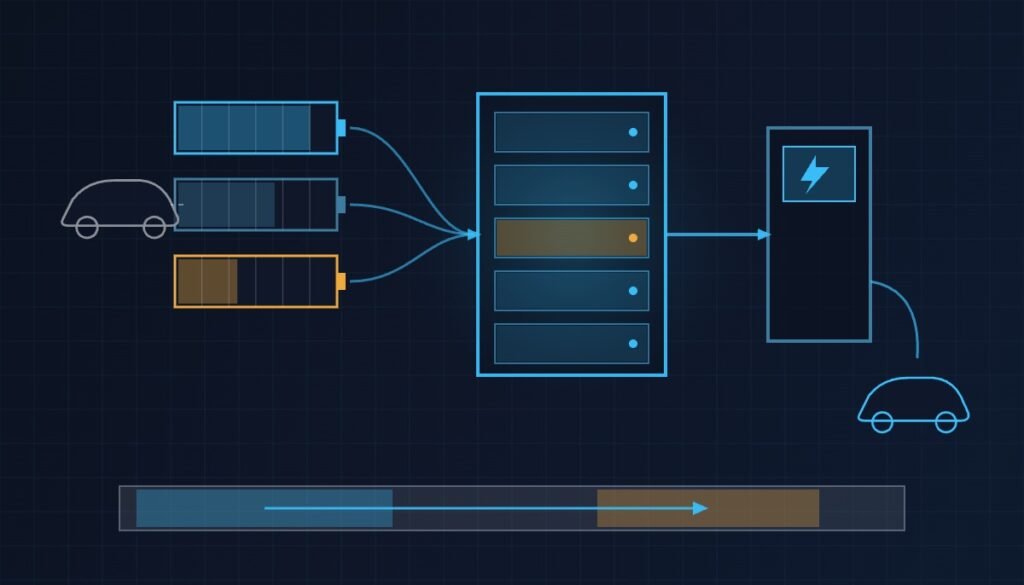
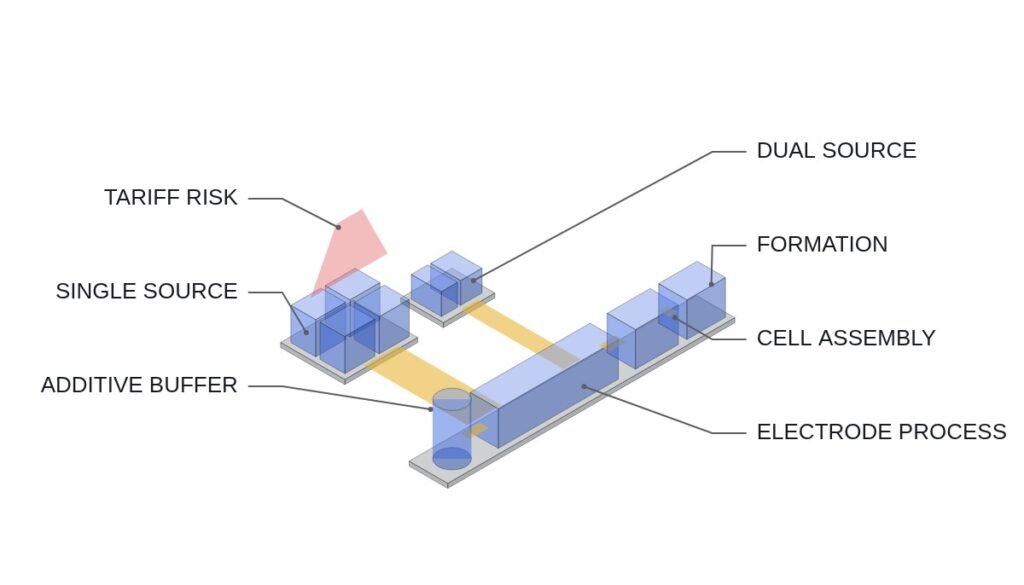
Bottom line first. In a wet electrode process, much of the energy load sits in the drying ovens that drive off solvent after coating, and in the recovery plant that reclaims the NMP solvent driven off in cathode production. A dry electrode process uses no solvent, so it removes both loads outright, and brings in new motor and heater loads for the mixing equipment that fibrillates the binder and for the heated calendering line. On energy grounds, dry processing wins where electrodes are thick, so a wet process would have to evaporate a large mass of solvent; the gain shrinks for thin high-power electrodes and for early lines whose yield has not stabilized. This article does not cover mechanical process conditions and looks only at power, energy and electrical design.
Where it wins, where it doesn’t
Current condition
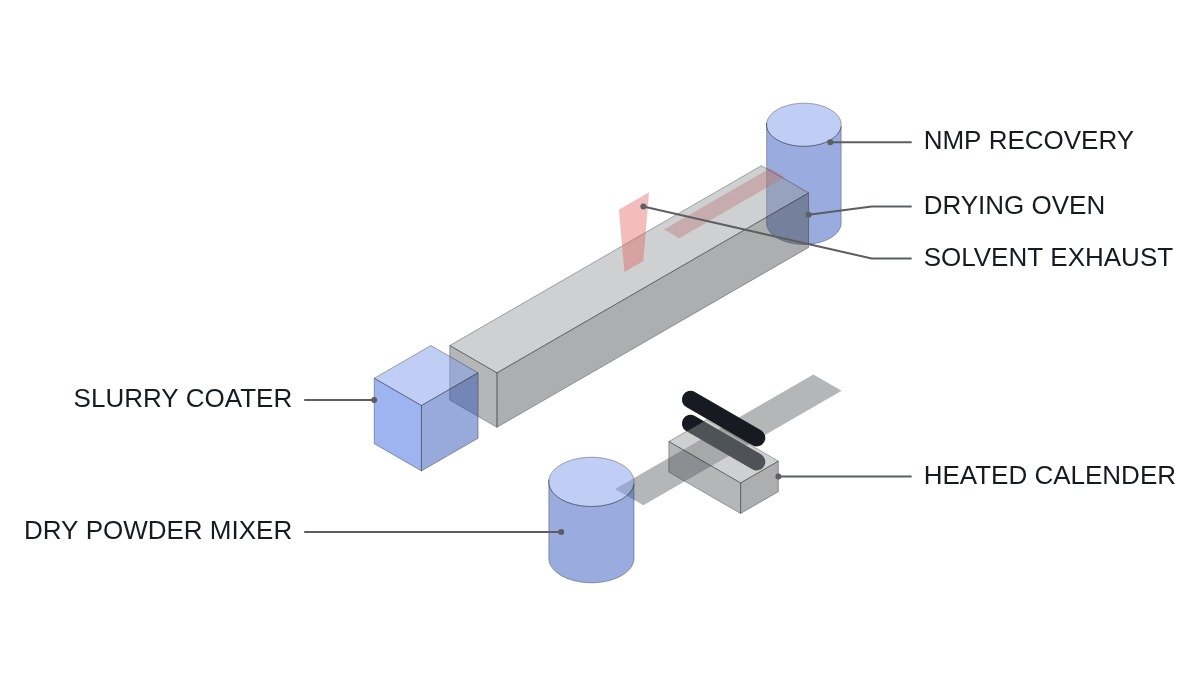
A wet process disperses active material, conductive additive and binder in a solvent to make a slurry, coats it onto the current collector, and runs it through a long drying oven to evaporate the solvent. Anodes mainly use water and cathodes mainly use NMP. NMP cannot simply be vented, so a recovery plant condenses and purifies it from the oven exhaust. The defining feature of a wet line’s power profile is that oven hot-air heaters, large blowers, and the recovery plant’s cooling and heating loads all run continuously.
After the change
A dry process mixes powder materials with binder while stretching the binder into fibrils that hold the powder together, then rolls it into a film with heated rolls and laminates it onto the current collector. With no solvent, neither drying ovens nor NMP recovery are needed. The power profile shifts from continuous thermal load to mixer and calender drive motors plus roll heaters.
Connecting logic
Wet drying energy is proportional to the mass of solvent to be evaporated. For the same electrode area, a thicker electrode means more slurry applied and more solvent driven off. Dry drive energy also rises with thickness, but there is no large fixed item like latent heat of evaporation. The result is a structure in which the energy advantage of dry processing grows as electrodes get thicker and shrinks as they get thinner.
Lower bound on evaporation energy
The theoretical lower bound on solvent evaporation energy is latent heat. The latent heat of evaporation of water is about 2,257kJ/kg, so evaporating 1kg of water takes at least 2,257kJ / 3,600 ≈ 0.63kWh. That is a theoretical floor; real ovens add losses from heating air and exhausting it, and from heating the collector and equipment, so actual energy is higher. NMP properties and recovery plant energy vary by plant configuration, so no figures are given here.
| Solvent evaporated (assumed) | Theoretical minimum |
|---|---|
| Water 100kg/h | about 63kW continuous |
| Water 500kg/h | about 313kW continuous |
| Water 1,000kg/h | about 627kW continuous |
Multiplying evaporation in kg/h by 0.627kWh/kg gives the continuous load directly in kW. Even this floor shows that drying load can take a substantial share of a line’s supply capacity, and the real load is larger. If thicker electrodes raise evaporation at the same line speed, this continuous load rises in proportion, and this is exactly the item dry processing removes.
Electrical load by process
| Item | Wet | Dry |
|---|---|---|
| Main energy load | Oven hot air and blowers | Mixing and calender drives, roll heating |
| Solvent recovery | NMP recovery required | Not required |
| Load character | Mostly continuous thermal | Mostly motors, more variable |
| Effect of thickness | Rises with evaporation | Drive load rises, no latent heat |
| Explosion protection | Solvent vapor (gas) | Powder (dust) |
| Power quality | Large blower drives | Large drive inverters and servos |
| Line length | Long oven section | No oven section |
The row electrical designers tend to miss is explosion protection. Wet lines design gas hazardous zones and LEL (lower explosive limit) monitoring around solvent vapor, while dry lines handle fine powders such as carbon conductive additive, so dust hazardous zones become the focus. Removing the solvent does not remove explosion protection; it moves it from gas to dust. Equipment for explosive atmospheres follows the IEC 60079 series, and zone classification is set by a site-specific hazard assessment.
The difference in load character also carries into supply design. The drying load of a wet line is large and flat, which makes peak demand management relatively simple. A dry line may have a lower average load without the ovens, but starting and accelerating large drive motors and controlling roll heater temperature make the load more variable. Even if average energy drops, peak load and swing set transformer and breaker ratings and protection coordination, so energy savings and supply capacity must be calculated separately. More large inverter load also changes power factor and harmonic conditions.
Decision sequence
- From target electrode thickness and line speed, compute the solvent a wet process would evaporate (kg/h) and the drying load floor using the method above.
- Check the existing plant’s supply capacity and heat sources (steam, electric, gas). If drying load runs into the supply limit, the value of dry processing rises.
- Estimate drive motor and roll heater loads and starting inrush for the dry line, and size transformers and breakers accordingly.
- Treat the grid impact of harmonics from large inverter loads as an item that requires waveform analysis and field measurement, and plan filters if needed.
- Reclassify hazardous zones from gas to dust criteria and design dust collection, grounding and static control.
- Confirm yield and quality metrics on a pilot line first. A scrapped electrode throws away all the energy put into it, so a yield gap can cancel the energy gain.
Steps 1 and 2 alone settle half the conversion review. If the drying load floor is small relative to plant supply capacity, the energy case for dry processing is weak and the decision moves to other axes such as quality, cost and space. If the floor alone would require a supply upgrade, dry conversion carries a bigger value than energy savings: avoiding that upgrade.
Boundary conditions
The energy advantage of dry processing shrinks or reverses under these conditions. First, thin high-power electrodes evaporate little solvent, so the wet drying load is small to begin with and conversion saves little. Second, if dry line yield is lower than wet, energy input per square meter of good electrode can actually rise. Third, water-based processes such as anodes carry no solvent recovery burden, so the energy gain from dry conversion is smaller than on the cathode side. Fourth, in plants that can use waste heat for the ovens, the power cost of drying is low and the dry advantage shrinks.
Fifth, converting an existing wet line and building a new line are different calculations. In a plant whose ovens and NMP recovery are already depreciated, dry-conversion energy savings must exceed new equipment investment and line downtime. On a new line, oven sections and recovery plant space and supply capacity can be cut from the start, so the dry advantage counts for more. The item to verify is the measured power profile of candidate dry equipment; do not fix the load from supplier specifications alone.
The single selection rule: dry conversion wins only on thick-cathode lines where the NMP a wet process would evaporate is large enough that drying and recovery loads bottleneck supply capacity or energy cost, and only once yield has been confirmed.