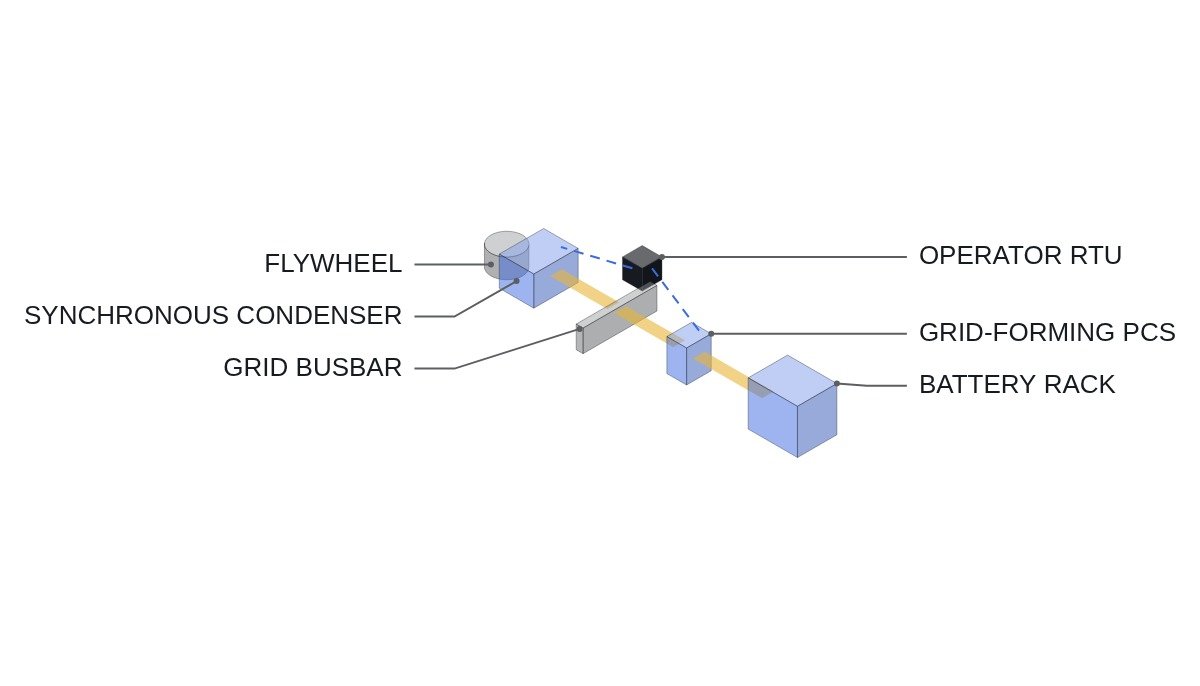
Here is the conclusion up front. Look at the choice between a synchronous condenser and a grid-forming inverter BESS for grid inertia from an energy standpoint, and the result is unexpected: the energy an inertial response actually needs is small, on the order of kWh. The real cost of inertia from a grid-forming BESS is therefore not storage capacity but inverter current headroom and SOC operating margin, while the real cost of a synchronous condenser is the standing loss it draws without generating anything. If short-circuit current contribution is the key requirement, the physical rotating machine wins; if you want inertia bundled with energy shifting and frequency response in one asset, the grid-forming BESS wins.
Where it wins, where it doesn’t
Where the synchronous condenser wins
The current conditions: large thermal generators are leaving, regional short-circuit capacity is falling, and protection relay operation and voltage stability are wobbling. A synchronous condenser couples a rotating mass directly to the grid, physically supplying large fault current along with inertia, so the existing protection scheme needs little change. The logic is fault current. Inverters typically limit fault current to around rated values to protect their semiconductors, which makes it hard to meet a short-circuit requirement with the same kVA.
Where the grid-forming BESS wins
If falling inertia coincides with growing renewable surplus, peak shifting and frequency response needs, the judgment changes. A grid-forming BESS behaves like a voltage source and provides inertial response while storing and shifting energy the rest of the time. The logic is value stacking. A synchronous condenser does nothing beyond inertia and reactive power, whereas a BESS spends so little energy on inertial response that the rest of its capacity keeps producing other value.
Where the grid-forming BESS loses
On a grid whose protection is set on the assumption of large synchronous fault current, with no capacity to re-set it, a grid-forming BESS alone is hard to substitute. Fault behavior in this case requires waveform analysis and field measurement for each installation; substitutability should not be judged from datasheet figures alone.
How small is inertial energy?
A synchronous machine’s stored kinetic energy is the product of its inertia constant H and rated capacity S: E = H × S. Assumptions: H = 4 s, S = 100 MVA. E = 4 × 100 = 400 MW·s = 400 MJ, which is 400 ÷ 3.6 ≈ 111 kWh.
So a 100 MVA rotating machine holds about 111 kWh. Size a 100 MW BESS for just one hour of discharge and it stores 100 MWh, of which 111 kWh is about 0.1%. The energy needed to emulate inertia is a tiny fraction of storage capacity, which is no surprise given that an inertial response is over within seconds. A grid-forming BESS almost never runs short of energy because of inertial response; its constraints come from elsewhere.
At the system level, the rate of change of frequency (RoCoF) is approximated by RoCoF = ΔP × f0 ÷ (2 × ΣH·S). Assumptions: lost generation ΔP = 1,000 MW, nominal frequency f0 = 60 Hz, total system inertia ΣH·S = 200,000 MW·s. RoCoF = 1,000 × 60 ÷ 400,000 = 0.15 Hz/s. Add one 100 MVA unit from above (400 MW·s) and the denominator grows to 200,400 MW·s, only 0.2%. In other words, inertia is a resource secured as a system-wide sum, not as the specification of one unit, and equipment should be compared on cost per unit of that sum.
Side-by-side comparison
| Item | Synchronous condenser | Grid-forming BESS |
|---|---|---|
| Source of inertia | Rotor kinetic energy | Stored energy, control |
| Adjusting inertia | Add flywheel | Control parameters |
| Fault current | Large (physical) | Limited near rated |
| Main cost driver | Standing losses, upkeep | Inverter current headroom |
| Energy shifting | Not possible | Possible |
| Reactive support | Yes | Yes |
| Fuel | None (draws grid power) | None (charging power) |
The rows that decide this table are fault current and energy shifting. If fault current is mandatory, lean toward the synchronous condenser; if you also want energy shifting from the same asset, lean toward BESS. If both are needed, do not try to solve everything with one asset: putting short-circuit capacity on a rotating machine and inertia plus energy shifting on a grid-forming BESS keeps both smaller.
The cost of a grid-forming BESS sits in kVA and SOC
Inertial response exchanges large power over a short time. The energy is small but the instantaneous power is large, so an inverter that normally discharges near its rating has no current headroom left for inertial response. A BESS contracted for inertia must therefore either oversize its inverter or cap everyday output below rating to keep headroom. And when SOC sits at its upper limit, absorbing-direction response is blocked; at its lower limit, injecting-direction response is blocked, so SOC must be kept away from both ends. A synchronous condenser has neither constraint: the rotor holds its inertia no matter what it is doing, and the operator never needs to reserve margin. These two constraints are the real cost of an inertia service, and how much they cut into energy market revenue must be calculated from operating data.
Decision sequence
- Split the system operator’s requirement into inertia, short-circuit capacity and voltage support. Lumping the three under one word blurs the equipment comparison.
- If short-circuit capacity is mandatory, make the synchronous condenser the first candidate and review whether retired generators can be converted to condensers.
- If only inertia is needed, calculate the required inertia (MW·s) with the formula above and check whether the grid-forming BESS’s inverter headroom and SOC operating range can meet it.
- When comparing annual cost, include the standing losses of the synchronous condenser and the energy market revenue the BESS gives up to keep headroom.
Items to verify
- Inertia constant and standby losses of the candidate machine (manufacturer specification to be confirmed)
- Short-time overcurrent capability and duration of the grid-forming inverter
- How the system operator calculates inertia and short-circuit requirements and qualifies equipment
- Whether protection relay settings need review (requires waveform analysis and field measurement)
Boundary conditions
The grid-forming BESS advantage shrinks the moment short-circuit capacity is written in as a core requirement, because the cost of enlarging inverter overcurrent headroom exceeds the cost of one rotating machine. Conversely, the synchronous condenser’s advantage shrinks when protection is re-set for inverter-based resources and inertia needs grow alongside energy shifting needs in the same area. And if a grid-forming BESS runs its SOC to the limits for revenue, its real inertia capability falls below the datasheet figure.
The single selection criterion: if short-circuit capacity is mandatory, choose the synchronous condenser; if inertia and energy shifting are both needed and short-circuit capacity is secured by other means, choose the grid-forming BESS.