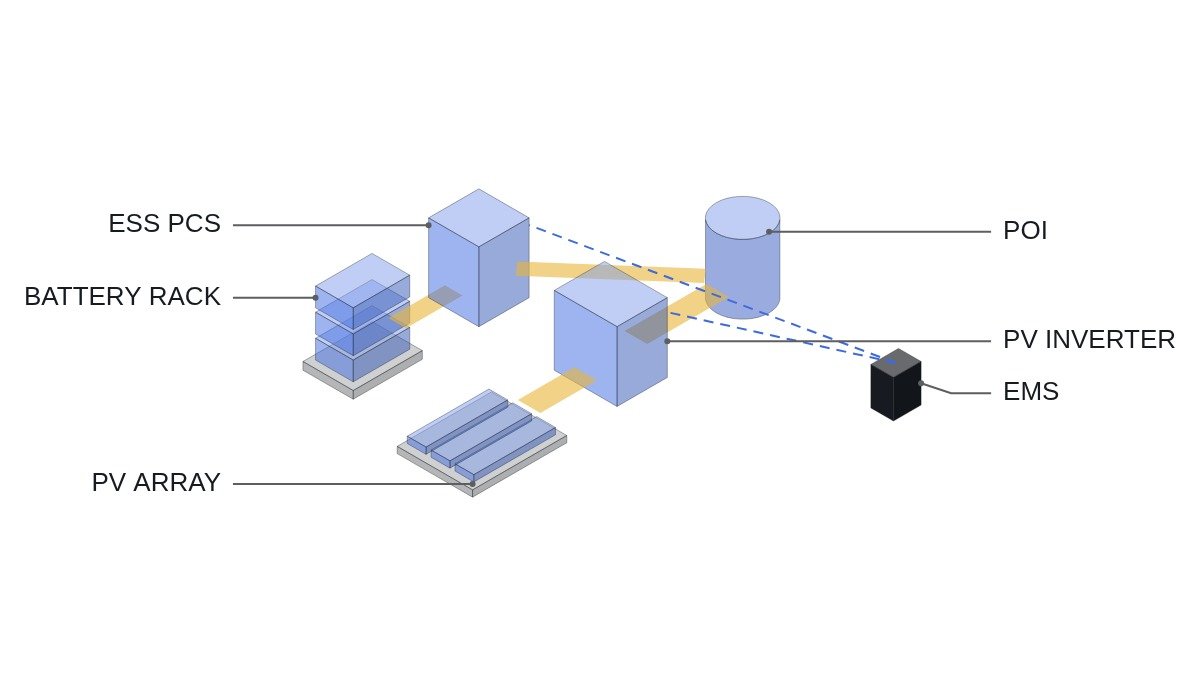
Bottom line first. An EMS tasked with ramp-rate limiting for a renewable+ESS plant needs an SOC band interlock before it needs a revenue schedule. Ramp-rate limiting calls for discharge when output drops sharply and charge when it rises sharply, so it needs headroom in both directions at the same time. If a time-of-day arbitrage schedule pushes SOC to the upper or lower limit, half of the plant’s ramp-limiting capability disappears for that period. The required energy reserve follows from a simple formula, ΔP²/(2R), and that value sets the width of the SOC band the schedule is not allowed to touch.
Safety interlock: what sits above scheduling and ramp control
- □ EMO and fire and gas detection open the PCS main circuit and the battery rack contactors through hardwired circuits. The EMS and PLC receive this state as a monitoring input only and never delay the disconnection for the sake of executing a schedule.
- □ The BMS cell voltage and temperature protection limits must always sit outside the EMS SOC band. The EMS band is an operating limit; the BMS limit is a protection limit. If the order is reversed, the BMS opens the contactors first and ramp control vanishes without warning.
- □ On loss of BMS communication (MODBUS_TCP or CAN), drive the PCS power setpoint to zero and report the ramp-control-unavailable state upward (to the plant controller and grid operator).
- □ The PCS power rating must be at least the design maximum swing ΔP. Sufficient energy does not help if power is short; ramp limiting fails.
- □ Curtailment commands from the grid operator take priority over the EMS schedule, and the SOC band interlock stays in force during curtailment.
Energy needed for ramp-rate limiting: ΔP²/(2R)
Suppose a cloud covers a solar plant and output drops by ΔP almost instantly. Grid-side output is only allowed to fall at the permitted ramp rate R (MW/min), so for ΔP/R minutes from the moment of the drop the ESS has to fill the gap. ESS discharge power starts at ΔP and falls linearly to zero, so the energy required is the area of the triangle: ΔP × (ΔP/R) / 2 = ΔP²/(2R).
Assumption: a 10 MW solar plant falls from rated output to zero, and the permitted ramp rate is 10% of rating per minute (1 MW/min). The energy required is 10² / (2 × 1) = 50 MW·min, or about 0.83 MWh. Under the same conditions, if the permitted ramp rate is tightened by half (0.5 MW/min), the required energy doubles to about 1.67 MWh. Required energy scales with the square of the swing and inversely with the permitted ramp rate. These assumed values are a calculation example; the actual permitted ramp rate must come from the applicable grid code or contract terms.
A sharp rise follows the same formula. When the cloud clears and output rises by ΔP, the ESS must absorb that much, and the charging headroom needed is the same ΔP²/(2R). SOC therefore has to hold discharge headroom above the lower limit and charge headroom below the upper limit at the same time, and what lies between is the range the schedule can use.
| Operating mode | SOC position | Sharp drop | Sharp rise |
|---|---|---|---|
| Arbitrage schedule first | Near upper/lower limits | Fails in some hours | Fails in some hours |
| Ramp only | Fixed at band center | Yes | Yes |
| Band interlock + schedule | Moves within band | Yes | Yes |
| Time-of-day band | Narrowed only in variable hours | Yes | Yes |
The third and fourth rows are the practical choices. With a band interlock, the schedule moves only inside the band, and because the band width is set by the calculated ramp energy, revenue and ramp performance do not encroach on each other. At night, when there is no irradiance variability and no ramp reserve is needed, the band can be released by time of day to widen the range available to the schedule.
SOC band interlock and schedule clamp logic
Assumed timing chart: the EMS generates charge and discharge schedule setpoints in 15-minute blocks. The PLC calculates the SOC band every scan and clamps the schedule setpoint. The ramp compensation setpoint takes priority over the schedule, is not limited by the band, and may use capacity only up to the BMS protection limits.
(* I/O MAP - PV+ESS RAMP CONTROL, EMS INTERFACE *)
(* %I6.0  DI_SAFETY_CHAIN_OK    : EMO/FIRE HARDWIRED CHAIN (MONITOR ONLY) *)
(* %I6.1  DI_BMS_COMM_OK        : BMS LINK HEALTHY (MODBUS_TCP WATCHDOG) *)
(* %I6.2  DI_PV_VARIABLE_WINDOW : 1 = IRRADIANCE-VARIABLE TIME WINDOW (DAYTIME) *)
(* %IW800 AI_BAT_SOC_PCT10      : SOC (% x10) *)
(* %IW802 AI_P_SCHED_KW         : EMS SCHEDULE SETPOINT (+ DISCHARGE, - CHARGE) *)
(* %IW804 AI_P_RAMP_KW          : RAMP COMPENSATION SETPOINT *)
(* %QW900 AO_P_PCS_SET_KW       : FINAL PCS ACTIVE POWER SETPOINT *)
(* %Q6.0  DO_RAMP_READY         : RAMP CAPABILITY REPORT TO PLANT CONTROLLER *)

(* 1. RAMP ENERGY RESERVE: E = DP^2 / (2 * R), DP IN MW, R IN MW/min -> MWh *)
R_E_RAMP_MWH := (R_DP_MW * R_DP_MW) / (2.0 * R_RAMP_MW_MIN) / 60.0;
R_BAND_PCT   := R_E_RAMP_MWH / R_E_USABLE_MWH * 100.0;

(* 2. BAND LIMITS - APPLY ONLY IN VARIABLE WINDOW *)
IF DI_PV_VARIABLE_WINDOW THEN
    R_SOC_LO := R_SOC_BMS_MIN + R_BAND_PCT;
    R_SOC_HI := R_SOC_BMS_MAX - R_BAND_PCT;
ELSE
    R_SOC_LO := R_SOC_BMS_MIN;
    R_SOC_HI := R_SOC_BMS_MAX;
END_IF;
R_SOC := INT_TO_REAL(AI_BAT_SOC_PCT10) / 10.0;

(* 3. CLAMP SCHEDULE - NO DISCHARGE BELOW LO, NO CHARGE ABOVE HI *)
R_P_SCHED := INT_TO_REAL(AI_P_SCHED_KW);
IF (R_SOC <= R_SOC_LO) AND (R_P_SCHED > 0.0) THEN R_P_SCHED := 0.0; END_IF;
IF (R_SOC >= R_SOC_HI) AND (R_P_SCHED < 0.0) THEN R_P_SCHED := 0.0; END_IF;

(* 4. RAMP COMPENSATION HAS PRIORITY, LIMITED ONLY BY BMS AND PCS RATING *)
R_P_TOTAL := LIMIT(-R_P_PCS_RATED, R_P_SCHED + INT_TO_REAL(AI_P_RAMP_KW), R_P_PCS_RATED);

(* 5. SAFETY AND COMMUNICATION *)
IF NOT DI_SAFETY_CHAIN_OK OR NOT DI_BMS_COMM_OK THEN
    R_P_TOTAL := 0.0;
END_IF;
AO_P_PCS_SET_KW := REAL_TO_INT(R_P_TOTAL);

(* 6. REPORT RAMP READINESS - BOTH DIRECTIONS NEEDED *)
DO_RAMP_READY := DI_SAFETY_CHAIN_OK AND DI_BMS_COMM_OK
                 AND (R_SOC >= R_SOC_LO) AND (R_SOC <= R_SOC_HI);
R_DP_MW, R_RAMP_MW_MIN and R_E_USABLE_MWH are set from plant conditions. Usable energy R_E_USABLE_MWH is the energy between the BMS upper and lower limits; it shrinks with aging and has to be updated periodically. Keep the order of summing the ramp compensation and the schedule first and then clipping to the PCS rating; that reduces cases in which ramp compensation gets cut off because of the schedule.
Operating checklist
- □ Extract the design maximum swing ΔP from historical 1-minute output records. The larger the plant, the less likely a cloud shadow covers all of it at once, so ΔP may be smaller than rated output. Set the actual value only from measured records.
- □ If the band width exceeds half of usable energy, no range is left for the schedule. In that case either give up the schedule revenue model or increase energy capacity.
- □ Link ramp readiness (DO_RAMP_READY) to the grid operator reporting items and tally unavailable hours monthly.
- □ Confirm from the grid code or contract documents the reference window for ramp-rate calculation (1-minute moving average or instantaneous value). A different reference window changes the definitions of ΔP and R.
- □ Cross-check the ESS grid connection design against the IEC 62933 series and NEC 706 as appropriate for the jurisdiction.
Boundary conditions: when the band interlock is unnecessary
First, if ramp-rate limiting is not a contractual obligation and violations carry no penalty, the SOC band is just a constraint that cuts revenue. Schedule-first operation is then rational.
Second, if the solar plant’s up-ramps can be controlled by PV inverter output limiting alone, no charging headroom is needed. Handle rises by curtailing the inverters and only drops with the ESS, and the band sits only on the lower side. In this case the required band width halves.
Third, if ESS energy capacity is several times ΔP²/(2R), the schedule keeps plenty of range even with the band in place; keep the interlock, but the design burden disappears.
The single decision rule: where ramp-rate limiting is mandatory, reserve the energy calculated by ΔP²/(2R) as a band at both the upper and lower SOC limits, and let the schedule move only inside that band.