Here is the conclusion up front. When deciding how to convert a coal-fired site, the first asset to look at is not the boiler but the grid connection capacity and substation equipment the site already has. Ammonia co-firing keeps the boiler, turbine and generator, preserving synchronous inertia and annual generation, but takes on a new fuel supply chain and toxic-gas management. Gas conversion gains start-up flexibility, but carbon emissions do not reach zero. Retirement followed by ESS reuses the connection point and can be installed quickly, but an ESS cannot make electricity on its own, so it replaces peak capacity, not annual generation. The choice therefore turns on whether the site’s role in the grid was annual energy or peak capacity and inertia.
Where it wins, where it doesn’t
Where ammonia co-firing wins
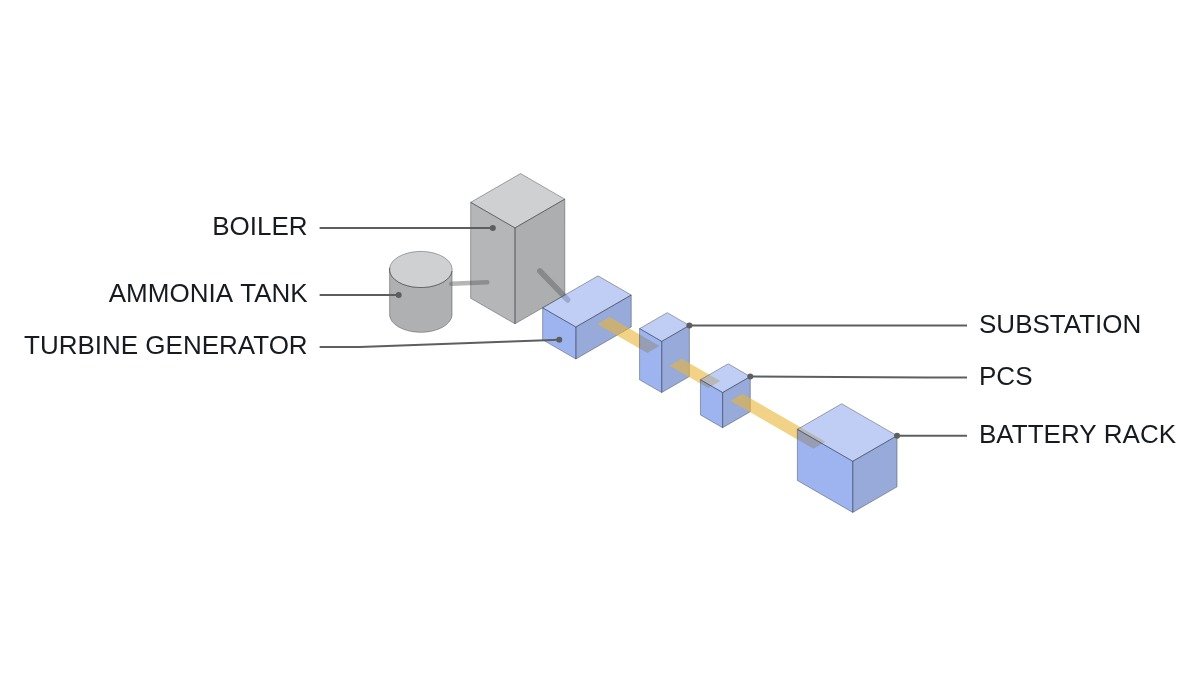
The current conditions: the plant is a large synchronous machine holding up regional voltage and frequency, and replacement resources are still short. With ammonia co-firing, the existing plant stays and part of the fuel is swapped for a carbon-free fuel, so inertia, short-circuit capacity and annual generation all remain. The logic is equipment continuity: it is the only path that cuts emissions without changing the site’s grid role.
Where gas conversion wins
If renewables have grown enough that the grid wants frequent starts, stops and output adjustment rather than baseload running, gas is the fit. Converted to gas, the plant starts faster than coal and has a wider part-load range, making it a flexibility resource. The logic is the operating pattern: if what the grid needs is flexibility rather than kWh, a fuel change becomes a role change.
Where retirement plus ESS wins
The current conditions: renewables already replace the site’s generation, and the remaining problems are the evening peak and output variability. Demolishing the coal plant and installing ESS reuses the transmission connection and substation, which can make interconnection simpler than on a greenfield site. The logic is reuse of connection capacity. But miss the fact that ESS is a shifting asset, not an energy source, and the judgment goes wrong.
ESS does not replace annual generation
Check it with numbers. Assumptions: 1 GW coal plant, 60% annual capacity factor. Annual generation is 1,000 MW × 8,760 h × 0.6 = 5,256 GWh.
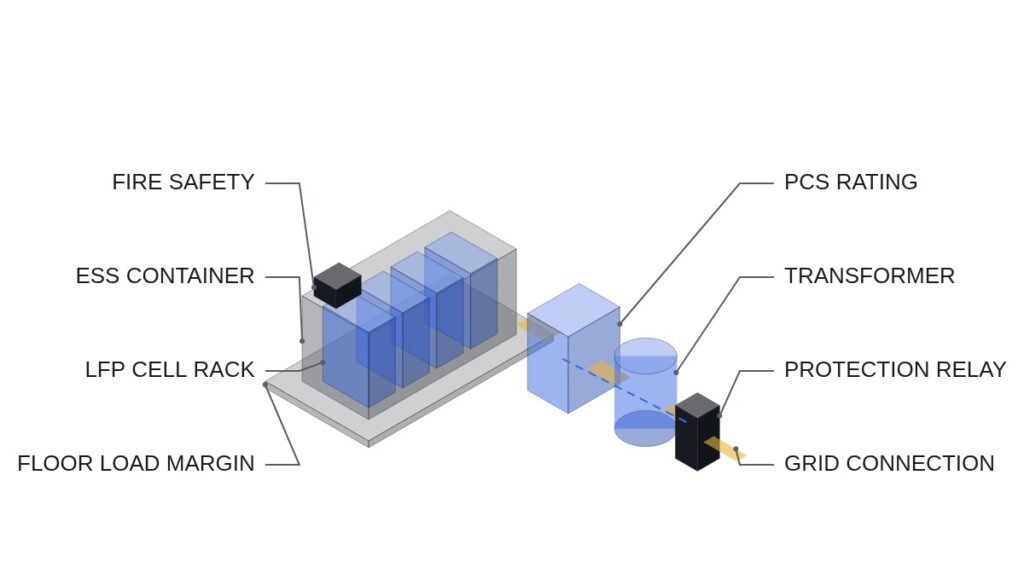
Put a 1 GW / 4 GWh ESS on the same connection and assume one full cycle per day: annual discharge is 4 GWh × 365 = 1,460 GWh. That energy is charged from other generators, and the grid as a whole consumes energy equal to the round-trip loss. In other words, the ESS fills the 1 GW power slot but leaves the 5,256 GWh energy slot empty. The conversion only works if renewables or other generation already on the grid can supply that energy. Put the other way, the decision to install ESS on this site is effectively bundled with the decision about where that energy will come from.
Check first whether the co-firing ratio is on a heat basis
Carbon reduction from ammonia co-firing is proportional to the reduction in coal heat input. Assumption: 20% co-firing on a heat basis. For the same output, a 20% cut in coal heat input cuts CO2 from coal combustion by about 20%. If the ratio is stated on a mass basis, however, ammonia and coal differ in heating value per unit mass, so the reduction differs. Read the plan without checking which basis it uses and you misread the benefit. And if the ammonia itself was produced from fossil fuels, the life-cycle reduction is smaller than the stack-level reduction.
Three paths compared
| Item | Ammonia co-firing | Gas conversion | Retire + ESS |
|---|---|---|---|
| Annual energy | Kept | Can be kept | Not replaced |
| Synchronous inertia | Kept | Kept | None (emulated only) |
| Stack CO2 | Down by co-firing ratio | Lower, not zero | No on-site emissions |
| Start-up flexibility | Coal level | Improved | Very high |
| New hazards | Toxicity, NOx | Gas supply competition | Thermal runaway |
| Connection reuse | Unchanged | Unchanged | Reusable |
The first two rows settle half the decision. If the grid still needs annual energy and synchronous inertia from this site, ESS is hard to justify and the choice narrows to co-firing or gas conversion. If both needs have moved to other assets, the third column becomes the fastest, emission-free option.
A combination not in the table: keep the generator, switch off the boiler
The three paths need not be exclusive. If what the grid needs from the site is not energy but inertia, short-circuit capacity and peak capacity, the boiler and turbine can be retired while the generator stays on the grid as a synchronous condenser, with ESS co-located on the same connection. The rotating machine then supplies inertia and short-circuit current, the ESS handles peaks and energy shifting, and the roles do not overlap. No fuel is burned, so there are no stack emissions. A synchronous condenser, however, draws continuous losses from the grid while generating nothing, so the inertia requirement must be clear enough to justify those losses. Whether an existing generator can be converted, and what start-up equipment it needs, must be reviewed per machine.
Decision sequence
- Confirm the site’s role from the system operator’s point of view. Write down which of annual energy, peak capacity, inertia and short-circuit capacity, or voltage support cannot be replaced.
- If inertia and short-circuit capacity cannot be replaced, review first the paths that keep the existing generator (co-firing, gas conversion, or converting the generator to a synchronous condenser).
- If reviewing co-firing, confirm the basis of the co-firing ratio (heat or mass), the ammonia supply route, and safety distance requirements for storage and unloading.
- If reviewing ESS, first confirm that the grid has resources to fill the energy gap, then look at the conditions for reusing connection capacity.
- Compare the commercial operation dates of the three paths to see whether a gap period opens up.
Items to verify
- Scope of boiler modification for ammonia co-firing and whether added NOx abatement is needed (plant-specific review required)
- Conditions and procedure for carrying over grid connection capacity on retirement
- Pipeline intake capacity and winter supply terms for gas conversion
- Whether the existing generator can be converted to a synchronous condenser (to be confirmed per machine)
Boundary conditions
This comparison rests on the premise that the role the grid expects from the site is fixed. Once enough renewables and grid-forming assets arrive nearby that the energy and inertia needs disappear, co-firing becomes a way to prolong an aging plant with expensive fuel. Conversely, converting to ESS while renewable build-out lags and an energy gap remains will block the peak but merely move the energy shortfall to fossil generation elsewhere. And without a secured ammonia supply route, co-firing stays a reduction on paper. Gas conversion, too, can become a stranded asset if carbon regulation tightens faster than the equipment pays back.
The single selection criterion: if the grid keeps requiring annual energy from the site, choose a generator-preserving path (co-firing or gas conversion); if it requires only peak capacity, choose retirement followed by ESS.