The conclusion first. Switching ESS batteries from LFP to sodium-ion (Na-ion) pays off where discharge performance in cold environments (-20℃ and below) and avoiding lithium supply chain risk are the priorities. Where storage capacity per installed footprint, that is, volumetric energy density, is the absolute criterion, LFP is still ahead. CATL’s decision on July 21, 2026 to sign a 2 GWh sodium-ion ESS supply contract with SolarPro for Eastern Europe should be read not as a verdict on which chemistry is better, but as the result of assigning applications by this criterion.
1. Background — why sodium-ion now
CATL announced on July 21, 2026 that it had signed a 2 GWh sodium-ion battery storage supply contract with SolarPro for Eastern Europe. Around the same time, CATL forecast that sodium-ion battery adoption would spread more widely in 2026. Behind this is the 'de-graphitization' trend in the battery industry at home and abroad, triggered by lithium price volatility and China's graphite export controls. Sodium-ion can reduce dependence on graphite anode material or replace it with hard carbon, and it is getting renewed attention as a way to diversify the supply chain.
Reading this trend as 'a replacement for lithium-ion', however, leads to the wrong call. The current volumetric energy density of sodium-ion is lower than LFP's, which means securing the same kWh requires more installation area or more racks. What divides the applications is not which chemistry is better, but installation conditions.
2. Where it wins — stationary ESS where cold climate and supply chain risk avoidance come first
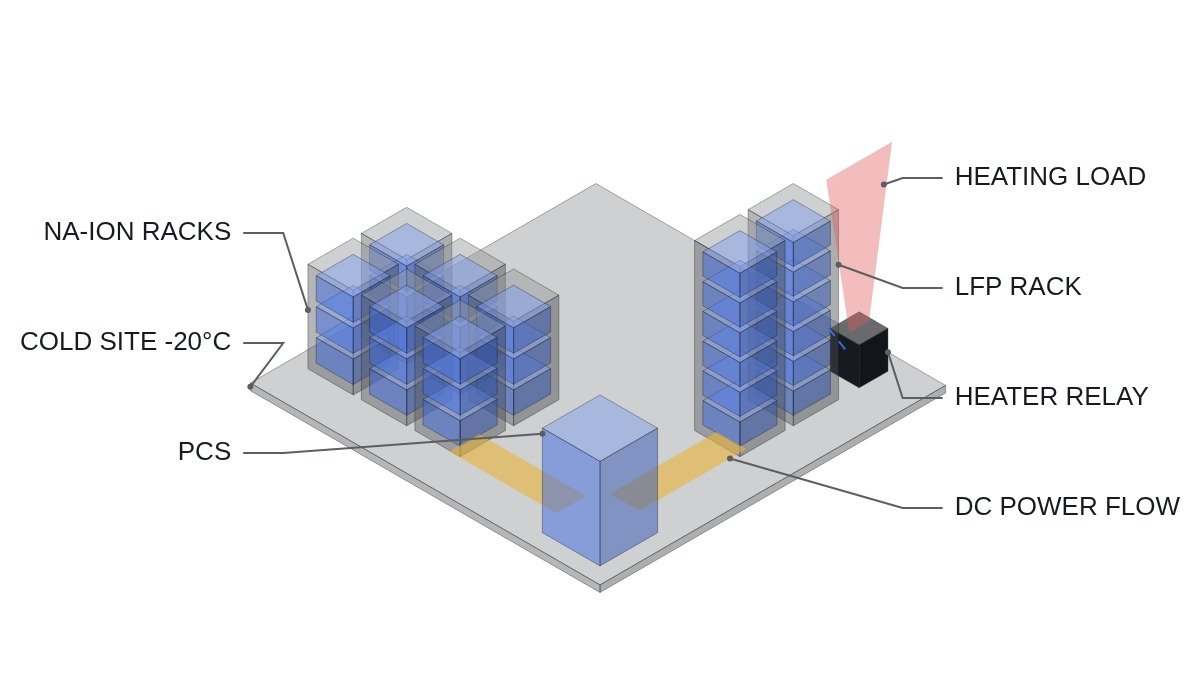
The current condition is this. Grid ESS installed in extremely cold regions (Northern Europe, Canada, parts of North America) sees discharge capacity drop sharply below -20℃ with LFP, and needs a separate heating system (including its self-consumption power).
Applying sodium-ion changes this. Sodium-ion batteries have better low-temperature discharge characteristics than LFP, with cases reported of higher capacity retention relative to room temperature even in the -20 to -30℃ range, and they can reduce the separate heating load. Because they are made from common elements such as sodium, iron and manganese with no lithium feedstock, their procurement cost fluctuates relatively less even when lithium prices spike.
The connecting logic is here. These two factors become real drivers for simplifying the heating interlock logic in the protection design. When the low-temperature heater start thresholds (e.g. ON at -15℃, OFF at -5℃) are reached less often, the number of switching cycles on the heater relay, and the resulting wear risk, go down as well.
3. Where it doesn't — sites where footprint is constrained and high density is the absolute criterion
The opposite condition is just as clear. At sites such as data center UPS and urban ESS, where installation area is limited and the maximum kWh has to be extracted from the same plot, volumetric energy density is the absolute criterion.
Applying sodium-ion changes this. The volumetric energy density of current commercial sodium-ion cells is lower than LFP's, so securing the same kWh takes more racks, and more racks mean more wiring and more protection coordination points (I/O points). The gap is narrowing depending on the manufacturer, but as of August 2026 LFP is still ahead.
Where site constraints are severe, LFP and NCM remain the first options to review.
4. Comparison table — from an ESS application perspective
| Item | Sodium-ion (Na-ion) | LFP |
|---|---|---|
| Nominal voltage (V/cell) | About 3.0-3.2 V | About 3.2 V |
| Volumetric energy density | Relatively low | Relatively high (advantage) |
| Low-temperature discharge (-20℃) | Relatively good | Relatively poor (heating needed) |
| Raw material risk | Low (common elements such as Na, Fe, Mn) | Lithium and iron phosphate, moderate |
| Cycle life (80% DOD) | Wide variation by manufacturer and model — check the datasheet | About 4,000-6,000 cycles or more |
| Safety standard compliance | New test cases under UL9540A etc. still accumulating | Same standards, many test cases |
| Suitable applications | Cold-climate grid ESS, supply chain diversification first | Footprint-limited ESS and UPS, high-density sites |
The row to watch in this table is not cycle life but safety standard compliance. Sodium-ion has not yet accumulated as many system-level test cases under UL9540A and similar standards as LFP. A decision to change chemistry is, in effect, a decision to redesign the BMS SOC estimation logic and the thermal runaway detection thresholds from scratch.
5. What changes in protection and interlock design
Start with the safety interlock conditions. The 6th edition of UL9540A (published March 13, 2026) requires Level 4 testing that targets the entire ESS installation system (container or indoor installation space, including BOS) rather than individual cells. This is the first item to check regardless of chemistry, and the principle is that this interlock path stays hardwired and is not replaced by control software judgment alone.
When the chemistry changes, the BMS side has to recalibrate the SOC estimation logic and the low-temperature heater start thresholds. Sodium-ion has a different voltage curve from LFP, so OCV-based SOC estimation needs a newly built reference table, and until that redesign is finished it is safer not to port existing LFP BMS firmware as is.
6. Boundary conditions and selection criterion
The point where this judgment flips is clear. At sites where the required energy density per installation area exceeds a threshold, that is, UPS and urban ESS where large capacity has to be packed into a small plot, the volumetric energy density of LFP and NCM takes priority over sodium-ion's low-temperature and procurement stability. If the environment is cold or avoiding lithium supply chain risk comes first, review sodium-ion; if the site is tight and high-density storage is needed, review LFP and NCM. The answer is set not by which chemistry is better, but by the constraints of the application.
References
- CATL signs 2 GWh sodium-ion ESS supply contract with SolarPro for Eastern Europe — FuelCellsWorks
- UL9540A 6th edition, Level 4 testing of the entire ESS system — Intertek
- Anode 'de-graphitization' accelerates — lithium metal and hard carbon rise — Good Morning Economy