Bottom line first. Most of the 21 turbines at Iberdrola’s Windanker offshore wind farm (315 MW) in the Baltic are already sending power into the German grid, yet the binding date for completing the grid connection is the end of September, and full commissioning is in Q4. What equipment engineers should read from this case is not turbine output but sequence. Because the offshore substation, roughly 100 km of subsea and land cable, and the onshore substation were prepared first on the schedule of transmission system operator (TSO) 50Hertz, the turbines could be energized one at a time. The completion schedule of offshore wind is set not by how fast turbines are installed but by when the grid connection is ready, and who is responsible for the connection, and when, is the biggest variable in project risk.
What was reported
On September 1, Offshore Wind reported that Iberdrola’s Windanker offshore wind farm had started feeding power into the German grid. Installed capacity is 315 MW from 21 Siemens Gamesa SG 14-236 DD turbines, each delivering about 15 MW with Power Boost. The site is northeast of Rügen Island in the Baltic Sea.
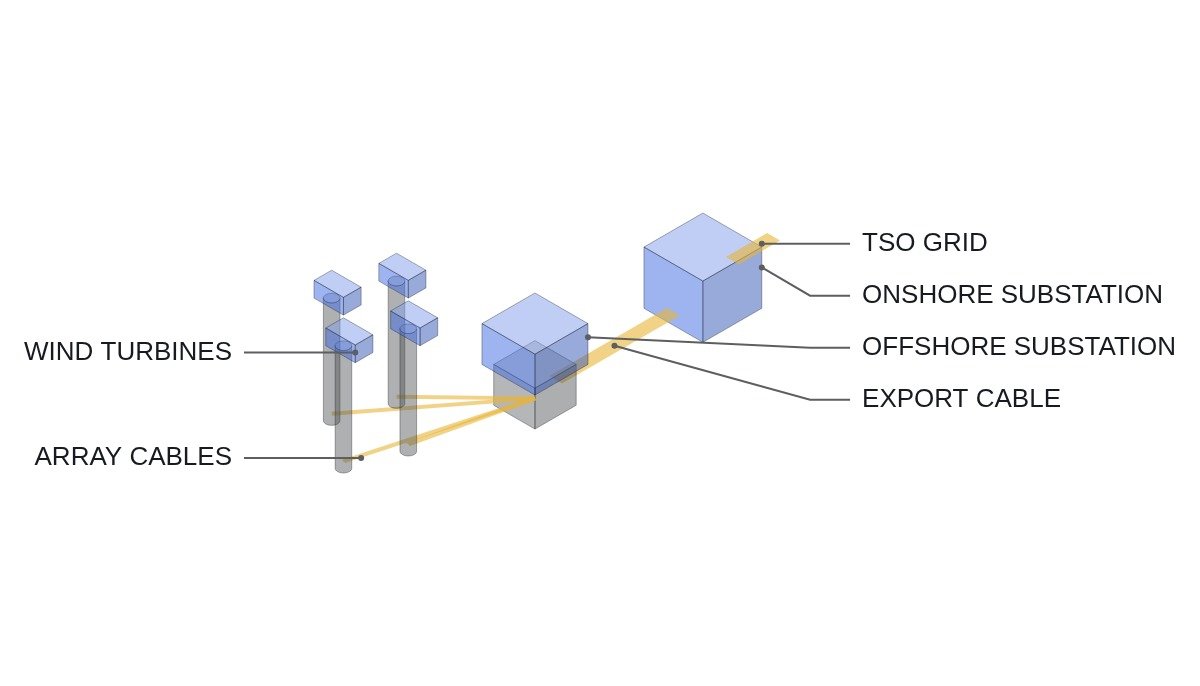
The grid connection is the Ostwind 3 connection built by 50Hertz. It includes the Jasmund offshore substation, a roughly 100 km subsea and land cable system, and the new Stilow substation near Greifswald. The offshore substation was built by the HSI joint venture of HSM Offshore Energy, Smulders and Iv, and installed by Heerema Marine Contractors. Turbine installation was handled by DEME, which acquired Havfram, the winner of the 2024 contract.
According to the article, the majority of the 21 turbines are already feeding the German high-voltage grid; the binding date for completing the grid connection is the end of September 2026, and full commissioning is in the last quarter of 2026. Together with Wikinger and Baltic Eagle, Windanker forms Iberdrola’s Baltic Hub of about 1.1 GW. Installed capacity checks out: 21 × 15 MW = 315 MW.
One more thing can be read from that number. About 15 MW per turbine assumes Power Boost. Raising a turbine’s rating through an operating mode increases farm output for the same turbine count, but it also eats into the capacity margin of the array cables and the offshore substation transformers. The ceiling on farm output is ultimately set not by the sum of turbine ratings but by the transmission capacity the connection allows, so boost operating hours and conditions have to be managed together with the connection design values.
Where it wins, where it doesn’t
Current conditions
An offshore wind grid connection is a long chain from the offshore substation through export cables to the onshore substation. If any link in the chain slips, the turbines cannot send power even after installation is complete. Where the developer builds the connection itself, the developer carries all of that delay risk.
With a TSO-built connection
Where the TSO builds the connection and commits to a date, as with Windanker, the developer can concentrate on the turbines and the array grid. With the connection ready first, turbines can be energized one by one as they are installed, and partial generation revenue starts before full completion. The reported state, “most turbines already feeding power,” is exactly the result of this sequential energization.
The connecting logic
In exchange, the developer loses control over the connection schedule. If the TSO slips, the developer has no way to pull it forward, and the compensation terms for missing the date decide the economics. A TSO-built connection is therefore not a structure that “removes schedule risk” but one that “moves schedule risk into contract clauses.”
| Item | TSO-built | Developer-built |
|---|---|---|
| Connection responsibility | Transmission system operator | Generation developer |
| Schedule control | Depends on TSO program | Managed by developer |
| Delay risk | Moved into date and compensation clauses | Carried entirely by developer |
| Design standardization | Repeatable connection design | Bespoke per farm |
| Sharing | Connection can serve several farms | Usually farm-dedicated |
The row that decides the business case is the third. A TSO-built connection wins only when there is a clause compensating the developer’s lost generation if the date slips; handing the schedule to the TSO without such a clause leaves the developer carrying the same risk while losing control. Offshore wind projects elsewhere should check who is responsible for the connection, the committed date and the delay compensation terms within the same framework.
Sequential energization and commissioning order
Energizing turbines one at a time is the usual way offshore wind is commissioned, and on the equipment side the conditions are checked in the following order.
- Safety first: confirm that the emergency-stop and fire detection systems of the offshore substation and turbines open breakers through hardwired paths and act regardless of remote-control communication status.
- Energize the connection: energize onshore substation → export cable → offshore substation in that order, checking inrush current and voltage rise when the cable is energized.
- Array grid: switch in the offshore substation’s collector feeders one at a time and test protection relay operation per feeder.
- Individual turbines: confirm each turbine’s grid synchronization, output ramp rate and reactive power control before moving to the next.
- Grid code compliance tests: once a certain number of turbines are connected, test voltage and frequency response requirements at the farm level.
- Items to verify: the transmission technology (AC or DC) and voltage level of Ostwind 3 were not given in this report. If the roughly 100 km cable is AC, charging-current compensation is very likely part of the design, but that is not confirmed from the source.
The size of the transients in steps 2 and 4 depends on cable length, compensation configuration and grid strength, so waveform analysis and field measurement are required. Energization conditions are not finalized from design values on paper alone.
Boundary conditions
The case for having the TSO prepare the connection first reverses under the following conditions. First, when the TSO’s connection program slips. If turbines are ready first, installed assets sit idle without generating, and with weak compensation terms the loss stays with the developer. Second, when several farms share one connection and one farm’s schedule slips. The design capacity and energization order of shared assets can end up tied to the slowest farm. Third, when the offshore substation or export cable fails. With a single connection path the whole farm stops, so whether the connection is redundant decides availability.
The single decision rule is this: assess offshore wind schedule risk by the grid connection date and its delay compensation clause, not by the turbine program, and do not treat a TSO-built connection without a compensation clause as better than a developer-built one.
References
- Offshore Wind, “Iberdrola’s New German Offshore Wind Farm Feeding Electricity into Grid”, 2026-09-01, https://www.offshorewind.biz/2026/09/01/iberdrolas-new-german-offshore-wind-farm-feeding-electricity-into-grid/