To state the conclusion first: renewable curtailment and VPP (virtual power plant) response are both lumped together as “output adjustment,” but they belong to different interlock layers — curtailment is a higher-level forced trip for grid security, while VPP response is a lower-level voluntary dispatch driven by economic incentives. If the two are designed with the same priority, the curtailment response can be delayed when the reserve margin drops sharply.
Renewable curtailment is a higher-level interlock over VPP response, not a concept that VPP replaces.
In its daily briefing on August 26, 2026, the Korea Power Exchange said that even after Cheoseo (the traditional end of summer heat), the power reserve margin had fallen to 11%, and that cloudy weather in the southern region had put solar generation in an emergency situation. At present, 189 substations nationwide are designated as “grid-managed substations,” restricting new renewable connections, and a conditional-connection scheme with curtailment is in operation. Meanwhile, the government is pursuing a policy of expanding a VPP-based quasi-central dispatch scheme, and some solar operators are already participating in voluntary output adjustment through VPP platforms.
Precondition: because the exact operating sequence of individual plants and substations was not provided, the checklist below is developed on the basis of a typical grid-connected solar plant configuration in which central-dispatch curtailment instructions and VPP response signals coexist on the same PCS (power conversion system). In actual application, it must be replaced and verified against the time chart in the plant specification.
Safety interlock check order (top priority)
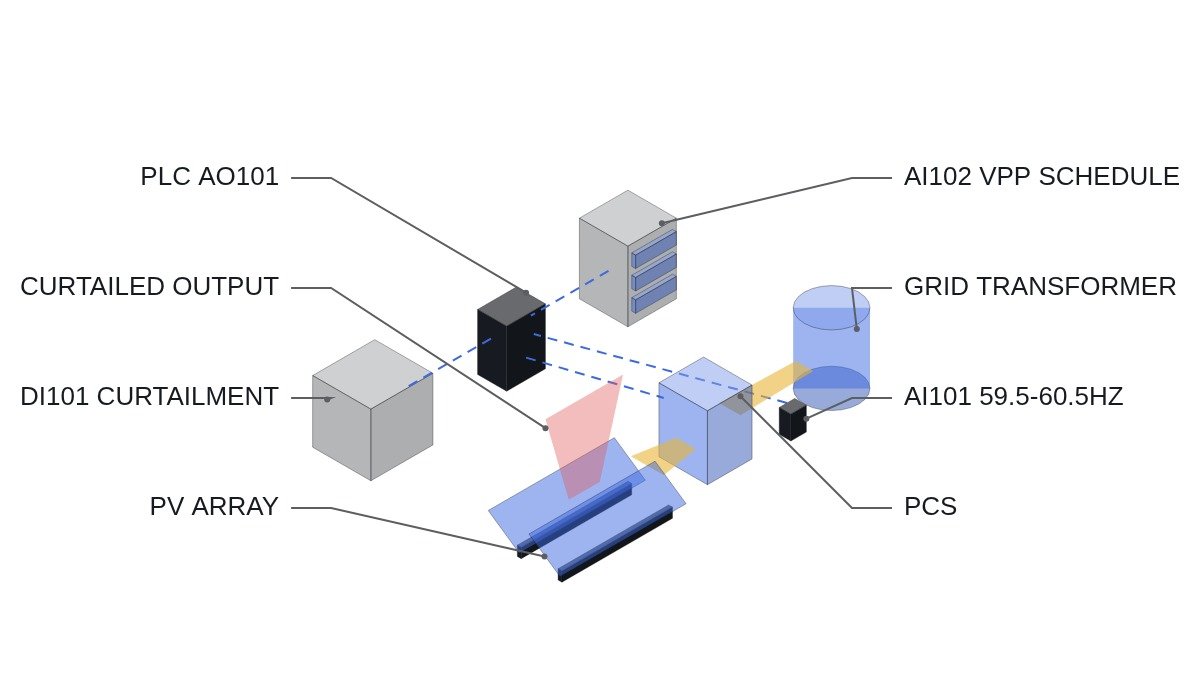
- Central-dispatch curtailment instruction interlock — on receiving a forced curtailment signal from the Korea Power Exchange or distribution operator, ramp down the PCS active power command immediately, with priority above the VPP response schedule
- Grid-managed substation restricted-connection interlock — within the area served by such a substation, block the start-up of new generation itself by interlock
- Frequency abnormality (UFR/OFR) interlock — disconnect or trip immediately on departure from 59.5-60.5Hz (highly likely to coincide with a frequency drop when the reserve margin falls sharply)
- VPP response schedule — lower-level logic that is valid only when all three interlocks above are normal; incentive-based and non-mandatory
- EMO (Emergency Off) — the principle is a hardwired configuration that directly cuts the PCS gate signal; designs that replace or bypass the EMO function with software logic alone are not covered on this site.
Grid connection and output adjustment I/O map
| Signal | I/O address | Type | Operating condition |
|---|---|---|---|
| Central-dispatch curtailment instruction | DI101 | Digital In | 1 = curtailment issued → ramp down PCS active power command immediately (top priority) |
| Grid-managed substation restricted-connection status | DI102 | Digital In | 1 = restricted-connection area → interlock on new generation start-up |
| Grid frequency | AI101 | Analog In 4-20mA | 59.5-60.5Hz, disconnect or trip immediately on departure |
| VPP response schedule command | AI102 | Analog In 4-20mA | 0-100% output command, valid only when upper interlocks are normal |
| PCS active power command | AO101 | Analog Out | Reflects the VPP schedule value only when DI101, DI102, and AI101 are normal |
The implication of this checklist is clear. The moment DI101 (central-dispatch curtailment) is issued, AI102 (VPP schedule) must be invalidated; if the two signals are handled with the same register priority, response delays can occur when the reserve margin drops sharply.
PLC logic snippet (IEC 61131-3 Structured Text pseudocode)
(* Solar PCS active power command logic - curtailment takes top priority *)
(* DI101: central-dispatch curtailment, DI102: grid-managed substation restricted connection, AI101: grid frequency *)
IF DI101 = 1 THEN
    AO101 := 0.0; (* Curtailment issued: ramp down immediately regardless of VPP schedule *)
ELSIF DI102 = 1 THEN
    AO101 := 0.0; (* Restricted-connection area: block new start-up itself *)
ELSIF (AI101 < 59.5) OR (AI101 > 60.5) THEN
    AO101 := 0.0; (* Frequency abnormal: disconnect immediately *)
ELSE
    AO101 := AI102; (* Apply VPP response schedule only when all conditions are normal *)
END_IF;
Boundary conditions — handling field variables
The designation status of the 189 grid-managed substations is updated from time to time by region, so whether it applies to a specific plant requires field verification and a re-check of KEPCO and Korea Power Exchange notices. In addition, the VPP quasi-central dispatch scheme is still in a pilot stage for some operators, so the timing of nationwide expansion and the detailed requirements may change depending on amendments to the enforcement decree — requires waveform analysis and field measurement. The selection criterion condenses to one question: when designing the interlock logic, did you first distinguish “which signal is imposed, and which signal is incentivized”?
References
- Energy Economy News, “Past Cheoseo, power reserve margin plunges to 11%… cloudy south puts solar on ’emergency’ too” (2026-08-26, Korea Power Exchange daily briefing)
- Haezoom blog, “As curtailment risk grows in the solar market… Haezoom finds a breakthrough with a VPP-based quasi-central dispatch scheme”
- KR20150117085A — Korea Electronics Technology Institute (KETI), Virtual power generation management platform system and energy management method (Google Patents)