Conclusion. The first item an electrical engineer should look at in this budget proposal is not the generation budget but “KRW 2.1 trillion (2.1조 원) in support for power, water and industrial complexes.” The reason is that its details are listed as “KEPCO capital injection, undergrounding of transmission lines, etc.” (Document 1, item 1 of the government budget table). When load grows, the bottleneck appears first not at the generator but along the path that reaches the load (author’s view).
The numbers
| Item | Details | Scale | Source |
|---|---|---|---|
| Power, water and industrial complex support | KEPCO capital injection, undergrounding of transmission lines, etc. | KRW 2.1 trillion | Doc. 1, government budget table |
| Infrastructure targets | Core infrastructure (power, water, industrial complexes) for semiconductors, physical AI and AIDC¹ | Full support | Doc. 1, SME and venture priority investment |
| Renewable energy deployment budget | Doubled | – | Doc. 1, SME and venture priority investment |
| Solar Income Villages | Expansion | 700 sites → 2,200 sites | Doc. 1, government budget table item 2 |
| EV subsidies | Expansion | – | Doc. 1, SME and venture priority investment |
| Frontier-class AI model | 10,000 GPUs + data + talent | KRW 4.7 trillion | Doc. 1, government budget table |
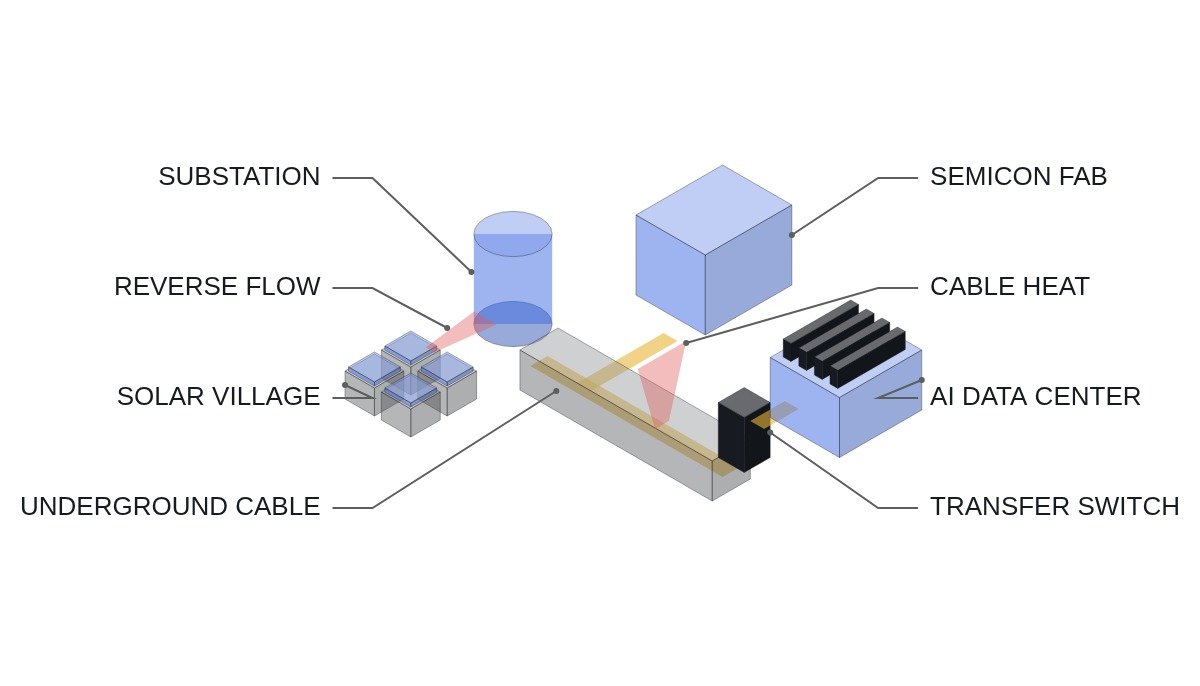
Implication: loads (AI data centers, semiconductor production hubs) and distributed generation (2,200 Solar Income Villages) are growing at the same time. One side is large concentrated load; the other is small distributed generation. Both sit on the same grid.
The assumption this article breaks
The assumption is that “if the renewable budget doubles, there will be twice as much spare power.” As Solar Income Villages grow from 700 to 2,200 sites, the number of points where reverse power flow³ appears in the distribution system² grows by the same measure. Generation increases on paper, but the path by which that power reaches where it is needed (data centers, industrial complexes) has to be built with a separate budget. I read this as the reason the KRW 2.1 trillion item is there (author’s view; the document gives no causal explanation).
What undergrounding of transmission lines means
Undergrounding⁴ involves different work items from overhead lines. In the author’s view, undergrounding near industrial complexes raises three design issues: (1) a grid switching⁵ plan during construction, (2) the ampacity of underground cables and their heat dissipation conditions, and (3) maintenance access after completion. The budget proposal only names the item and does not state the target sections or voltage levels, so the specific specifications cannot be confirmed from the information provided.
Two signals from the private sector
- DeltaX: an AI and energy solutions company that raised a KRW 32 billion (320억 원) Series B from Quantum Ventures Korea and others (Document 1, FUNDING). It is one of 188 domestic startup investments in August, totaling KRW 1,037.05 billion (1조 370억 5,000만 원) (Document 1, August investment report). The document does not say whether DeltaX’s business relates to the power grid.
- Willog: recorded temperature, shock and tilt of the cargo on the first commercial Arctic route voyage with IoT, collecting data over the entire Busan-Rotterdam route (Document 2).
Implication: the Willog case is not in the power sector, but IoT measurement that keeps an uninterrupted record of environmental data over long distances and long periods has actually been applied to commercial shipping, which makes it a reference for designing remote monitoring of power equipment (author’s view).
Counterargument
There is a view that “diversifying generation sources matters more than undergrounding.” The budget proposal also raised funding for the seven national strategic core technologies (SEED), including SMRs and fusion, from KRW 11.0 trillion to KRW 13.8 trillion (Document 1, government budget table item 2). Even so, more generation sources cannot reach the load without a path. I see the two budgets not as competitors but as a question of sequence.
Practical checklist
If you are reviewing receiving facilities for an industrial complex or data center:
- ☐ Whether the grid path to the point of receipt is overhead or underground, and whether it falls within a section planned for undergrounding
- ☐ Whether reverse power flow and voltage rise from nearby distributed generation (solar) interconnection have been reviewed
- ☐ Switching scenarios during construction and the interlock changes they require
- ☐ Once the detailed sections in the budget are published, recheck the items above against them
- AIDC (AI Data Center): a data center for AI computing.
- Distribution system: the low- and high-voltage lines that divide power from substations to customers.
- Reverse power flow: a phenomenon in which the output of distributed generation exceeds local load and flows back up to the upstream grid.
- Undergrounding: work that replaces overhead lines with underground cables.
- Switching/transfer: an operation that moves the power supply path to another circuit during construction or inspection.