Korea Electric Power Corporation (KEPCO) revised its “Rules on the Use of Transmission and Distribution Facilities,” and the revision took effect on July 20, 2026. It creates a new basis for reclaiming secured connection capacity if a project does not apply to use the grid within one year of receiving its generation business license, or does not sign a use contract within one year of applying, and the grace period for existing projects ends on September 20, 2026. In short, the revision clears out roughly 30GW of so-called “delayed or speculative generation projects” that had sat in a management blind spot, and reorders grid operating priorities so that connection capacity is reallocated to developers who are actually building.
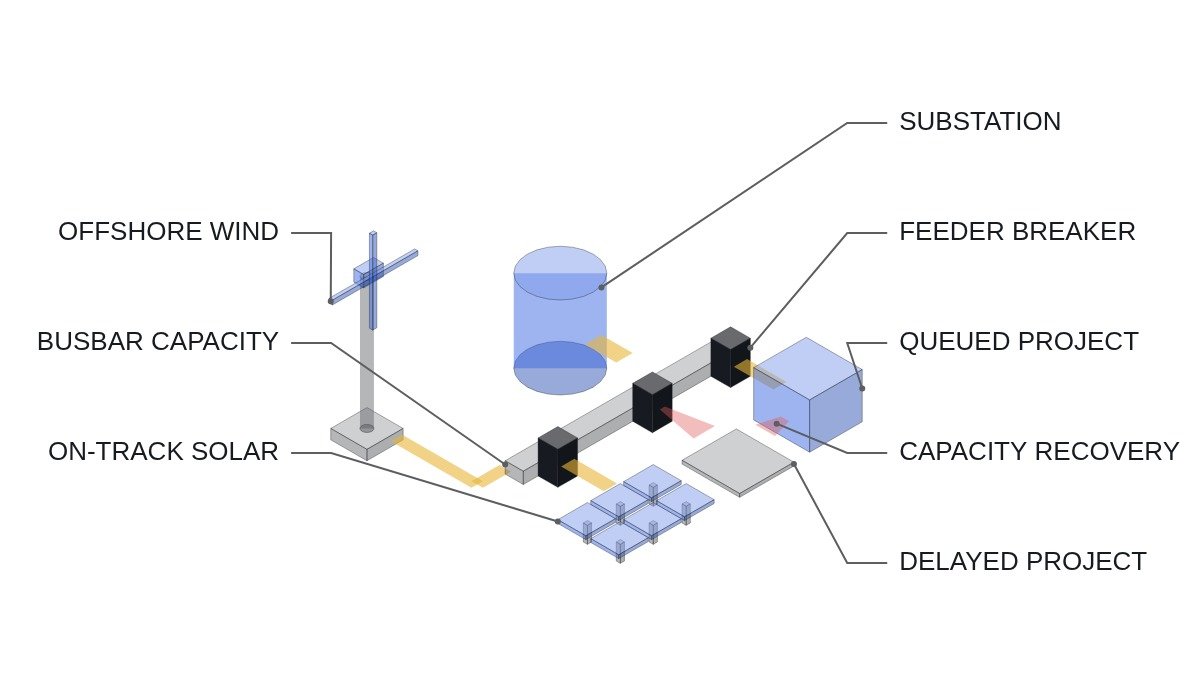
Connection capacity has been redefined — not as an asset secured first-come, first-served, but as a conditional right that can be reclaimed according to how fast the project actually moves.
Where it wins — the revision works in favor of renewable developers who have moved through project procedures such as signing the use contract on schedule. The current condition was a structure in which delayed or suspended projects kept occupying connection capacity, blocking later projects from entering the grid. After the revision there are clear deadlines — one year to apply and one year to sign the use contract — and the project-progress review cycle is shortened from two years to one, so the risk that a developer on schedule has its secured capacity reclaimed early actually falls. The connecting logic is simple: because project speed itself becomes the condition for keeping connection capacity, the more diligently a developer follows the procedures, the larger its relative advantage.
Where it doesn’t — the revision can work against offshore wind developers, whose project periods are inherently long. Offshore wind involves lengthy environmental impact assessment, permitting and grid interconnection procedures, so even a project advancing normally could be misclassified as “delayed” if the uniform one-year review cycle were applied as is. KEPCO has taken this into account by separately introducing an interim review for offshore wind only, checking whether the environmental impact assessment is complete five years before the start of use and whether a fixed-price contract has been signed three years before, but the final judgment rests with the discretion of a committee made up of the Ministry of Climate, Energy and Environment, KEPCO, the Korea Energy Agency and private members.
Comparison of the previous and revised rules
| Item | Previous rules | Revised rules (effective 2026-07-20) |
|---|---|---|
| Application deadline | No explicit basis for reclaiming | Capacity reclaimed if no application within 1 year of generation license |
| Use contract deadline | No explicit basis for reclaiming | Capacity reclaimed if no contract within 1 year of application |
| Progress review cycle | 2 years | 1 year |
| Offshore wind interim review | None | Environmental impact assessment checked 5 years before start of use; fixed-price contract checked 3 years before |
| Grace period | – | Licensed before 2025-08-21: apply by 2026-08-20 / Applied before 2025-09-21: sign contract by 2026-09-20 |
The implication of the table is that the criterion deciding whether connection capacity is reclaimed has clearly shifted from project size to compliance with project-progress deadlines.
What connection capacity means on the grid side
For an electrical engineer, “connection capacity” is not an abstract entitlement. It is a share of a specific substation transformer, a specific feeder or a specific transmission bay that the grid operator has counted as committed when it studies the next applicant. Every megawatt held by a project that never builds is a megawatt that later projects cannot be offered, even though no current flows through it. The network looks full on paper while the equipment runs lightly loaded.
Reclaiming that capacity therefore changes the input to every subsequent interconnection review in the same area. When capacity held by a stalled project is released, the hosting headroom at the associated substation or feeder is recalculated, and projects that were told to wait may receive a different answer. For developers in grid-constrained regions, the September 20 deadline is less about their own project than about whether their neighbors’ capacity comes back into the pool.
It also changes the order of engineering work. Under a first-come, first-served regime, a developer could secure capacity early and defer detailed electrical design. Under a one-year deadline regime, the deliverables needed to apply and to sign the use contract — single-line diagrams, protection coordination, point-of-interconnection design — move to the front of the schedule. Electrical design becomes the pacing item for keeping capacity, not a task that can wait for financing.
How different project types are exposed
| Project type | Exposure | What protects capacity | Key check |
|---|---|---|---|
| On schedule | Low | Meeting both deadlines | Dates of license, application, contract |
| Delayed, own cause | High | Nothing under the new rules | Whether the grace period can still be met |
| Delayed, not own cause | Moderate | Committee finding of no fault | Evidence of permit or grid delays |
| Offshore wind | Moderate | Interim review milestones | EIA and fixed-price contract status |
| Speculative holding | Highest | None | Expect capacity to be released |
The table shows that exposure is decided by the cause and documentation of delay, not by technology or size. Two projects with the same delay can end up on opposite sides of the line: one that can show the delay came from permitting or grid connection outside its control, and one that cannot. The paperwork of delay is now part of the asset.
Items to verify before the grace period ends
- □ Confirm the generation business license date and whether it falls before 2025-08-21.
- □ Confirm the grid use application date and whether it falls before 2025-09-21.
- □ Confirm that the use contract can be signed by 2026-09-20 if the application predates 2025-09-21.
- □ For any delay, collect records showing whether it came from the developer or from permitting and grid-connection processes outside its control.
- □ For offshore wind, map the start-of-use date back to the five-year (environmental impact assessment) and three-year (fixed-price contract) checkpoints.
- □ Check whether the electrical design deliverables needed for the use contract are complete, not merely scheduled.
- □ In constrained regions, track whether capacity released from other projects changes the headroom available at the target substation or feeder.
Boundary conditions
The point at which this judgment flips is a delay that is not the developer’s fault. If the committee finds that the developer bears no fault, it can adjust the start-of-use date to an appropriate point instead of terminating the use contract, so variables the developer cannot control — such as permitting delays or grid connection delays — are excluded from reclaiming. The selection criterion narrows to one: the real condition for keeping connection capacity is not project size, but whether the developer met the procedural deadlines that were within its own control.
References
- Dailian, “KEPCO strengthens management of delayed and speculative generation projects to improve grid use efficiency”, 2026-07-20, https://www.dailian.co.kr/news/view/1668519/
- KR20150028436A / KR102193439B1, Apparatus and method for calculating connection possible capacity of distributed generator, Korea Electric Power Corporation, filed 2013-09-06 / registered 2020-12-21, legal status: Active (expected expiry 2033-09-06)