Renewable energy isn’t expanding merely because it’s “eco-friendly.” Solar and wind have begun to genuinely outperform other generation sources in cost-effectiveness for specific regions and applications.
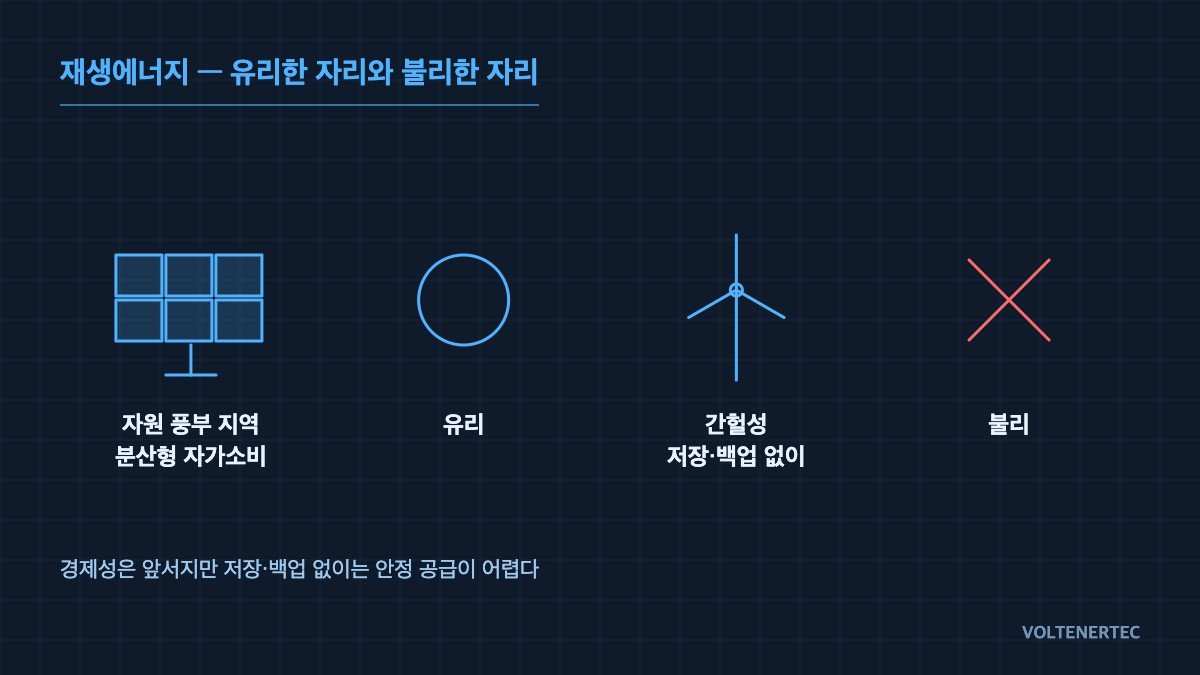
Where It Wins
| Use Case | Reason |
|---|---|
| New generation in regions with abundant sunlight/wind | Levelized cost of electricity (LCOE) is already lower than fossil fuels in many cases |
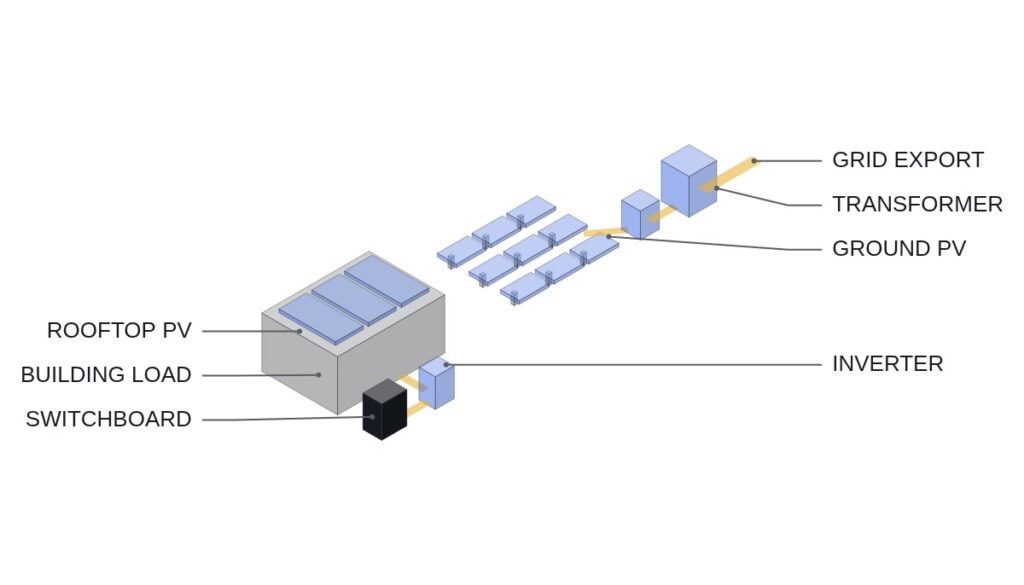
| Distributed small-scale generation (residential/factory self-consumption) | Can be consumed on-site immediately with no transmission loss |
Takeaway: in both cases, economics is decided less by the generation cost itself than by where power is produced and where it is used. The cost advantage becomes real profit only when the site and the point of consumption line up.
Where It Struggles
Output is dictated by weather and time of day, so on its own it cannot guarantee a stable power supply. This makes pairing with ESS or other generation sources essential, and once that pairing cost is added, comparison based on generation cost alone becomes difficult.
Summary
Renewable energy is strongest where resources are abundant and when paired with storage and backup. Used alone, stability issues remain.
Where It Wins, Where It Struggles: Reading the Conditions
- Wins — distributed self-consumption — Current condition: daytime load at a factory or home is met from the grid supply. → After applying: on-site generation directly reduces grid purchases. → Link: with no transmission in between, the generation-cost advantage turns straight into bill savings.
- Wins — new generation in resource-rich regions — Current condition: a new generation source has to be chosen. → After applying: a source with no fuel cost is added. → Link: it is not exposed to fuel price swings, so long-term costs are easier to predict.
- Struggles — regions with little grid connection headroom — Current condition: the connection point and transmission/distribution capacity are already tight. → After applying: even with more capacity installed, output is curtailed when generation peaks. → Link: economics erode by the amount of energy thrown away, and generation-cost comparisons do not show this loss.
Electrical View: An Inverter-Based Source
Solar and most wind generation connect to the grid through inverters. Unlike rotating generators they have no mechanical inertia, so as their share grows, the buffer that used to slow grid frequency changes shrinks. Grids with a high renewable share therefore also need fast ESS response or grid-support functions in the inverters. Inverter switching harmonics and voltage fluctuation at the connection point vary with equipment and grid conditions, so waveform analysis and field measurement are required.
Comparing generation cost alone leaves out these grid-side costs. The real value of a renewable installation is set not by its installed capacity but by whether the connection point can absorb its output.
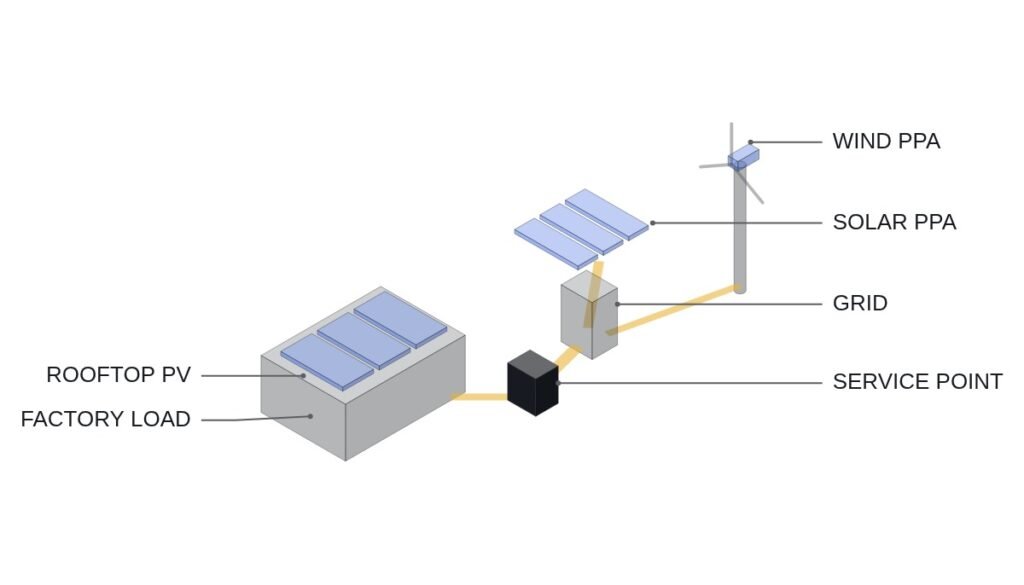
The same problem appears on a smaller scale in self-consumption installations. Connecting solar to a factory’s service equipment lowers daytime grid demand, but grid demand then rises and falls quickly every time a cloud passes. If contracted demand and peak management are based on the service point, the surge in grid demand at the moment generation drops can set a new peak. In that case the ESS should be sized not for bill savings but as a buffer for service-point fluctuation, with the required power and response determined by logging and measuring power at the service point.
In the end, even identical solar installations need different supporting equipment depending on the connection location and load mix, so the connection conditions should be settled before the installed capacity.
Character Comparison by Supporting Configuration
| Item | Renewables alone | Renewables + ESS | Renewables + backup generation |
|---|---|---|---|
| Output stability | Weather-dependent | Short-term swings smoothed | Can supply over long periods |
| Extra equipment | None | Battery, PCS | Backup generation plant |
| Grid burden | High | Reduced | Reduced |
| Fuel cost exposure | None | None | Only for backup operation |
| Suited use | Supplementing self-consumption | Absorbing daily swings | Facilities needing stable supply |
Takeaway: renewables should be compared not against another source on its own but as a bundle of renewables plus supporting equipment. Only a bundle-cost comparison gives the right answer.
Checklist Before Adoption
- How far do the site load profile and the generation hours overlap?
- Have connection-point capacity and the possibility of curtailment been confirmed with the grid operator? (item to verify)
- Has it been decided what will supply the load during cloudy or windless periods?
- Has the effect of grid-demand surges during sudden generation drops on contracted demand and peak management been reviewed?
- Has it been decided whether the ESS is sized for bill savings or as a service-point buffer?
- Is the energy lost to curtailment included in the economic calculation?
- Have the inverter’s anti-islanding and grid-support specifications been confirmed?
- Is there a plan to measure harmonics and voltage fluctuation at the connection point after installation?
Boundary Conditions
The advantage of renewables holds where resources are abundant, generation hours overlap with consumption hours, and there is connection headroom. The judgment flips in regions with frequent curtailment due to limited connection capacity, in facilities whose load falls mostly at night or in windless periods, and where renewables alone must carry loads that cannot tolerate interruption; there, the cost of supporting equipment exceeds the generation-cost advantage.
Single selection criterion: choose renewables when the bundled cost, including storage, backup and connection, is lower than the alternative, not when the generation cost alone is lower.
Related reading (Korean) — Solar, Wind & Hydro — Comparing Renewable Energy Sources