Nuclear power is often framed as opposed to renewable energy, but in practice the two serve different roles as generation sources. The key question is whether output can be held steady regardless of weather.
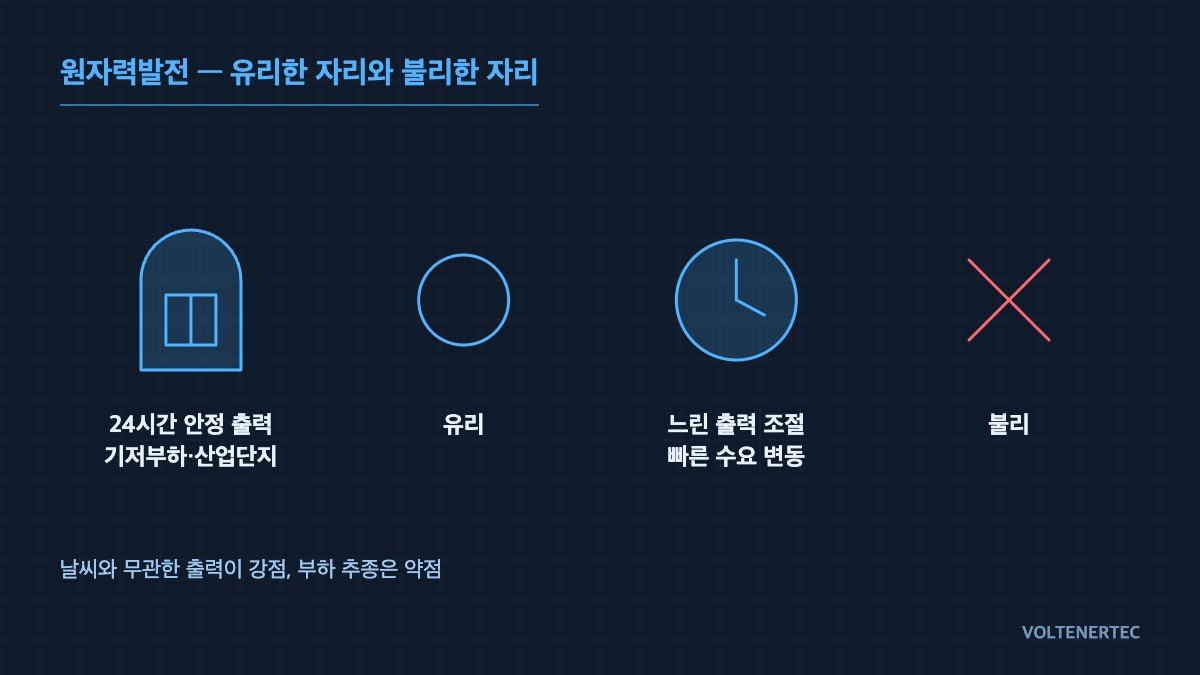
Where It Wins
| Use Case | Reason |
|---|---|
| Baseload power supply | Maintains steady output 24 hours a day regardless of weather or time |
| Stable supply for large industrial complexes | Suited to sites that need large-capacity power with no variability |
Takeaway: both use cases need the property that output does not change. The larger and flatter the demand, the more directly nuclear’s strength turns into value.
Where It Struggles
Output adjustment is slow, making it difficult to respond quickly to variable demand and supply the way solar and wind can. Also, high initial construction costs and long licensing periods make it unsuited to rapid capacity expansion.
Summary
Nuclear power is strongest in supplying a “large, unchanging block” of power reliably. It is not suited to responding quickly to demand swings or to small-scale, distributed supply.
Where It Wins, Where It Struggles: Reading the Conditions
- Wins — baseload — Current condition: the minimum demand present all day is met by sources exposed to fuel price swings. → After applying: a constant-output source takes over that band. → Link: output does not need to change in that band, so slow load-following never becomes a problem.
- Wins — large industrial complexes — Current condition: large continuous loads are sensitive to supply variation. → After applying: large-capacity power arrives without variation. → Link: facilities that need process continuity carry less equipment to cope with supply swings.
- Struggles — load-following on a highly variable grid — Current condition: a high renewable share makes net load swing widely. → After applying: nuclear adjusts output slowly and cannot track the swings. → Link: the swings must be taken by other sources or ESS, so nuclear alone cannot balance the grid.
Grid View: The Other Side of a Large Single Unit
A nuclear unit is a very large single source on the grid. If it trips unexpectedly, the grid must immediately fill a supply gap of that size. The larger the unit, the more reserve the grid operator must hold at all times against its loss, and that cost rarely shows up in generation-cost comparisons.
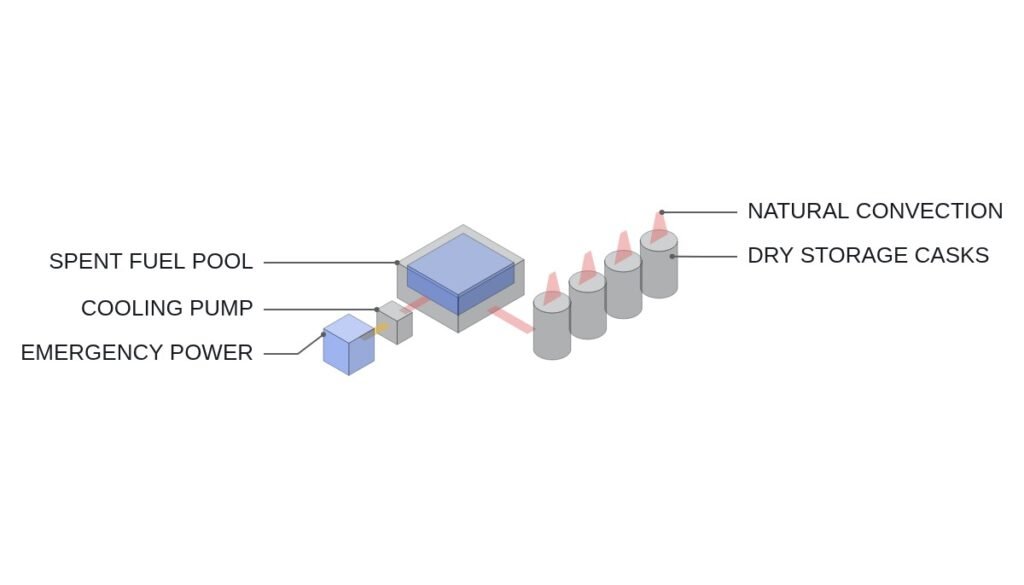
There is dependence in the other direction as well. A nuclear plant must keep its cooling systems running even when shut down, so station power is essential, and emergency generators take over if off-site power is lost. The plant is both a generator and a load that demands highly reliable power. This is why redundant transmission connections and the reliability of the emergency power system belong in the siting decision.
The weakness of slow output adjustment is, from the grid side, also a matter of operating practice. Changing output often puts stress on fuel and equipment and hurts economics, so grid operation is arranged to keep nuclear at constant output as far as possible and hand the swings to other resources.
From the customer side, nuclear’s constant output is a property at the plant terminals, not a guarantee of power quality at the service point. Voltage variation, sags and harmonics at the service point are shaped by the transmission and distribution path and nearby loads, so facilities that need process continuity must judge the need for UPS or voltage compensation separately, regardless of the generation source. This calls for waveform analysis and field measurement.
In short, the value of nuclear is set not by the characteristics of a single plant but within the configuration of the grid as a whole.
Character Comparison of Roles by Source
| Item | Nuclear | Renewables | Gas-fired |
|---|---|---|---|
| Output profile | Constant | Weather-driven variation | Adjustable |
| Load-following | Slow | Tied to resource | Fairly fast |
| Unit size | Large single unit | Small, distributed | Medium to large |
| Construction and licensing | Long | Relatively short | Moderate |
| Role on the grid | Baseload | Energy supply, needs support | Balancing swings |
Takeaway: nuclear and renewables fill different slots rather than competing for the same one. The real design task is deciding who handles the swings between them.
Checklist for Evaluation
- Is the baseload of the target grid stable enough to absorb the unit’s capacity?
- Is there a plan to secure reserve against an unexpected unit trip? (item to verify)
- Are the sources or ESS that will handle the swings planned alongside it?
- Has power quality at the customer’s service point been measured independently of the generation source?
- Has the supply gap during the unit’s planned outages been reviewed at the grid level?
- Is there a test plan for emergency power transfer on loss of off-site power?
- Have redundant transmission connections and the reliability of the on-site emergency power system been confirmed?
- Has it been decided what will cover demand during the construction and licensing period?
Boundary Conditions
Nuclear’s advantage holds when demand is large and flat, the grid is large enough to absorb the loss of a big unit, and there is time to wait for construction. The judgment flips when the grid is small enough that one unit makes up an excessive share, when a growing renewable share pushes net-load swings down into the baseload band, or when demand grows so fast that capacity is needed immediately.
Single selection criterion: choose nuclear as a baseload source only when there is flat, large-volume demand and the grid can absorb the loss of a large unit.
Related reading (Korean) — The Basic Principles of Nuclear Power and Why SMRs (Small Modular Reactors) Are Drawing Attention