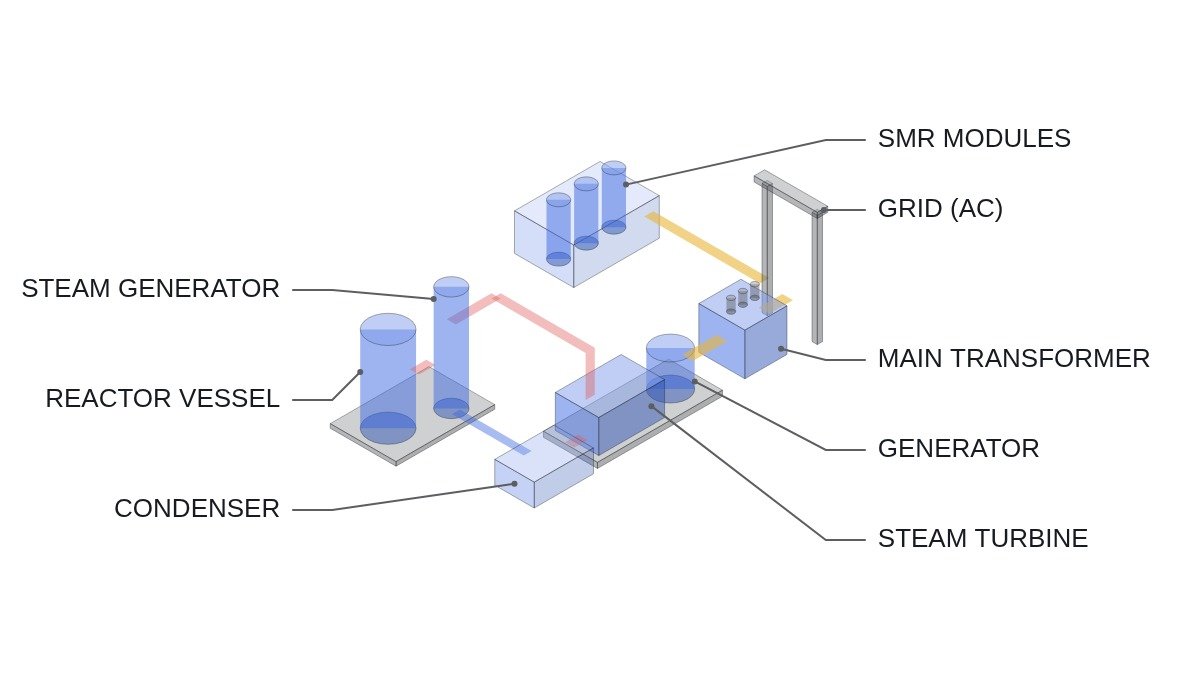
Nuclear power works much like thermal power in principle: heat from uranium fission boils water into steam, and that steam turns a turbine to generate electricity. The difference is that the heat source is fission rather than combustion.
| Item | Large reactor (conventional) | SMR (small modular reactor) |
|---|---|---|
| Output | 1,000 MW class and above | Typically 300 MW or less |
| Construction method | Mainly on-site construction | Modules built in a factory, then assembled on site |
| Safety design | High share of active safety systems | Emphasis on passive safety systems such as natural circulation |
| Siting flexibility | Requires a large site and a cooling water source | Wider siting options, including inland and near industrial complexes |
Why SMRs are drawing attention — Because modules are prefabricated in a factory and only assembled on site, SMRs can shorten construction time and reduce the burden of initial investment. Their small output also makes heat removal after an accident relatively easier, which favors passive safety designs. Plans to deploy SMRs as dedicated power sources matched to specific industrial demand, such as data centers, are another reason interest in SMRs is growing.
Reading the comparison from the grid side
The output row is more than a size difference. The grid has to hold enough reserve to survive the loss of its largest single unit, so a 1,000 MW-class reactor trip is a planning event that the whole system is sized around. An SMR of 300 MW or less presents a smaller single contingency, and a site built from several modules does not lose all of its output when one module trips. From the power system side, this is a change in the shape of the risk, not only in the amount of capacity.
The construction row moves schedule risk from one place to another. On-site construction concentrates risk at the site: labor, weather, and field quality control. Factory module production shifts that risk toward the factory and the transport route, where it is easier to control but depends on the factory actually running a production series rather than building one unit at a time.
The safety design row is about what the plant needs from outside in order to stay safe. Active safety systems rely on pumps, valves, and the power supplies that drive them. Passive systems built around natural circulation lean on physical phenomena instead, which reduces how much the heat-removal function depends on available electrical power after shutdown. For an electrical engineer, that is the practical meaning of “passive”: fewer safety functions tied to the station power system.
The siting row changes where the plant meets the grid. A large reactor connects to the transmission backbone. An SMR placed near an industrial complex or a data center can sit closer to its load, which shortens the path to the consumer, but it also means the local grid at that point must be able to accept the plant and carry it through faults and outages.
Character comparison from the system side
| Aspect | Large reactor | SMR |
|---|---|---|
| Single-unit contingency | Large | Small, split by module |
| Where build risk sits | Construction site | Factory and transport |
| Post-shutdown heat removal | More reliant on active systems | Leans on natural circulation |
| Typical role | Bulk grid supply | Dedicated industrial supply |
| Grid connection point | Transmission backbone | Can be closer to load |
What this table shows is that the SMR case rests on flexibility, not on replacing large reactors one-for-one. The large reactor remains the tool for bulk supply on a strong grid, while the SMR fits where a smaller contingency, a closer connection to load, and less dependence on active safety systems are worth more than scale.
Where it wins, where it doesn’t
Where the SMR wins — Current condition: a demand such as a data center or industrial complex, where continuous load is concentrated at one point and needs a dedicated supply. After applying it: the source sits close to the load, the single-unit contingency is small, and because the plant is split into modules, one module stopping does not remove all output. Linking logic: it wins where a smaller single contingency and proximity to load are worth more than scale.
Where the large reactor wins — Current condition: bulk baseload supply is the goal at an established site with a strong transmission grid and an ample cooling water source. After applying it: the scale of a 1,000 MW-class unit becomes supply capacity directly. Linking logic: where the grid can withstand a large single contingency, the advantage of scale outweighs siting flexibility.
Where each loses — The SMR loses when a first-of-a-kind unit is built alone without series module production, and when the local grid at the load is too weak to carry the load while the plant is offline. The large reactor loses where the grid is small and the reserve burden for its single contingency is heavy, or where a large site and cooling water source cannot be secured.
When an SMR is used as a dedicated supply, the core of the power system design is less the reactor itself than the backup source that takes over the load during refueling and maintenance outages, and the transfer sequence to it. If that transfer path has not been laid out on an operating time chart, the dedicated-supply concept is not yet complete.
Items to verify before treating an SMR as a dedicated supply
- Licensing status of the specific design in the target country, since a design that has not been licensed cannot be scheduled.
- Whether a module factory exists and is producing in series, since the construction advantage depends on it.
- Connection capacity of the local grid at the proposed site, including how the load is carried when the plant is offline for refueling or maintenance.
- The load profile of the dedicated consumer: a continuous load such as a data center matches steady output, while a highly variable load needs additional balancing resources.
- Cooling water or heat sink conditions at the site, which remain a siting factor even with wider options.
- Backup supply for the consumer during planned outages of the plant.
Boundary conditions
The SMR advantage reverses when the goal is large-volume baseload supply on a strong grid at an established site with ample cooling water. In that setting, the scale of a 1,000 MW-class reactor works in its favor, and the siting flexibility of an SMR adds little. The advantage also weakens if module production never reaches series manufacturing, because a first-of-a-kind module built alone does not deliver the construction time and investment benefits that justify the concept.
The single selection criterion is this: is the requirement bulk supply to the grid, or a dedicated supply placed close to a specific load where a smaller single contingency matters more than scale?