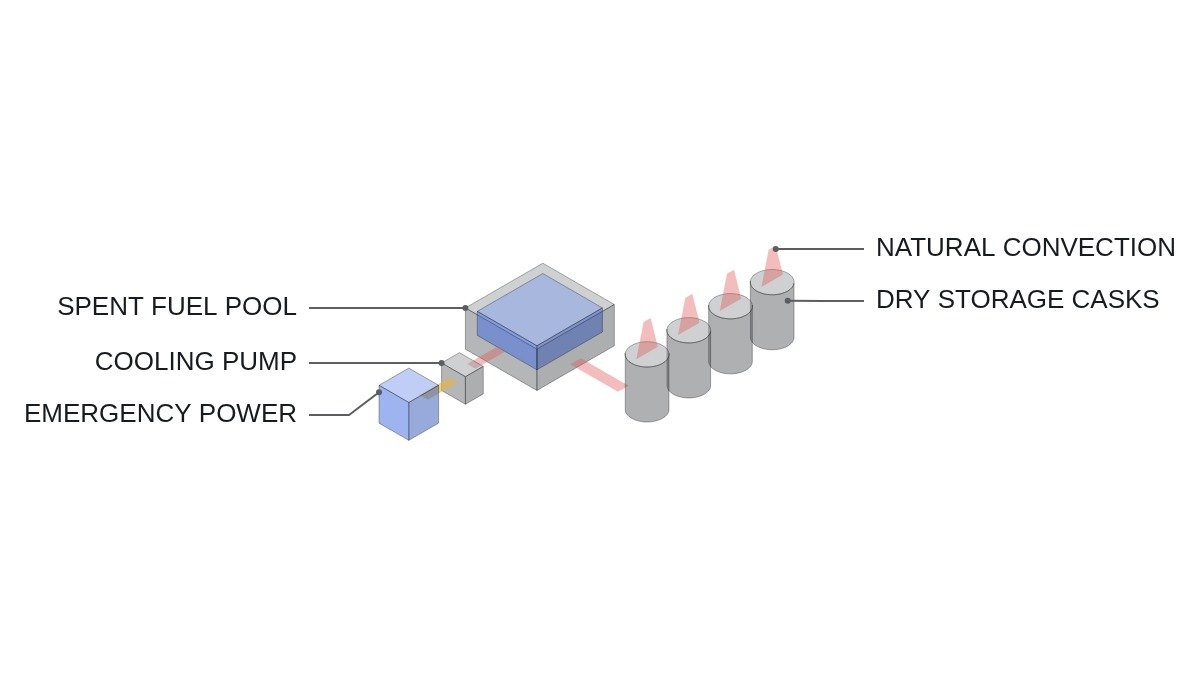
The conclusion first. Wet and dry storage of spent fuel are not competitors but steps in a sequence, and what separates them is decay heat level and dependence on electrical power. Fuel just discharged from the reactor has high decay heat and must go into a water-cooled pool, where safety rests on active equipment, cooling pumps and makeup water supply, and therefore on power. Once fuel has cooled long enough for decay heat to drop, it can move into dry casks that remove heat by natural convection alone, and from that moment cooling no longer depends on power. While the pool has spare capacity and its cooling system is reliable, wet storage is economical. When pool saturation approaches, or after permanent shutdown when the electrical system needs to shrink, dry storage wins.
Where it wins, where it doesn’t
Start with the current conditions. Most nuclear plants have a spent fuel pool next to the reactor building and keep discharged fuel in underwater racks. Water is both the heat removal medium and the radiation shield. Pool heat goes through cooling pumps and heat exchangers to the ultimate heat sink, and makeup water systems replace what evaporates. Keeping this running normally requires power for the pumps.
Applying dry storage changes the structure. Fuel is sealed in a metal canister and placed in a concrete or metal shielding cask, and heat is removed by natural convection of air. No pumps, no makeup water. What remains on the electrical side is temperature and radiation monitoring plus security and lighting loads. In exchange, fuel must be taken out of the water and loaded into casks, and that handling carries the heavy-load risk of lifting and transporting the cask.
The connecting logic: wet storage has high cooling capacity and can accept high-decay-heat fuel, but its safety hangs on continuity of active equipment and power supply. Dry storage accepts only low-decay-heat fuel, but its safety hangs on the passive design of the cask. The cooler the fuel gets, the less reason there is to keep it wet, and every assembly left in the pool keeps carrying power-dependence risk.
Storage method comparison
| Item | Wet (pool) | Dry (cask) |
|---|---|---|
| Cooling | Forced-circulation water | Natural air convection |
| Power dependence | Cooling pumps, makeup water | Monitoring instruments only |
| Acceptable fuel | Freshly discharged, high heat | Fuel cooled for a set period |
| Capacity expansion | Limited by pool size | Modular, add casks |
| Main risk | Loss of cooling, low water level | Drop during handling, long-term aging |
| Monitoring | Level, temperature, radiation | Cask surface temperature, radiation |
The takeaway: the risks of the two methods are concentrated at different times. Wet storage risk persists throughout the storage period, while dry storage risk concentrates at loading and transfer and drops sharply afterward. The choice is whether to carry risk over a “period” or at a “moment of work.”
Power dependence as an electrical engineer sees it
From an equipment standpoint, pool cooling is often classified as a safety-related load and designed to be picked up by emergency power on loss of offsite power. The pool’s large water inventory means that even if cooling stops, temperature rise and level drop take time, but that time is inversely proportional to the total decay heat of stored fuel. The more densely the pool is racked and the more recently discharged fuel it holds, the shorter the margin.
A practical judgment follows. The ways to raise pool cooling reliability are power redundancy and emergency makeup paths, but the surest way is to reduce the total decay heat left in the pool. Moving sufficiently cooled fuel to dry storage lowers the heat load the pool cooling system must handle and lengthens the margin after loss of cooling. Dry storage is both a way to secure space and a way to cut the pool’s power-dependence risk.
| Situation | Favored | Reason |
|---|---|---|
| Freshly discharged fuel | Wet | High decay heat needs water |
| Pool nearly full | Transfer to dry | Modular capacity expansion |
| Preparing decommissioning | Transfer to dry | Pool must be emptied |
| Long operation, ample space | Stay wet | No extra handling |
| Electrical system must shrink | Dry | Removes active cooling loads |
What this table shows is that the trigger for moving to dry storage is almost always “a reason the pool must be emptied.” In Korea, the saturation timing of pools at several plant sites has been raised repeatedly, and the Wolsong site with its CANDU units has operated on-site dry storage from a comparatively early stage.
Decision sequence
- Estimate the pool saturation date from remaining capacity and the fuel discharge plan.
- Confirm how much fuel in the pool meets the dry-transfer conditions (cooling time, decay heat limit).
- Check the power arrangement of pool cooling and the emergency makeup path, and reassess the margin after loss of cooling against the current heat load.
- Review crane interlocks, lift paths, and drop-prevention conditions for cask loading and transfer.
- Tie it to the decommissioning schedule after permanent shutdown and back-calculate when the pool must be empty.
What is easy to miss in dry storage monitoring
“Dry storage does not depend on power” is true only for cooling. Monitoring is still needed, and poor monitoring design hides the benefit of passive cooling. A natural-convection cask removes heat as air flows in through bottom inlets and out through top outlets, so the most realistic abnormal condition is inlet blockage. Snow, debris, or installed objects blocking the passage degrade cooling without any power problem.
So it is more practical to monitor the difference between outlet air temperature and ambient temperature, and its trend, rather than absolute temperature. Absolute temperature moves with ambient, so a simple high alarm produces false or late alarms depending on the season. Procedures should link a departure from the usual trend to a field inspection. Alarm setpoints come from cask design data and site weather conditions, and no generic values are given here.
Items to verify
- The minimum cooling time and decay heat criteria for transfer to dry storage differ by cask license, so they must be checked in the cask design documents.
- The expected saturation date of a given plant’s pool depends on the discharge plan and whether racks are replaced, so it should be taken from the operator’s published data.
Boundary conditions
Dry storage’s advantage weakens under two conditions. First, when most fuel has not cooled long enough after discharge; the thermal design limit of the cask means little fuel can be moved. Second, a policy condition that requires reopening canisters for final disposal or reprocessing; repackaging adds work and dry storage’s handling risk occurs once more.
Conversely, wet storage’s advantage collapses when the pool is densely racked and the margin after loss of cooling has shrunk, or at the stage where the electrical system must be reduced for decommissioning.
The single selection criterion: dry storage wins from the point at which the power-dependence risk carried by fuel that already meets dry-transfer conditions, for as long as it stays in the pool, is judged larger than the risk of a single loading and transfer operation.