The conclusion first. Nuclear decommissioning strategies divide into immediate and deferred dismantling, and they are usually compared as “whether to wait for radioactivity to decay.” But the bottleneck that actually drives the schedule is not radioactive decay; it is when spent fuel leaves the pool. While fuel remains in the pool, cooling systems, power, and security must be kept close to operating levels, so under either strategy full-scale dismantling starts only after fuel is removed. If operating staff and plant knowledge can carry straight over and the site must be reused soon, immediate dismantling wins. If the radioactive waste disposal route is not settled and long-term care costs can be carried, deferred dismantling wins.
Where it wins, where it doesn’t
Start with the current conditions. The International Atomic Energy Agency (IAEA) distinguishes three decommissioning strategies: immediate dismantling, deferred dismantling, and entombment. Immediate dismantling proceeds to decontamination and dismantling as soon as practical after permanent shutdown; deferred dismantling places the plant in a safe, sealed state and maintains it for decades before dismantling. The United States requires decommissioning to be completed within 60 years of permanent shutdown, so deferral is also a time-limited option. Korea has adopted immediate dismantling as its basic direction, with Kori Unit 1 as the first case.
What deferred dismantling changes is radiation dose. Among activation products in reactor structures, Co-60, a major contributor to worker dose, has a half-life of about 5.27 years. Waiting 50 years passes about 9.5 half-lives, reducing it to 1 in 2 to the 9.5th power, roughly 1/700. Worker dose falls and some waste may drop to a lower class. By contrast, a long-lived nuclide such as Ni-63 (half-life about 100 years) decreases only about 30% over the same 50 years, so the benefit of waste reclassification is limited depending on nuclide composition.
The connecting logic: the benefit of deferral comes from Co-60 decay, but in exchange there are decades of site care, monitoring, and security costs, and the people and plant knowledge that ran the plant disappear. Immediate dismantling carries a heavier dose management burden, but the people who know the plant best take part in dismantling it. The choice is which costs more: radiation dose or organizational memory.
Strategy comparison
| Item | Immediate | Deferred |
|---|---|---|
| Worker dose | Relatively high | Lower after Co-60 decay |
| Staff and knowledge transfer | Favorable | Decades-long gap |
| Site reuse | Fast | Delayed by decades |
| Long-term care cost | Small | Ongoing monitoring, security |
| Dependence on disposal route | Repository needed first | Can wait until secured |
| Regulatory and cost uncertainty | Fixed at current rules | Exposed to future rule changes |
The takeaway: deferral’s advantages are mostly “things that shrink if you wait,” and its disadvantages are “things that grow while you wait.” Dose falls but care costs and uncertainty rise, so the value of waiting depends heavily on whether the waste disposal route is settled.
The bottleneck is spent fuel removal
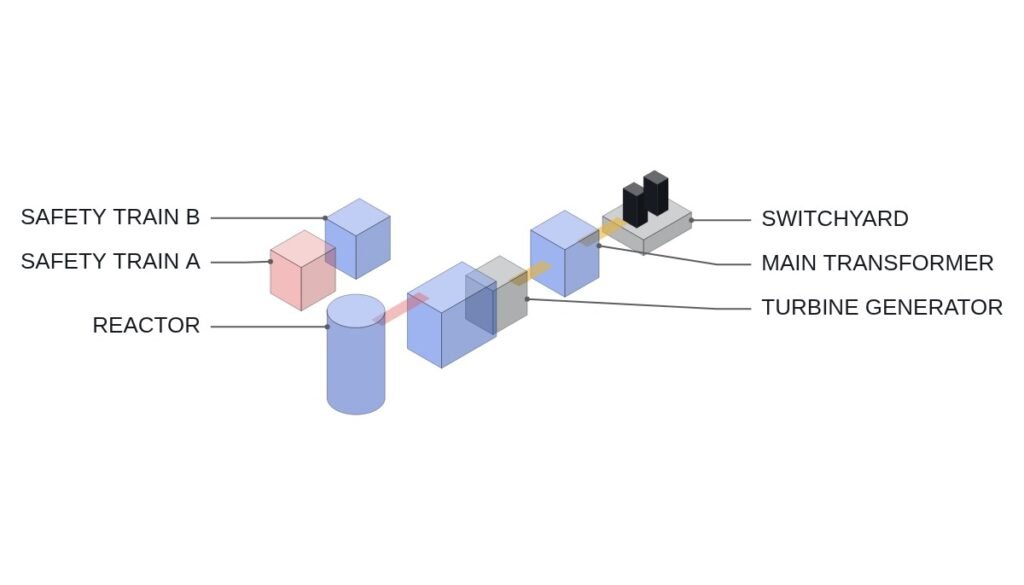
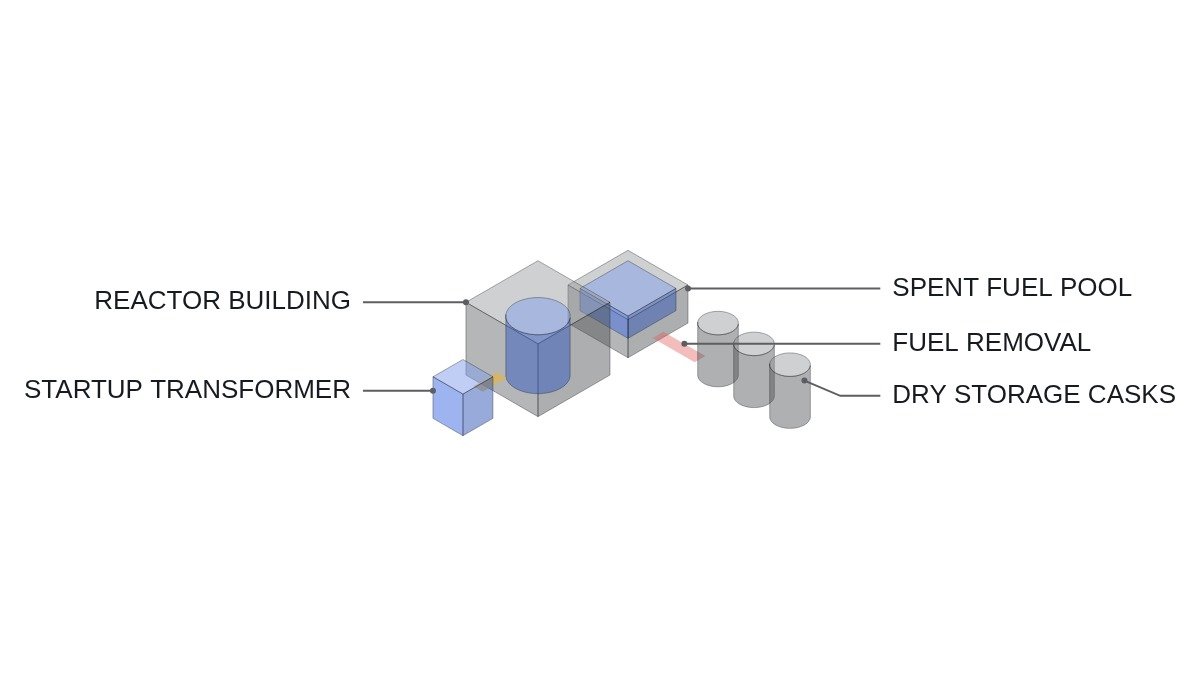
Viewed by an electrical engineer, the decommissioning schedule becomes clear. Even after permanent shutdown, as long as fuel is in the pool, pool cooling, the station and emergency power behind it, and radiation monitoring and security must all stay alive. With the generator stopped, station power must come from the grid through the startup transformer, and the power arrangement for safety-related loads must largely stay at operating standards.
Once all fuel is removed and the plant reaches a “fuel-free” state, things change. Pool cooling, the largest safety-related load, disappears, and emergency power requirements and monitoring scope can be cut substantially. The electrical system can be rebuilt around temporary power for dismantling work. So the real start of the decommissioning schedule is not the permanent shutdown date but the date fuel removal is complete, and removal depends on securing dry storage or interim storage.
| Stage | Electrical system state | Key constraint |
|---|---|---|
| Right after shutdown | Fed via startup transformer, safety loads kept | Continuity of pool cooling |
| During fuel removal | Pool cooling and crane power kept | Destination (dry storage) secured |
| Fuel-free state | Safety loads reduced, temporary power | Licensing of system reconfiguration |
| Full dismantling | Temporary power by work area | Waste disposal route |
What this table shows is that the point at which the electrical system can shrink is the point at which decommissioning costs start to fall. As long as fuel stays in the pool, near-operating maintenance costs continue, so under either strategy the fuel removal plan must come first.
If deferral is chosen, the electrical loads left during the care period after the fuel-free state are roughly ventilation, radiation monitoring, fire detection, security, and drainage. The loads are small but must be kept for decades, so equipment aging becomes a new management item. Incoming power equipment and monitoring instruments go through several replacement cycles over that period, and with each replacement fewer people remain who know the original design intent. Leaving these replacement and document-management costs out of deferred care costs tilts the comparison with immediate dismantling.
Decision sequence
- Confirm when a destination for spent fuel (on-site dry storage or an off-site facility) will be available. That date is the real start of the decommissioning schedule.
- Estimate the power arrangement and maintenance cost while pool cooling is kept.
- Check whether the radioactive waste disposal route is settled. If not, waste will pile up on site even under immediate dismantling.
- Confirm that operating staff and plant documents can be transferred to the decommissioning organization.
- Compare the urgency of site reuse plans with long-term care costs.
Items to verify
- Decommissioning cost and duration for a given plant depend on its decommissioning plan and license conditions, so no figures are given here.
- Activation nuclide composition by reactor structure depends on operating history and material composition and must be confirmed by characterization results.
Boundary conditions
The advantage of immediate dismantling flips under two conditions. First, when no radioactive waste repository is secured and there is nowhere to send dismantling waste; rushing dismantling then only brings forward the burden of storing waste on site. Second, when other units on the same site keep operating, so the benefit of site reuse is small and the existing operating organization can also handle care.
Conversely, deferral’s advantage collapses when regulatory standards tighten during the long care period, or when plant documents and staff memory are lost so that survey and characterization costs at dismantling time rise sharply. What shrinks substantially while waiting is the activity of relatively short-lived nuclides such as Co-60; what grows is the age of the equipment under care and the gaps in the record. For a plant whose operating history and maintenance records were not transferred systematically, the decommissioning organization decades later will have to survey the plant from scratch.
The single selection criterion: if both a spent fuel destination and a waste disposal route are secured, immediate dismantling wins; if either is uncertain, a deferred strategy that keeps the plant in a safe care state until they are secured wins.