The conclusion first. Shortening planned outages or extending the fuel cycle are the usual answers for raising nuclear capacity factor, but when you run the numbers, the effect of a longer cycle is smaller than expected, and cutting unplanned shutdowns and outage overruns competes at the same scale. Extending the cycle from 12 to 18 months while outage days also rise changes time availability by only about 1 percentage point, and losing a week to one trip in an 18-month cycle wipes out much of that gain. For a plant whose fuel and equipment conditions support it, cycle extension wins. For a plant with no slack in outage schedule control and equipment reliability, keeping the cycle and reducing unplanned shutdowns wins.
Where it wins, where it doesn’t
Start with the current conditions. A light water reactor must replace part of its fuel every cycle, and the plant shuts down and performs its planned outage at the same time. Inspection, testing, and maintenance items that can only be done with the reactor shut down pile into this period, and the regulator’s periodic inspection follows the same schedule. Outage length is therefore set by the critical path of a schedule that tangles refueling, reactor head work, safety system testing, and major electrical equipment inspection.
Extending the cycle reduces the number of shutdowns and so reduces annual outage days. In return, one cycle must deliver more energy, so the enrichment of the reload or the number of fresh assemblies rises, and near end of cycle, reactivity margin shrinks and there may be a coastdown period of gradually reducing power. The longer interval between shutdowns also raises the demands on surveillance and testing performed during operation and on component reliability.
The connecting logic: capacity factor is a ratio of outage days to cycle length, and extending the cycle enlarges the denominator while also increasing the work in each outage, which enlarges the numerator. What finally sets capacity factor is less the cycle length itself than control of the outage critical path and the frequency of unplanned shutdowns during the cycle.
Time availability by cycle
Time availability is approximated as (cycle days − outage days − unplanned outage days) ÷ cycle days. Capacity factor multiplies this by the average power ratio, so it is lower if there is end-of-cycle coastdown. The values below are assumptions to show the calculation structure, not any plant’s actual record.
| Cycle (assumed) | Outage days (assumed) | Time availability |
|---|---|---|
| 12 months (365 days) | 30 days | About 91.8% |
| 18 months (548 days) | 40 days | About 92.7% |
| 24 months (730 days) | 45 days | About 93.8% |
The takeaway: stretching the cycle by half moves availability by only about 1 percentage point if outage days rise with it. In the same 18-month cycle, cutting the outage by 10 days moves it about 1.8 points, and losing 7 days to an unplanned shutdown moves it about 1.3 points. One step of cycle extension competes at the same scale as outage schedule control and trip prevention. Add end-of-cycle coastdown and the long cycle’s advantage shrinks once more on a capacity factor basis.
Electrical equipment sets the outage window
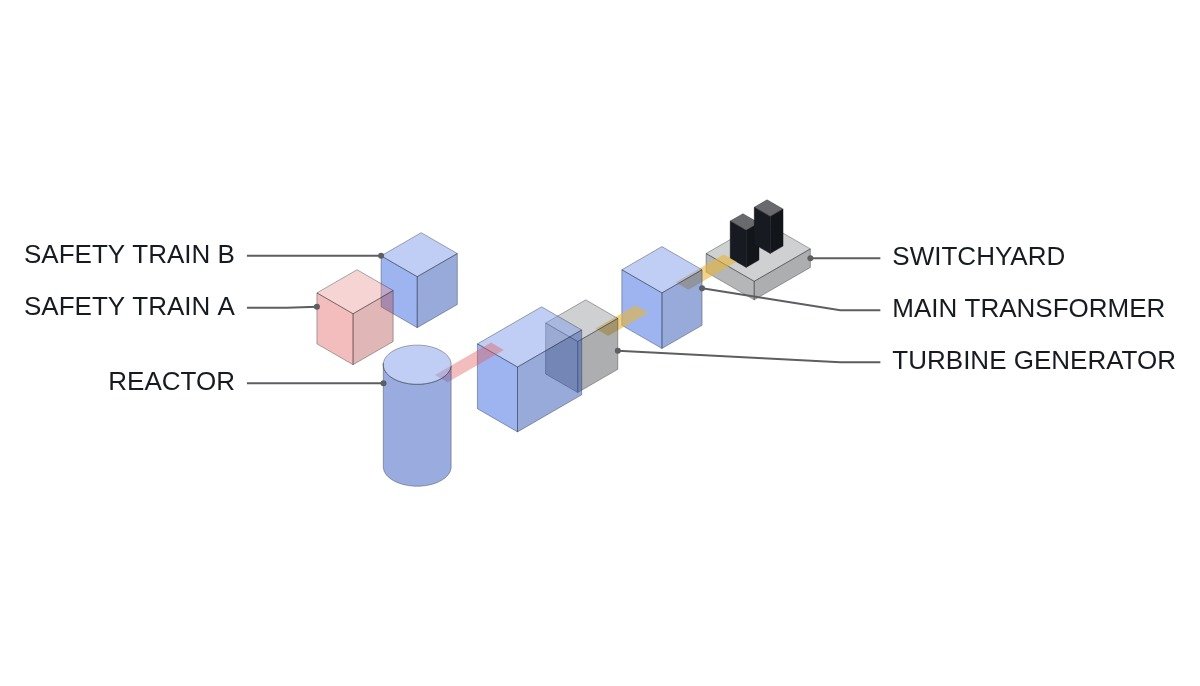
From an electrical engineer’s view, electrical equipment often shows up on the outage critical path. Equipment configured as a single path, such as the main transformer, generator breaker, and main generator, cannot be maintained during operation. Unless spares exist, detailed inspection is possible only during outages, and the longer the cycle, the longer the inspection interval.
Safety system components configured in multiple trains, on the other hand, can be maintained one train at a time during operation within what the technical specifications allow. This reduces outage workload, but while a train is out for maintenance the plant operates under the time constraint of an allowed outage time. Increasing on-line maintenance is an exchange that turns outage days into an on-line risk management burden, and the exchange rate is set by system configuration and regulatory requirements.
| Maintenance target | On-line maintenance | Effect of longer cycle |
|---|---|---|
| Refueling, reactor head | Not possible | More work per outage |
| Main transformer, generator | Not possible if single path | Longer interval, needs stronger condition monitoring |
| Multi-train safety systems | Possible within limits | Larger share done on-line |
| Instrument channels | Possible under bypass conditions | On-line test design matters |
What this table shows is that the real constraint on cycle extension lies less in fuel than in “single-path equipment that cannot be maintained on-line.” Without a condition monitoring system for equipment such as the main transformer (dissolved gas analysis, partial discharge monitoring, and the like), extending the inspection interval itself raises the risk of an unplanned shutdown.
Practical items for reducing unplanned shutdowns
Causes of unplanned nuclear shutdowns are not confined to reactor systems. Factors on the turbine-generator, main transformer, station power, and transmission side also lead to plant shutdowns. Events such as unnecessary operation of generator protection relays, misoperation of transformer protection elements, or propagation of grid-side faults cut availability regardless of reactor safety. One such trip can cancel out one step of cycle extension, as the calculation above shows.
So a capacity factor improvement list should put items such as review of protection relay settings, checking whether trip logic depends on a single signal, and building transformer condition monitoring ahead of fuel design. Stretches of trip logic that depend on one sensor’s signal will shut the plant on that sensor’s failure alone, so check redundancy and coincidence logic first. Whether a given trip was caused by noise or a momentary voltage disturbance should not be assumed; it requires waveform analysis and field measurement of the recorded data.
Decision sequence
- Extract critical-path items from outage records over the last several cycles. Separate refueling, electrical equipment, and inspection waiting.
- Classify unplanned shutdown history by cause and estimate average days lost per cycle.
- Confirm the fuel design changes and licensing scope needed for cycle extension.
- Assess whether the condition monitoring level of single-path electrical equipment can support longer inspection intervals.
- Compare the effect of cycle extension against outage shortening and unplanned shutdown reduction using the same formula, and set investment priorities.
Items to verify
- Actual cycle length, outage days, and capacity factor for a given plant must be taken from the operator’s disclosures; the table here uses assumptions.
- The allowed scope of on-line maintenance and allowed outage times follow each plant’s technical specifications.
Boundary conditions
The advantage of cycle extension flips under two conditions. First, when condition monitoring for single-path electrical equipment or large components is weak, so a longer inspection interval leads directly to unplanned shutdown risk. Second, when the grid strongly requires nuclear outages to be spread out, and a longer cycle makes outages of several units overlap.
Conversely, the advantage of keeping the current cycle weakens at a plant whose outage schedule is already well optimized with little room to cut, and whose fuel design and condition monitoring can support a longer cycle.
The single selection criterion: cycle extension wins only when the availability gain from extending the cycle is larger than what the same investment could gain from shorter outages and fewer unplanned shutdowns.