The conclusion first. The difference between a pressurized heavy water reactor (CANDU) and a light water reactor is usually explained as “natural uranium versus enriched uranium,” but the heavier difference for operating decisions is whether refueling is a shutdown job or a routine on-line job. CANDU eliminates refueling outages through on-power refueling, but it must run an active machine, the fueling machine, every day and it produces more spent fuel per unit of energy. A light water reactor stops at fixed intervals to reload fuel in batches, but carries no on-line fuel-handling burden. If reducing dependence on enrichment services comes first, CANDU wins. If reducing spent fuel storage burden and tritium management comes first, the light water reactor wins.
Where it wins, where it doesn’t
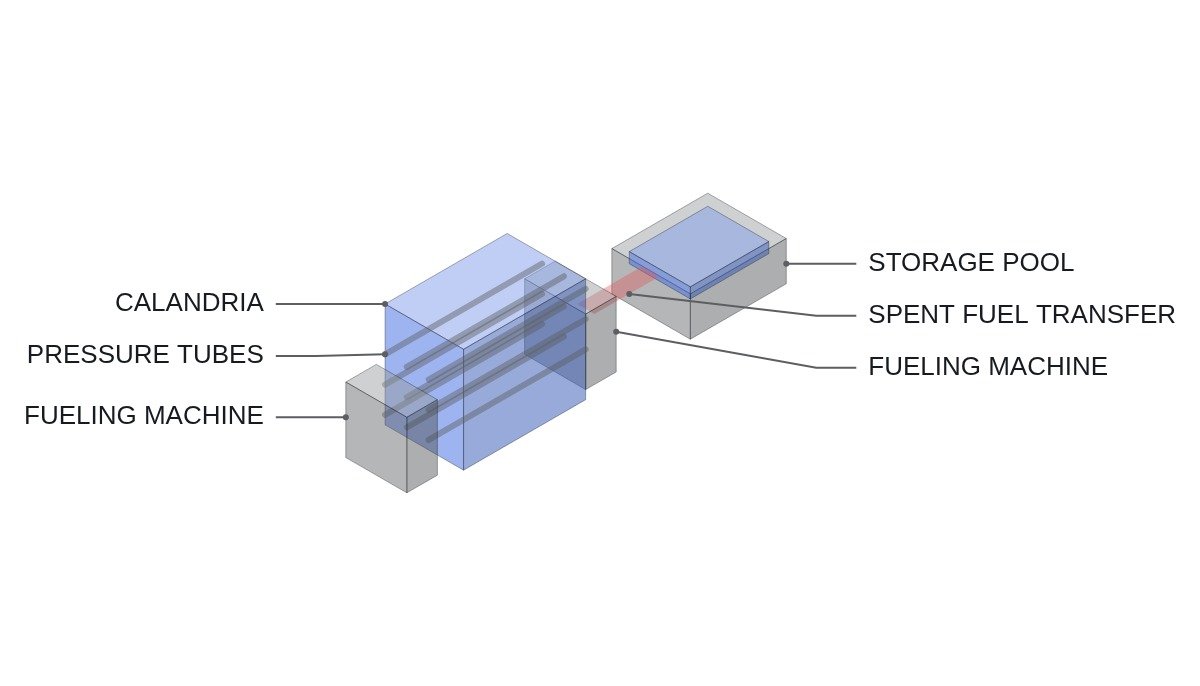
Start with the current conditions. Because light water absorbs some neutrons, a light water reactor needs low-enriched fuel with a higher U-235 fraction. CANDU uses heavy water, which absorbs few neutrons, as moderator and can stay critical on natural uranium (about 0.7% U-235). The price is securing and managing heavy water, plus a distinctive structure: a calandria holding the moderator and several hundred horizontal pressure tubes.
Adopting CANDU changes the fuel supply chain and the operating mode. With no enrichment step, dependence on enrichment services drops out of fuel supply. Fuel bundles are short and simple, which makes manufacturing comparatively easy. Fueling machines attach to both ends of a pressure tube to push fresh bundles in and take spent ones out during operation, so no refueling outage is needed. On the other hand, lower burnup means more spent fuel bundles for the same electricity, and neutron absorption in heavy water produces tritium, which requires dedicated systems and procedures.
The connecting logic is this. In a light water reactor, refueling is bundled with the planned outage, so fuel issues show up as outage length. In CANDU, refueling is a repeated on-line task, so fuel issues show up as fueling machine availability. If the fueling machine stops, the margin for managing core reactivity shrinks, and a prolonged stoppage affects output. A problem of managing outage duration becomes a problem of managing continuous equipment reliability.
Fuel and operating characteristics
| Item | CANDU | LWR (PWR) |
|---|---|---|
| Fuel | Natural uranium | Low-enriched uranium |
| Moderator | Heavy water (low-pressure calandria) | Light water (also coolant) |
| Pressure boundary | Many horizontal pressure tubes | Single reactor pressure vessel |
| Refueling | Continuous, on-power | Batch, after shutdown |
| Shutdown means | Two independent shutdown systems | Control rods + boron injection |
| Spent fuel generated | More per unit energy | Less per unit energy |
| Tritium | Produced in heavy water, managed | Comparatively low |
| Major life-management job | Pressure tube replacement | Steam generator replacement, etc. |
The rows an operator should read first are “Refueling” and “Spent fuel generated.” CANDU gains by eliminating refueling outages and pays for it with storage burden at the back end of the plant. If storage space fills first, CANDU’s operating advantage returns as a site-level constraint.
What the shutdown system layout says about design philosophy
CANDU has a positive void coefficient of reactivity: when coolant voiding increases, reactivity rises. To compensate, it carries two independent shutdown systems working on different principles. One drops shutoff rods; the other injects a neutron-absorbing solution directly into the moderator. The principle is that the two systems share no detectors, logic, or actuators.
From an electrical and control engineer’s view, the meaning is clear. Diversity and independence are secured at the system level, so when adding instrument channels or migrating to digital I&C, the first check is that the two systems cannot be disabled together by a common cause. If the two systems end up sharing power, communications, or a software platform, the design intent collapses. Light water reactors also follow redundancy and diversity principles, but in CANDU the shutdown means themselves are two physically different systems, which stands out.
What the grid operator and the site manager each see
To a grid operator, a light water reactor is a large unit that leaves the grid for a period every fuel cycle. Because outage dates are fixed in advance they are easy to include in reserve planning, but outages of multiple units on the same site must be staggered. CANDU has no refueling outages, which removes one coordination item. CANDU still needs planned outages for equipment inspection, so it is more accurate to say refueling disappears from the list of outage reasons than to say outages disappear.
To the site manager, the story runs the other way. In Korea, the Wolsong site, home to the CANDU units, has operated on-site dry storage from a comparatively early stage. Replacing low-burnup fuel every day fills the pool first, and licensing and siting of the next step, dry storage, becomes a precondition for running the plant. An operating advantage inside the plant is transferred to a storage problem outside it.
Putting both views in one table sharpens the decision. The grid-side gain is roughly one fewer outage coordination item; the site-side burden is the long-term task of licensing and expanding storage. Because the gain and the burden land on different organizations, a reactor-type comparison must put both organizations’ costs on the same ledger to avoid distortion.
Decision sequence
- Confirm whether reducing dependence on enrichment services is a core goal of the fuel strategy. If not, CANDU’s biggest advantage drops out.
- Look at the site’s spent fuel storage capacity and room to expand dry storage. CANDU carries a heavier burden here.
- Confirm maintenance capability for continuously operating machinery such as fueling machines. The benefit of on-power refueling holds only if fueling machine availability supports it.
- Check that tritium management systems and release control procedures can be operated.
- Include in life planning the possibility of large mid-life work such as pressure tube replacement.
Items to verify
- Specific figures for burnup, capacity factor, and generation cost by design depend on design version and operating history, so none are given here.
- Pressure tube replacement interval and duration must be judged from each plant’s degradation assessment.
Boundary conditions
CANDU’s advantage flips under three conditions. First, if enrichment services are stable and prices vary little, the benefit of natural uranium weakens. Second, if spent fuel storage space is the site’s top constraint, CANDU, with more spent fuel per unit energy, is at a disadvantage. Third, if fueling machine maintenance capability is thin, the benefit of on-power refueling turns into equipment failure risk.
Conversely, the light water reactor’s advantage weakens when planned outages tied to refueling cut deeply into capacity factor, and when dependence on a particular stage of the fuel supply chain is assessed as a strategic risk.
The single selection criterion: if the operating time gained by eliminating refueling outages exceeds the combined burden of added spent fuel storage and continuous fueling machine maintenance, CANDU wins; if it is smaller, the light water reactor wins.