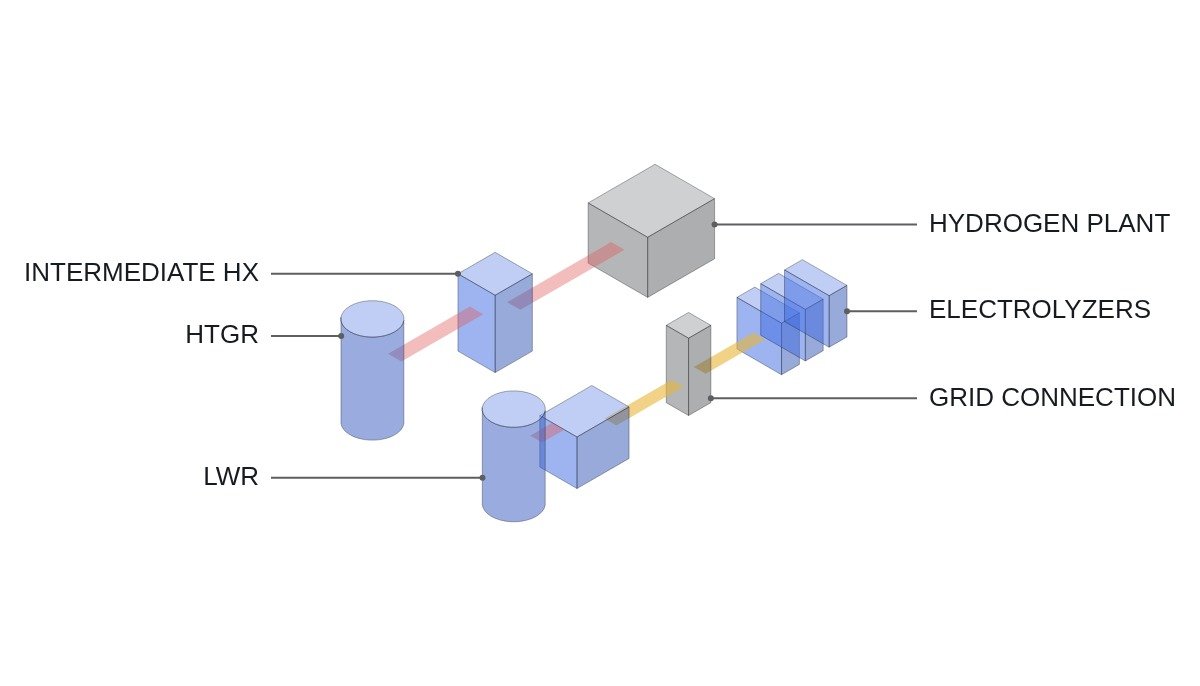
The conclusion first. There are three broad routes to making hydrogen with nuclear energy, and what separates them is less the efficiency figure than how tightly the reactor and the hydrogen plant are coupled. Running low-temperature electrolysis on light water reactor electricity has the lowest efficiency, but the reactor and the hydrogen plant are connected only through the grid and operate independently. Using high-temperature gas-cooled reactor (HTGR) heat for high-temperature electrolysis or a thermochemical cycle cuts electricity conversion losses and raises theoretical efficiency, but it becomes coupled operation in which a hydrogen plant trip turns into a reactor transient. To start quickly with proven equipment, LWR electrolysis wins. If large-scale continuous production is secured for the long term and coupled-operation licensing can be handled, the HTGR route wins.
Where it wins, where it doesn’t
Start with the current conditions. The energy needed to split water into hydrogen and oxygen can be supplied as a combination of electricity and heat. The higher the temperature, the larger the share that heat can cover and the smaller the electricity share. A reactor is fundamentally a heat source, so the more heat is used directly, the more of the heat-to-electricity conversion loss is skipped.
Route by route, here is what changes. The first route runs alkaline or polymer electrolyte membrane (PEM) electrolysis on LWR electricity. It uses the existing plant as-is and only adds electrolyzers, so it has the highest technology readiness. The second is high-temperature steam electrolysis (SOEC): supplying high-temperature steam reduces the electricity needed for the same hydrogen. The third is a thermochemical cycle such as sulfur-iodine (SI), which aims to split water with high-temperature heat alone. The sulfuric acid decomposition step of the SI cycle, however, needs temperatures above 800°C, which is impossible with an LWR and presupposes a helium-cooled HTGR.
The connecting logic: the more heat you use, the higher the efficiency, but reactor outlet heat must go directly to the hydrogen plant, which puts an intermediate heat exchanger and heat transport loop between the two. That loop starts behaving like part of the reactor’s cooling system, and when the hydrogen plant stops, the reactor loses a heat sink. It is a structure that trades operating independence of the two plants for efficiency.
Route comparison
| Item | LWR + low-temp electrolysis | High-temp steam electrolysis | HTGR + thermochemical |
|---|---|---|---|
| Reactor requirement | Existing LWR | High-temp steam source | HTGR required |
| Energy form | Mostly electricity | Electricity + high-temp heat | Mostly high-temp heat |
| Reactor-hydrogen coupling | Separated by the grid | Partly coupled via heat | Tightly coupled heat loop |
| Technology readiness | Commercial equipment | Demonstration stage | Research/demonstration |
| Operating flexibility | Electrolyzer ramps alone | Limited | Continuous operation assumed |
How to read it: moving left to right, efficiency potential rises while operating independence and technology readiness fall. Which column to choose comes down to which of those two risks the operator can carry.
Efficiency calculation structure
Reactor heat consumption for the electrolysis route is a multiplication. The higher heating value (HHV) of 1 kg of hydrogen is about 39.4 kWh. Reactor heat per kilogram is 39.4 ÷ (generation efficiency × electrolysis efficiency).
Assumptions: LWR generation efficiency 33%, electrolysis efficiency 70% on an HHV basis (illustrative). Then 39.4 ÷ (0.33 × 0.70) ≈ 170.6 kWh(thermal)/kg. If the generation-efficiency term can be removed or reduced in the same formula, meaning part of the required energy is covered directly by reactor heat, the denominator grows and heat consumption falls. That denominator is exactly where the high-temperature routes gain. Real efficiency must include heat transport loss, auxiliary power, and the share of part-load operation, so it must be derived from a plant-level heat and mass balance.
| Condition | Favored route | Reason |
|---|---|---|
| Fast demo, proven equipment | LWR + low-temp electrolysis | Commercial components |
| Absorbing surplus power | LWR + low-temp electrolysis | Electrolyzer ramps alone |
| Large continuous output | High-temp routes | Direct use of heat |
| Process heat supplied too | HTGR | Multi-use high-temp heat |
| Simpler licensing | LWR + low-temp electrolysis | Minimal plant design change |
The takeaway: most “fast and simple” conditions point to low-temperature electrolysis; the high-temperature routes become an option only when “large-scale and continuous” is certain.
Electrolysis as a load-following tool
From the grid’s perspective, the low-temperature route has a value that the efficiency table does not show. If the reactor runs flat at rated power and the electrolyzers take electricity and convert it to hydrogen during low-demand hours, only the plant’s net sent-out power moves. It amounts to near-load-following operation without adjusting reactor power directly.
In this configuration, the electrolyzer plant becomes a large variable load. Rectifier energizing and tripping sequence, ramp-rate limits, and protection coordination between station auxiliary power and the grid connection point become new design items. The first condition is to electrically separate the plant’s safety-related buses from the bus feeding the electrolyzers so that an electrolyzer-side fault cannot propagate into safety-related power. The high-temperature heat-loop route, by contrast, ties reactor thermal output itself to hydrogen plant operation, so this kind of output decoupling is hard. Counting operating flexibility as value, the low-temperature route’s advantage is larger than the efficiency table suggests.
What to check first in coupled operation
- Confirm the reactor heat removal path when the hydrogen plant trips. For a heat-loop route, the design must include a separate path that removes reactor heat regardless of hydrogen plant status.
- Evaluate separation distance between reactor and hydrogen plant and the consequence zone of a flammable gas release. An accident on the hydrogen side must not affect reactor safety systems.
- For the electrolysis route, review the power quality impact of electrolyzer rectifiers. The effect of harmonics from large rectifier loads on station power requires waveform analysis and field measurement.
- Confirm the continuity of hydrogen demand. If demand is intermittent, the advantage of a tightly coupled route disappears.
Items to verify
- Commercial-scale efficiency and durability of SOEC and thermochemical cycles depend on demonstration results, so no figures are given here.
- Licensing criteria for coupled reactor-hydrogen facilities are still being established by regulators and must be checked case by case.
Boundary conditions
The advantage of the low-temperature electrolysis route flips under two conditions. First, when large-scale hydrogen demand is locked in year-round without interruption and the efficiency gap widens into a large cumulative fuel cost gap. Second, when high-temperature heat has value of its own, as in an industrial complex that needs process heat alongside hydrogen. Then there is a reason to accept the complexity of coupled operation.
Conversely, the high-temperature route’s advantage collapses when hydrogen demand is intermittent, or when uncertainty in coupled-operation licensing shakes the whole project schedule. Efficiency gains accumulate only while the plant runs continuously.
The single selection criterion: if you cannot give up the condition that a hydrogen plant stoppage must not affect reactor operation, LWR electrolysis wins; if the design resolves that condition and continuous large-scale demand is secured, the HTGR route wins.