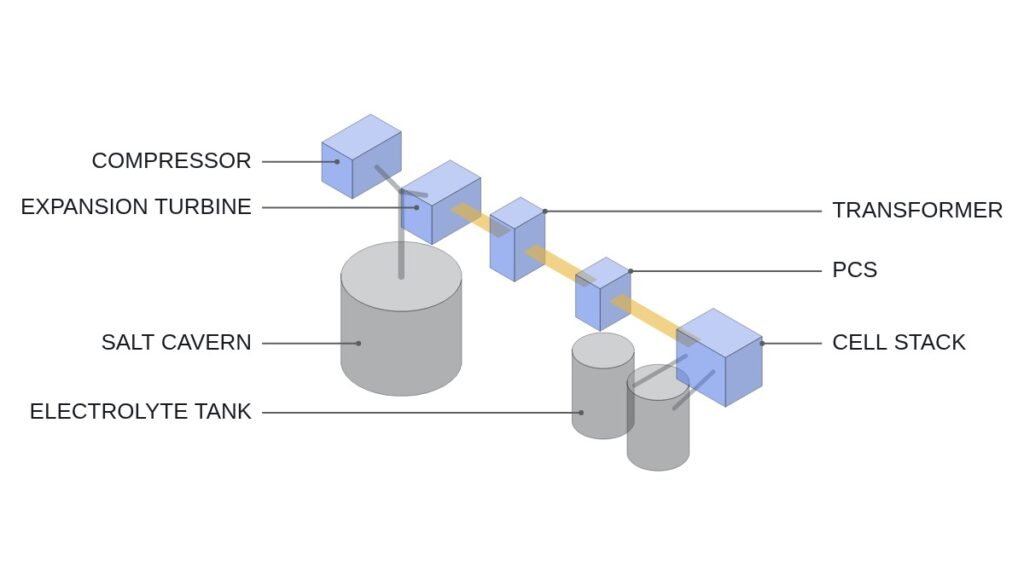
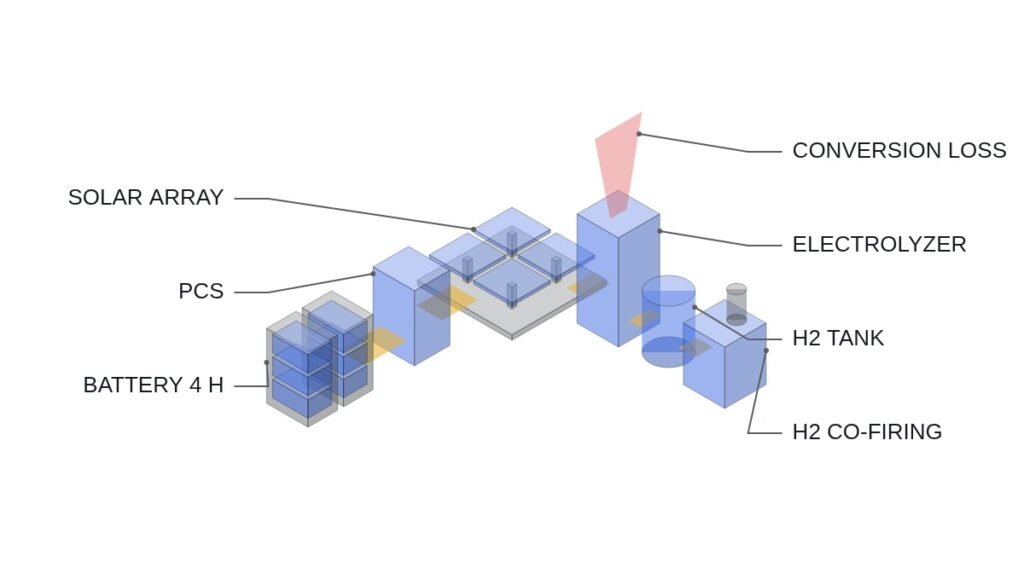
Even for the same “1 kWh of storage capacity,” secondary batteries, hydrogen, and pumped hydro have completely different cost structures. Viewed through the lens of storage duration, which option wins becomes clear.
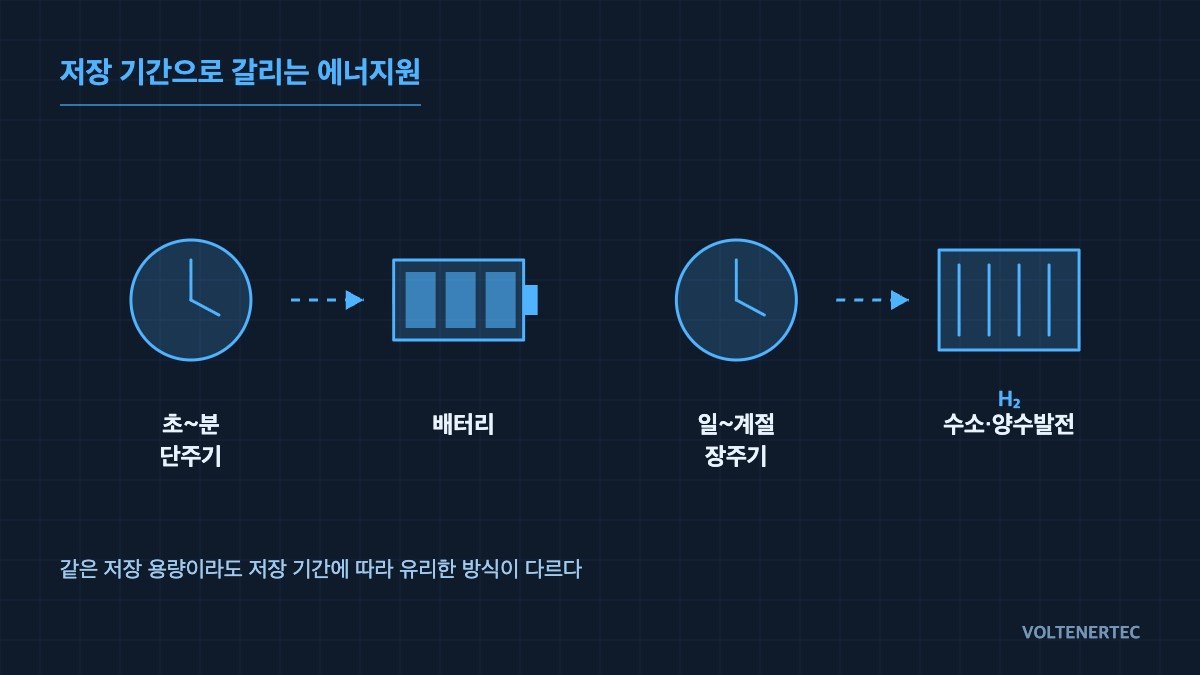
Comparison by Storage Duration
| Storage Duration | Favorable Option | Reason |
|---|---|---|
| Seconds to minutes (frequency regulation) | Secondary batteries | Overwhelmingly fast response speed |
| Hourly (daily peak response) | Secondary batteries, pumped hydro | Both are sufficiently fast and cost-effective |
| Days to seasonal | Hydrogen, pumped hydro | Battery cell cost accumulates in proportion to storage duration |
Takeaway: the lines in this table mark differences in cost structure by storage duration, not a ranking of technologies. Even with the same capacity figure, no comparison holds until it is fixed how many hours the storage must last.
The Key Question Is “How Long Must It Be Stored?”
The shorter the storage duration, the more batteries win; the longer it gets, options like hydrogen or pumped hydro take the cost advantage. Asking “which storage technology is best” without this criterion is a question that doesn’t even hold up.
Summary
Comparing energy sources only makes sense once storage duration is set as the axis. Determining the storage duration that fits the application comes first.
Translating Storage Duration into Equipment Specifications
In equipment terms, storage duration is storage capacity (kWh) divided by rated power (kW). The comparison between storage methods can therefore be restated as: can the power equipment and the storage medium be scaled separately? A battery system can size its PCS separately, but extending duration still means adding cells one for one. Pumped hydro assigns power to the turbine-generator and capacity to the reservoir. Hydrogen assigns power to the fuel cell or generating plant and capacity to the storage tanks. The more power and capacity are decoupled, the lower the added cost of extending duration.
Conversely, at short durations the conversion equipment and response speed, not the storage medium, dominate cost and performance. That is why batteries lead where second-level response is needed, as in frequency regulation.
A common mistake in the field is matching capacity (kWh) without checking power (kW). With the same capacity, too little rated power cannot deliver what is needed when it is needed, and too much power shortens the storage duration so it no longer fits the application. Always state both values together in the specification and first confirm that their ratio matches the target storage duration.
Where Each Wins, Where Each Struggles
- Secondary batteries — Current condition: frequent charge/discharge on short cycles is required. → After applying: fast response absorbs swings and the equipment is used often. → Link: the more often it is used, the more often the cell investment is recovered. When longer duration lowers usage frequency, this logic breaks down.
- Pumped hydro — Current condition: large amounts of energy must be shifted over a day to several days, and suitable terrain exists. → After applying: duration is extended with reservoir volume. → Link: capacity expansion attaches to civil works, lowering unit storage cost. Without terrain, the option disappears entirely.
- Hydrogen — Current condition: energy must be shifted across seasons. → After applying: hydrogen made from surplus power is stored and converted back to electricity when needed. → Link: longer duration only adds tank cost, which favors it, but electricity-to-hydrogen-to-electricity conversion losses are large, so it does not suit frequent use.
Character Comparison of Storage Methods
| Item | Secondary battery | Pumped hydro | Hydrogen |
|---|---|---|---|
| Power/capacity decoupling | Partial (PCS only) | Decoupled (generator, reservoir) | Decoupled (conversion, tanks) |
| Response speed | Very fast | Fairly fast | Depends on conversion equipment |
| Round-trip efficiency | Relatively high | Moderate | Relatively low |
| Siting constraints | Small | Large | Moderate |
| Suited usage frequency | High | Moderate | Low |
Takeaway: as storage duration grows, usage frequency falls, so capacity expansion cost rather than efficiency drives the choice. For short storage it is the reverse: efficiency and response dominate.
Selection Order
- Define the application first: frequency regulation, daily peak response, or long-term energy shifting.
- Size the required rated power and duration from load data (item to verify).
- Estimate the expected charge/discharge frequency. The higher it is, the more efficiency and cycle life matter; the lower it is, the more capacity cost matters.
- Check siting conditions: terrain, safety distances, and whether hydrogen can be supplied and stored.
- If several durations are mixed, also consider splitting them between short-duration and long-duration equipment.
- After selection, state rated power and capacity together in the specification and verify that their ratio matches the target storage duration.
Boundary Conditions
There are conditions where the storage-duration criterion does not hold as is. Pumped hydro drops out regardless of duration when there is no terrain. Hydrogen has no cost advantage even for long durations unless the supply chain and storage safety equipment are in place. Batteries can regain competitiveness on efficiency even in long-duration applications if actual usage frequency turns out higher than expected. Storage duration is the first axis; usage frequency and siting are the second axis that can overturn the judgment.
Single selection criterion: fix the required storage duration (capacity ÷ power) first, then choose the method with the lowest capacity expansion cost at that duration.
Related reading (Korean) — Energy Selection Criteria Seen Through LCOE Comparison by Generation Source