To state the conclusion first: with the very same modules, rooftop solar is equipment that cuts the electricity bill, while ground-mount solar is equipment that sells power. Rooftop value is proportional to the share of generation the building consumes itself (the self-consumption ratio); ground-mount value depends on sales terms and on land and grid-connection conditions. Each also carries one hidden variable: remaining roof life for rooftop, connection queues and curtailment for ground-mount. Which one wins can only be judged after looking at the load and the roof, not the equipment.
Where It Wins, Where It Doesn’t
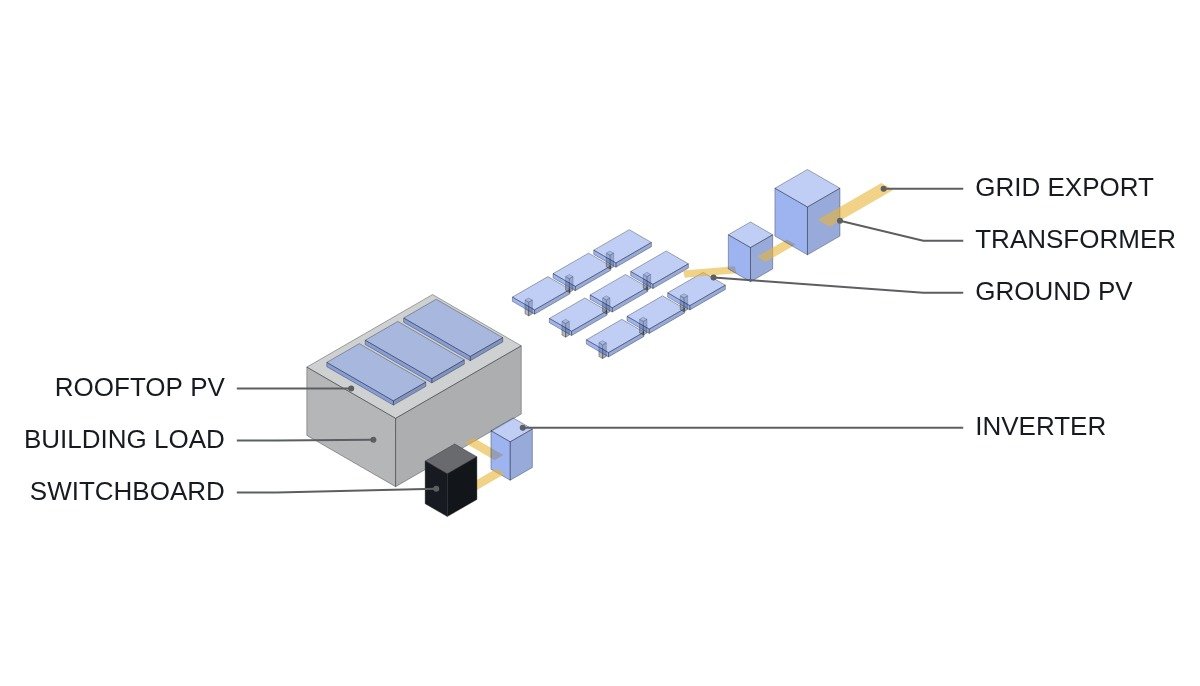
Under current conditions, the roof of a factory or warehouse is unused area. The building already has its service entrance equipment, so the array can tie into the in-plant switchboard without buying land or running long lines. Every kWh generated and consumed on site is a kWh not purchased from the utility.
Applying rooftop solar changes things in two directions. At a site whose daytime load absorbs the output, each generated kWh displaces a purchased kWh, so its value is set at the retail tariff level. If load is light during generating hours, surplus appears, and its value depends on how that surplus is handled: export, net metering, or sale.
Ground-mount works under different conditions. Land must be secured and a new grid connection obtained, but azimuth and tilt can be optimized and capacity can grow as far as the land allows. Value comes from the power sales price and certificate revenue.
The connecting logic is this. Rooftop is demand-side equipment, worth more the more it overlaps the building’s load curve; ground-mount is supply-side equipment, worth more the more the grid can accept its output. Because the yardsticks differ, comparing the two on installed cost per kW alone leads to the wrong decision.
| Item | Rooftop | Ground-mount |
|---|---|---|
| Land | Existing roof, no extra land | Land purchase or lease |
| Revenue model | Displaces purchased power | Power and certificate sales |
| Design limits | Roof azimuth, area, load review | Azimuth and tilt can be optimized |
| Grid connection | Uses on-site service equipment | New connection, possible queue |
| Fire and safety | DC wiring on building, rapid shutdown | Separate from buildings, easy access |
| Lifetime variable | Remaining roof life | Land contract term |
The rows that decide the matter are revenue model and lifetime variable. Rooftop depends on the building’s load and roof; ground-mount depends on the grid and the land contract. The real question is therefore which dependency is less risky.
Self-Consumption — How Weekends Erode Rooftop Value
What moves rooftop value most is the operating schedule. Assumption: generation is equal on every day of the week, the site runs five days a week in daytime only, and weekend load is small (lighting and HVAC standby). Then weekend generation is 2/7, about 28.6% of annual output, and most of it becomes surplus.
Add weekday lunch-break shutdowns, seasonal production cuts, and maintenance periods, and the surplus share climbs further. The first data to look at in a rooftop study is therefore not the available roof area but the utility meter’s interval data at 15-minute or 1-hour resolution. Overlay the expected generation curve on the metered load and the self-consumable energy falls out; that result sets the appropriate system size.
Roof azimuth should be reread from the same angle. For a sales-oriented plant, south-facing gives the most annual energy; for a self-consumption plant, splitting east- and west-facing surfaces can lower the midday peak and add morning and afternoon output, reducing surplus. Even with slightly lower total generation, if more purchased power is displaced, it is the better layout by rooftop logic. Which is better is decided only by calculating against the metered load above.
If the design does not export surplus, one more electrical condition applies. A reverse-power relay at the service point must limit or disconnect inverter output when reverse flow occurs, and generation available during those periods is discarded. The more the array is oversized relative to load, the larger this loss.
Additional Safety Conditions for Equipment on a Building
With rooftop systems, DC wiring runs in or on the building. Modules produce voltage whenever there is light, so even with the AC breaker open, voltage remains on the DC circuit between modules and inverter. The US NEC 690.12 requires rapid shutdown for PV systems on buildings, and NEC 690.11 covers DC arc-fault protection. Internationally, IEC 60364-7-712 covers electrical installation requirements for PV systems.
In practice, three things need checking: whether the means of lowering DC circuit voltage during firefighting is implemented in hardware, whether roof penetrations and cable routes compromise fire compartments, and whether module layout blocks firefighter access and smoke-venting paths. Structural review of roof loading and fixing methods is outside the scope of this article, but it is a precondition for whether installation is possible at all, so the structural engineer’s result should come first.
Ground-mount is separated from buildings, so these conditions are lighter. Instead, site conditions such as fencing, grounding, and drainage, plus protection coordination for the new connection equipment, come onto the checklist.
| Decision variable | Favors rooftop | Favors ground-mount |
|---|---|---|
| Daytime load | Absorbs most generation | Small daytime load |
| Operating schedule | 7 days a week, year-round | Frequent weekend or seasonal stops |
| Roof condition | Recently renewed, ample remaining life | Aging, replacement planned |
| Grid situation | Long queue for new connections | Connection headroom available |
| Required scale | Fits within roof area | Exceeds roof area |
Use this table as a row-by-row checklist. If the roof condition row points to ground-mount, hold the conclusion even if the other four rows point to rooftop. If roof replacement falls within the system’s operating life, the cost of removing and reinstalling modules plus the lost generation during that period cuts directly into the rooftop advantage.
Decision Sequence
- Obtain one year of metered load data at 1-hour resolution or finer.
- Overlay the expected generation curve for the available area and calculate self-consumable and surplus energy.
- Confirm remaining roof life and replacement plans, and compare them with the system’s operating life.
- Decide how surplus is handled (export, net metering, sale, or export prevention) and finalize the protection scheme at the service point.
- If required capacity exceeds roof area, study only the excess as ground-mount or external procurement.
Boundary Conditions
The rooftop advantage flips under three conditions. First, when remaining roof life is shorter than the system’s operating life. Second, when self-consumption is low, as at sites with weekend- or night-heavy load or frequent seasonal shutdowns; the rooftop array effectively becomes a small sales plant with only the design constraints that make it worse than ground-mount. Third, when the building’s use makes the fire risk of DC wiring hard to accept.
The ground-mount advantage flips in areas with long connection queues or frequent curtailment. Sales equipment has no value in hours when the grid will not take its output. There, a rooftop array tied to on-site load is comparatively less exposed to grid constraints.
The single decision criterion is this: if the building consumes more than half of the generation directly and the roof can outlast the system’s operating life, go rooftop; if either condition fails, make ground-mount the baseline.