To state the conclusion first: for a small generation business, small hydro and solar are entirely different equipment even at the same kW. Small hydro generates day and night as long as water flows, so it yields more energy per kW over wider hours, but sites are severely limited by head, flow, and river permits, and it needs standing operating staff for tasks such as clearing trash racks. Solar can be sited freely and built quickly, but its output is concentrated at midday and fully exposed to curtailment and midday price drops. The starting point of the decision is not the equipment but a flow duration curve built from long-term flow records.
Where It Wins, Where It Doesn’t
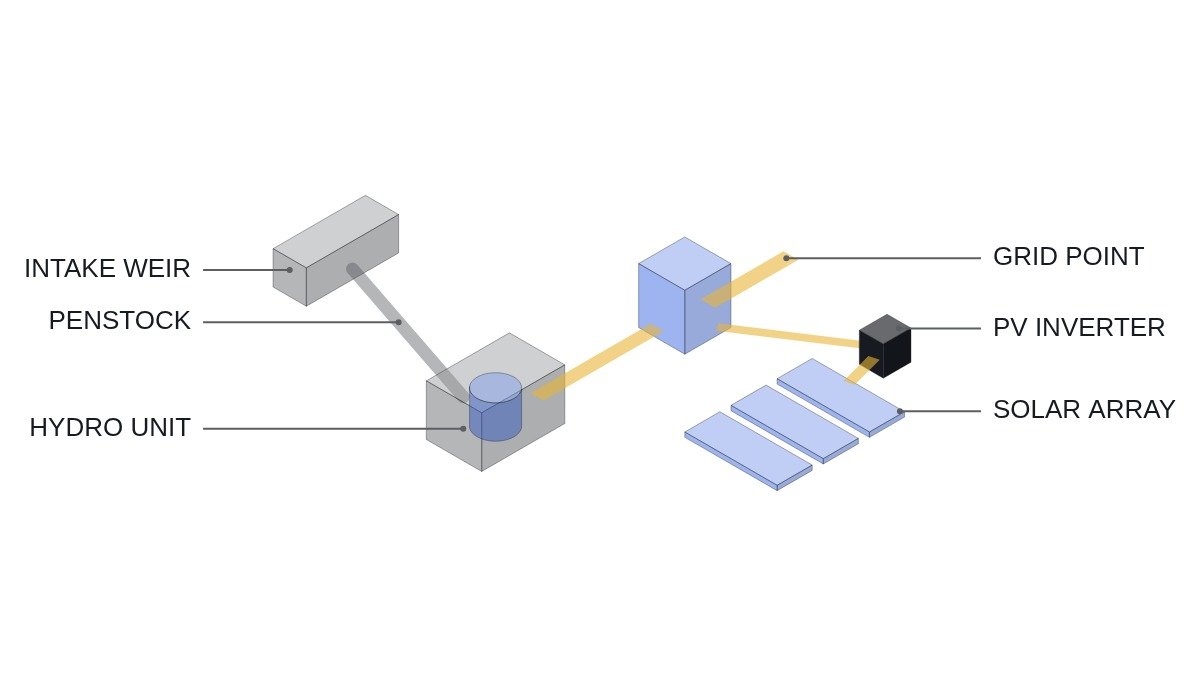
Under current conditions, solar is the default choice for small generators. Once land is secured, the module-and-inverter configuration is standardized, design and construction are short, and operation can be largely remote monitoring. But generation happens only while the sun is up, and every solar plant in the same area generates at the same time, so midday brings grid constraints and price drops together.
Apply small hydro and the generating hours change. During periods with adequate flow it also generates at night and in the early morning, supplying power in hours that do not overlap midday solar. The unit of variability changes too. Solar varies by minutes and days with clouds; run-of-river hydro varies by weeks and seasons with rainfall, which is comparatively easier to forecast.
The connecting logic is this. Small hydro’s value comes not from kW but from generating hours and when they occur. Compared against solar on installed capacity alone, small hydro is undervalued; compared without its site constraints and operating burden, it is overvalued. Both have to sit on the same table for the comparison to hold.
Small Hydro Output and the Design-Flow Trap
Hydro output is calculated as P = 9.8 × Q × H × η (kW), where Q is flow (m³/s), H is net head (m), and η is the combined turbine-generator efficiency. Assumption: Q = 0.5 m³/s, H = 8 m, η = 0.75. Then P = 9.8 × 0.5 × 8 × 0.75 = 29.4 kW. A 29.4 kW solar array delivers that output only for a few midday hours; small hydro delivers it continuously as long as flow holds.
The difference also shows up in grid connection capacity. To get the same annual energy (kWh), solar, with fewer generating hours, needs more installed capacity, and correspondingly more connection and transformer capacity. Where connection capacity is scarce, annual energy per kW of connection becomes the business metric, and on that metric small hydro with stable flow has a structural advantage.
The trap is that Q is not constant. In Korea, rainfall is concentrated in the summer monsoon and typhoon season, so seasonal swings in river flow are large. Set the design flow high and installed capacity grows but the period when that flow is available shortens; set it low and the plant runs longer each year but spills water in the wet season. The tool for striking this balance is the flow duration curve, daily flows sorted by magnitude and plotted against exceedance probability.
Another trap is the turbine’s minimum operating flow. Each turbine type holds its efficiency over a different flow range, and below a certain flow efficiency collapses or operation becomes impossible. If dry-season flow falls outside that range, calculated and actual energy diverge widely. For rivers with large flow swings, consider a type with a wide part-flow efficiency range or split the capacity across two turbines.
| Item | Small hydro (run-of-river) | Solar |
|---|---|---|
| Generating hours | 24 h when flow is available | Daylight only |
| Variability unit | Weeks, seasons (rainfall) | Minutes, days (clouds) |
| Siting | Limited to head/flow sites | Relatively free |
| Permitting | River occupancy, ecological impact | Development permit, setback rules |
| Construction | Includes civil works, long | Short |
| Operating burden | Constant trash and sediment management | Mostly remote monitoring |
| Grid characteristics | Rotating machine, overspeed protection | Inverter-based |
In short, small hydro leads on quality of generation (timing and predictability), and solar leads on speed of development and operating simplicity. For a small operator, staffing is as heavy a variable as capital cost, so anyone considering small hydro should first settle who will clear trash racks and do routine inspections.
What a Rotating Machine Means Electrically
Small hydro is rotating equipment, with a synchronous or induction generator coupled to the turbine. If a grid fault opens the breaker and load suddenly disappears, the turbine accelerates while still receiving the water’s energy. Preventing that overspeed requires a path to close the inlet valve or guide vanes, and that protection must be secured as a hardware path that works regardless of controller communication status. It is a protection item that solar inverters do not have.
An induction generator draws excitation current from the grid, so power factor correction is needed, and oversized correction capacitors can let voltage persist through self-excitation after the plant is separated from the grid. Anti-islanding is required for both technologies, but because of inertia a rotating machine shows frequency change more slowly than an inverter right after separation, so the detection conditions differ. Actual behavior requires waveform analysis and field measurement for each installation.
| Decision variable | Toward small hydro | Toward solar |
|---|---|---|
| Flow records | Long-term records available | None or short-term |
| Dry-season flow | Above minimum operating flow | Frequently below |
| Operating staff | Can be stationed nearby | Remote operation only |
| Midday curtailment | Frequent in the area | Rare in the area |
| Project horizon | Long-term operation | Fast start |
In this table the first two rows are not selection criteria but preconditions. Without long-term flow records, or with dry-season flow outside the turbine’s operating range, the business case cannot even be calculated, even if the other three rows all point to small hydro.
Decision Sequence
- Obtain long-term daily flow records for the candidate site and build the flow duration curve.
- Survey the achievable net head and calculate annual energy for each design-flow candidate.
- Confirm the period during which dry-season flow exceeds the minimum operating flow of each turbine type.
- Confirm permitting issues such as river occupancy and fish passage/ecological impact, and the time they require.
- Decide how trash clearing and routine inspection will be staffed and include it in operating costs.
- Compare, on the same basis, the energy and curtailment exposure of a solar plant built with the same land and budget.
Boundary Conditions
The small hydro advantage flips under three conditions. First, when flow records are short or missing and the flow duration curve cannot be trusted; the calculated energy is then only an estimate and cannot support a business decision. Second, on rivers with long dry seasons where the turbine sits below minimum operating flow for much of the year. Third, when operating staff cannot be kept near the site and trash-related shutdowns go unattended.
The solar advantage weakens on grids with frequent midday curtailment and high value for night and early-morning power. There, small hydro’s generating hours carry value that installed capacity does not show.
The single decision criterion is this: if the flow duration curve from long-term records stays above the turbine’s minimum operating flow for most of the year and on-site operating staff can be secured, choose small hydro; otherwise, choose solar.