To state the conclusion first: on wind conditions alone, offshore wind wins almost every time. Turbine output scales with the cube of wind speed, so even a small difference in mean wind speed opens a large gap in energy yield. Real siting decisions, however, are not settled by wind speed. They are settled by three things: the electrical distance to the grid connection point, the number of days a failed turbine can actually be reached, and the permitting issues. Onshore is easy to reach and connect but loses on wind resource and setback constraints; offshore has the better wind but gives availability back to subsea cables and weather.
Where It Wins, Where It Doesn’t
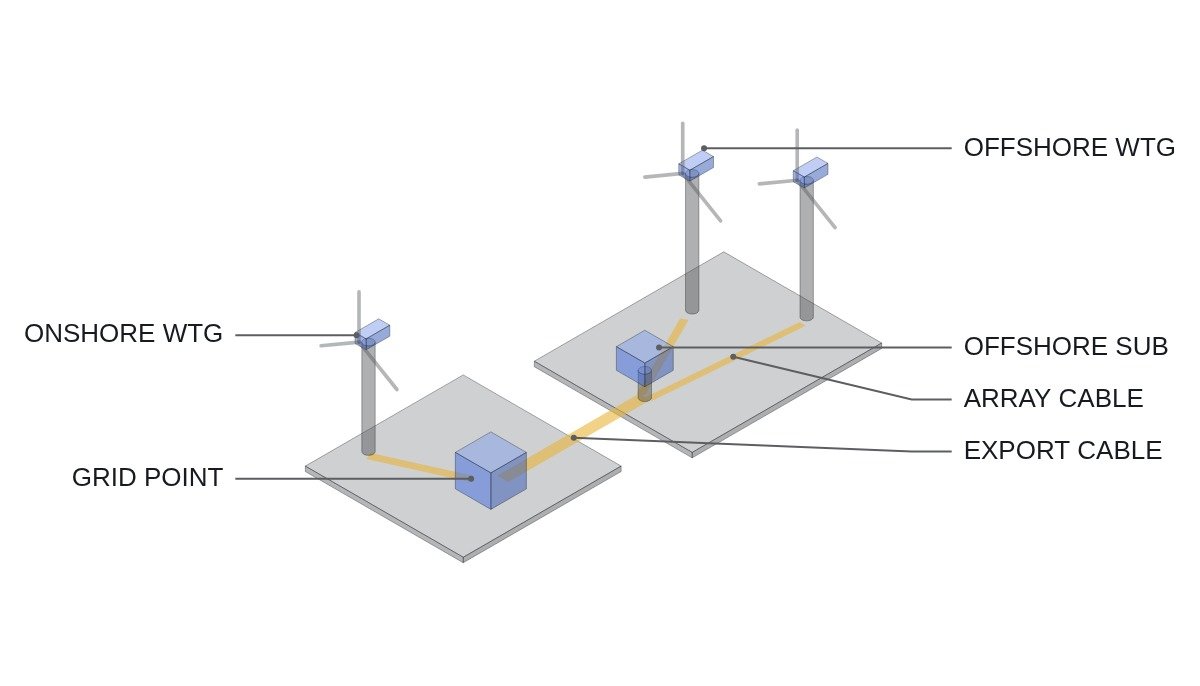
Start with the current condition. Onshore wind in Korea is mostly built on mountain ridges. Complex terrain generates turbulence, and blade transport routes, setback distances from homes, and noise complaints cap both the number of turbines and their size. In exchange, the plant simply ties into nearby distribution or transmission lines, so the electrical distance is short, and a failed turbine can be reached by truck the same day.
Move offshore and the conditions change. Water has low surface roughness, so wind speed at a given height is higher and turbulence is lower. Vessel transport allows large turbines laid out at wide spacing. On the other hand, subsea array cables, an offshore substation, and an export cable to shore become new requirements, and maintenance can only happen on days when wave height and wind speed allow it.
The connecting logic is this. The offshore wind-speed gain is a gain in generating hours; the access constraint is a loss in repair time. Only when both are converted to the same unit, annual energy (MWh), does the comparison hold. With the same failure rate, a longer wait for repair means a larger availability loss, and how much of the wind gain that loss cancels is the real substance of the siting decision.
The Wind-Speed Cube and Its Upper Limit
Turbine power is expressed as P = ½ × ρ × A × v³ × Cp, where ρ is air density, A is the rotor swept area, v is wind speed, and Cp is the power coefficient. Assumption: same turbine, same Cp, same air density. A 10% higher wind speed then gives 1.1³ = 1.331, or roughly 33% more power.
That calculation, however, holds only below rated wind speed. Above rated, pitch control clamps output at rated power, so higher wind no longer adds output. “A 10% difference in mean wind speed equals a 33% difference in yield” is therefore an upper bound, not an actual figure. The real difference is set by the share of time the wind distribution spends below rated speed, and that share is only known after measuring the site with a met mast or lidar.
Wind shear, the change of wind speed with height, also behaves differently at the two sites. Onshore, where surface roughness is high, wind speed climbs steeply with height, so raising hub height becomes the main lever for more energy, and tower transport and installation conditions come back as constraints. Over water, shear is small and good wind is available at comparatively lower heights; design effort shifts instead toward larger rotor diameters to increase swept area A.
This is the first decision point. Compare a high-wind onshore site that already spends much of its time near rated with an offshore site that has higher wind but a long above-rated tail, and the difference may be much smaller than the cube law suggests.
| Item | Onshore | Offshore |
|---|---|---|
| Wind resource | Terrain turbulence, high site variance | Low turbulence, higher speed |
| Turbine size | Capped by transport routes | Vessel transport eases scale-up |
| Grid connection | Nearby line, short distance | Subsea cable and offshore substation |
| Maintenance | Road access, any time | Depends on wave/wind limits |
| Permitting issues | Setback, noise, forest | Fisheries, shipping lanes, marine environment |
| Single point of failure | Individual turbine | Offshore substation, export cable |
Reading the table is straightforward. The wind resource and turbine size rows lean offshore; the other four lean onshore. Offshore economics ultimately come down to whether the wind gain exceeds the connection and access costs plus the availability loss, and that difference cannot be judged in general terms without site-specific measurement.
What an Electrical Engineer Checks First — Export Cables and Single Points of Failure
A subsea AC cable has far higher capacitance than an overhead line, so charging current flows. The reactive power produced by a three-phase cable is Q = 2π × f × C × U² × L (C: equivalent capacitance per km, U: line-to-line voltage, L: length), which grows in proportion to length. That reactive power occupies the cable’s current rating, so as distance increases, headroom for active power shrinks and shunt reactor compensation is needed at both ends. At longer distances still, HVDC is considered despite the converter cost.
The second item is the single point of failure. When an onshore turbine fails, only that turbine stops. Offshore, it is common for the entire plant output to hang on the offshore substation’s main transformer or a single export cable circuit. A failure there requires special vessels and long waits to repair, so main transformer redundancy and the number of export circuits become siting variables as important as the wind resource.
Short-circuit capacity and voltage fluctuation at the point of connection also need checking. A large plant tied to a weak grid can push the connection-point voltage around as output varies. The actual impact belongs to grid studies and requires waveform analysis and field measurement.
Siting Decision Sequence
- Wind measurement: obtain the wind-speed distribution with a met mast or lidar and calculate the share of time below rated speed.
- Connection distance and capacity: confirm the distance to the connection point, available connection capacity, and short-circuit capacity.
- Accessible days: estimate monthly accessible days against the weather limits of the maintenance vessels or vehicles.
- Permitting issue list: list setback, forest, and noise issues for onshore, and fisheries, shipping lanes, and marine environment for offshore, early in the project.
- Single-point-of-failure design: decide on main transformer and export circuit redundancy and how spare parts will be held.
Steps 1 and 3 must be read from the same weather data at the same time. Whether the high-wind months overlap with the hard-to-access months is the core of the next section.
Items to verify are kept separate. This article does not give capacity factors or generation costs for any specific sea area or ridge. Those values can only be calculated once site wind measurement, the turbine power curve, the connection scheme, and maintenance contract terms are all fixed; plugging generic averages into a project decision hides the boundary conditions below.
Boundary Conditions
The first condition that flips the offshore advantage is a sea area where the best wind season and the hardest access season coincide. Strong seasonal winds also raise wave height. In such waters, a failed turbine stands idle longest exactly when it should be generating most, and the gain calculated from annual mean wind speed is heavily eroded in actual energy.
The second is a single export cable circuit. A cable fault needs a dedicated vessel to locate and repair, recovery takes a long time, and the whole plant stops meanwhile. The third is when onshore ridge sites with good wind and spare grid capacity are still available; the reason to go offshore weakens. Conversely, the onshore advantage flips when setback rules cut the number of turbines that can be placed, shrinking the capacity served by each grid connection.
The single decision criterion is this: if you can answer how many days it takes to restore a failed turbine during the best wind season, go offshore; if you cannot, look at onshore sites or near-shore waters first.