VOLTENERTEC WEEKLY · 2026 Week 37 · 3/4
Conclusion. When choosing power sources for an AI data center (AIDC), the axis that separates the options first in practice is not KRW/kWh but time. Last year in Korea, a situation in which the combined capacity factor of solar and wind stayed below 15% lasted about 66 hours, and an ESS with the usual 6–8-hour duration cannot cover that stretch. That single line takes ESS out of the position of a standalone answer, places LNG as the first alternative, and puts SMR next in line.
Where it wins, where it doesn’t — speed to power comes first
The current conditions were laid out at the symposium “Power Mix and Market Design for National Competitiveness in the AI Era,” held on the 9th at the Korea Chamber of Commerce and Industry. Ha Min-yong, head of AIDC development at SK Telecom, named speed to power as the core of the competition to attract AIDCs, saying that “how much power you can supply by June 2029 is the basic condition for getting a seat at the negotiating table.” An offer to deliver 15GW in 2035 is not accepted in negotiations, he said. SK Telecom aims to secure 15GW of AIDC infrastructure by 2035.
The constraint lies not in generating capacity but in the grid. Ha said, “In the past you picked the land and applied for electricity, but now you have to go where the electricity is and find land there,” adding that “looking only at the grid is a very big constraint.” According to Professor Jeon Woo-young of Seoul National University of Science and Technology, transmission construction projects in Korea are running an average of about 5.3 years behind plan. Even if generating capacity exists, it does not turn into actual supply unless the transmission and substation network is ready in time.
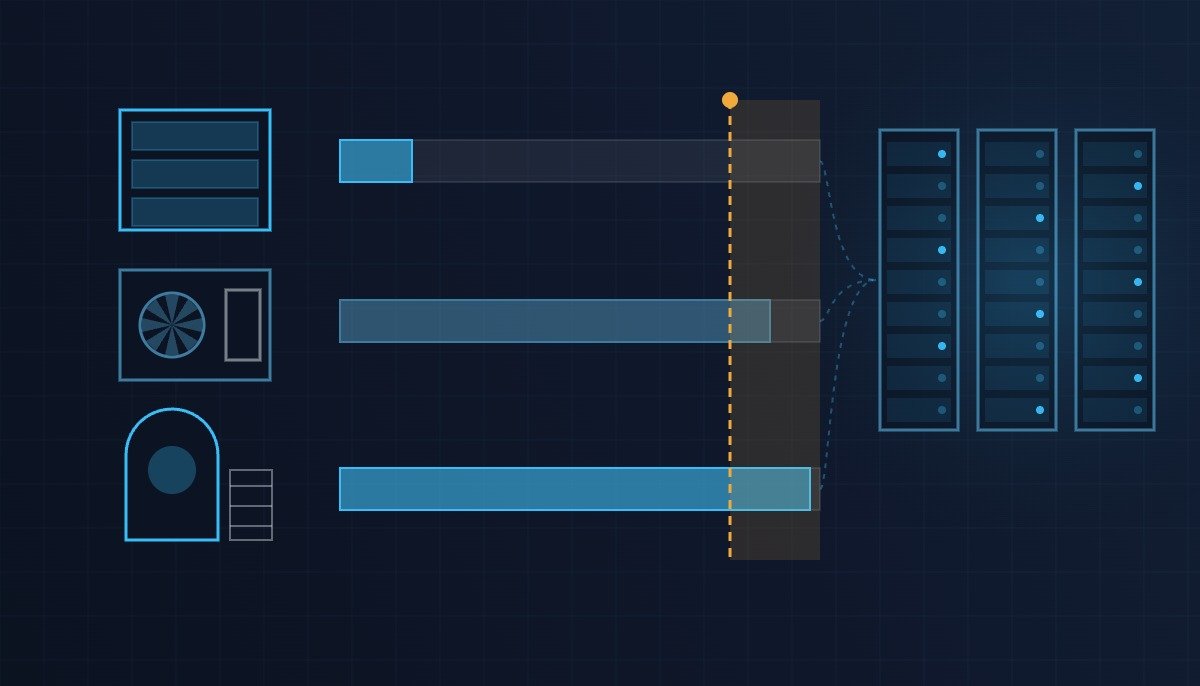
The change after applying this comes from redefining what backup power is. Professor Jeon cited last year’s case in which the combined capacity factor of solar and wind stayed below 15% for about 66 hours, saying that “a 6-hour or 8-hour duration cannot cover 66 hours of power.” Ha likewise said that ESS is effective for short-term output fluctuation and peak response but has limits in low-generation conditions lasting several days, and named LNG as the flexible backup power source to complement it. Professor Jeon said, “In the first instance it will be LNG, and later SMR could also be an alternative.”
The linking logic is simple. The gap between 6–8 hours and 66 hours is not closed by making ESS cheaper. To hold the same kW for 66 hours, storage capacity (kWh) must be increased more than eightfold, and at that point the problem moves off the unit-cost curve and onto site area, separation distances and grid connection. In other words, the axis of this comparison is not KRW/kWh but the kW that can be secured per hour (h) of continuous low generation.
Comparison by power source — where the advantage splits
The table below matches the three power sources against AIDC requirements based on the reported statements and figures. Unit cost is not in this table, because unit cost does not explain the differences in the second and third rows below.
| Axis | ESS | LNG generation | SMR |
|---|---|---|---|
| Response time | ms class | Minutes class (start-up and ramp-up) | Constrained load-following range |
| Continuous supply time | Typically 6–8 hours | Continuous as long as fuel supply is maintained | Continuous (based on maintenance cycle) |
| 66-hour low-generation coverage | Not possible (insufficient duration) | Possible | Possible |
| Supply by June 2029 | Possible | Possible if equipment is secured | No domestic commercial operating record |
| Dependence on grid expansion | Low if co-located on site | Low if co-located on site | Heavy site and permitting constraints |
| PPA applicability | Discussed in connection with renewables | Need for permission raised | Need for permission raised |
The row that actually decides the outcome in this table is “66-hour low-generation coverage” alone. That one row takes ESS out of the standalone-answer position, and the remaining rows change character from a question of which source to choose to a question of how to combine them.
Implications from an energy-system perspective
ESS dropping out at the 66-hour stretch does not mean it is struck off the list. AIDC load swings sharply from moment to moment according to training job schedules, and absorbing those swings at the ms level is still the role of ESS. Ha’s remark that large AIDCs should be approached as a single energy system that considers generation, transmission and ESS together reads the same way. In short, ESS covers the response-time axis, and LNG and SMR cover the duration axis. What fails is a design that tries to cram both axes into one source, not any one source being inferior.
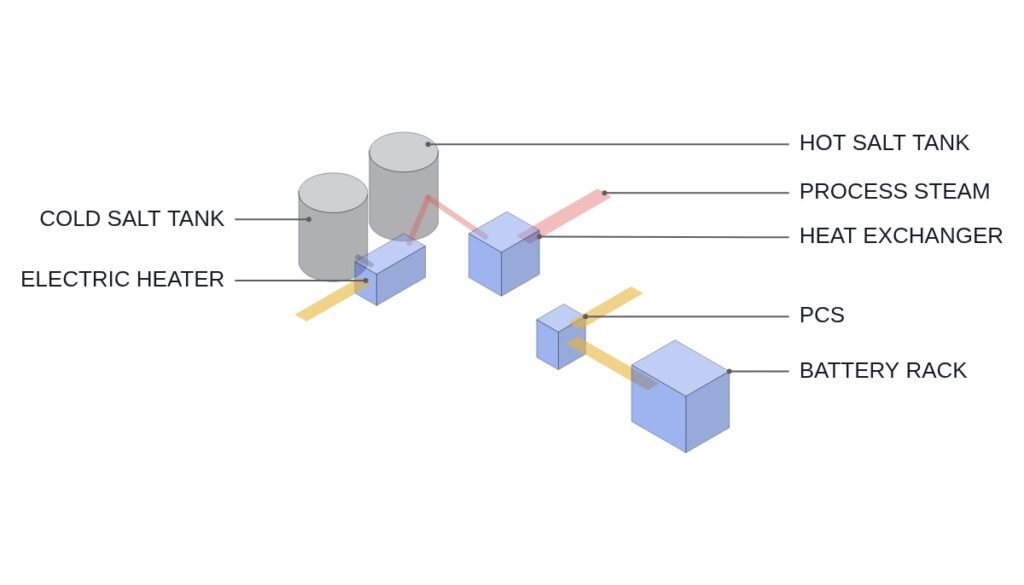
The price the SMR camp pays for the duration axis is its load-following constraint. A technology direction that tries to work around this weakness with thermal storage can be confirmed in a patent. TerraPower, LLC’s granted patent KR102921140B1 (filed 2020-04-13, granted 2026-01-30, Active per Google Patents lookup) claims an integrated energy system in which thermal energy generated by a nuclear thermal plant located at the plant site is transferred to a thermal energy storage system outside the site, and that storage system is thermally coupled to a remote power generation system. It is a structure that keeps reactor output constant while varying only the output on the generation side. However, this patent only shows a technology direction, and whether it applies to Korean SMR projects or AIDC-dedicated configurations has not been confirmed.
Ha Min-yong, head of AIDC development at SK Telecom: “From the data center’s point of view, where the electricity comes from is not that important.” Stable 24-hour supply, price and timely delivery are the core conditions, he explained.
Boundary conditions — where the advantage flips
- The nature of 66 hours: this value is a case observed last year, not a design constant that recurs every year. If the mix and regional distribution of renewable capacity change, the longest low-generation stretch changes too. Fixing backup duration at 66 hours in the design leads to overinvestment.
- Timing condition: move the June 2029 reference to 2035 and the fourth row of the table changes, and the ranking flips with it. This comparison is a result dependent on the timing condition.
- Institutional variable: permitting LNG and SMR PPAs was a recommendation made at the symposium and is an institutional matter. The conclusion cannot be reached by technical comparison alone, and the current scope of permitted PPAs needs to be checked separately. The 5.3-year transmission delay is also an average, with large variation from route to route.
Taking these three conditions into account, the single selection criterion narrows to one. How many kW can be secured on site by the required date, without waiting for grid expansion, that can ride through the longest low-generation stretch? Unit cost only matters among the candidates that pass this condition.
Source: Electric Times (Jeonki Sinmun), September 9, 2026, “‘Big Tech can’t wait until 2035‘… LNG and SMR PPA recommended” (in Korean). Patent bibliographic data and legal status from a direct Google Patents lookup (2026-09-11).