Bottom line first. A fuel cell CHP unit earns its value by producing electricity and heat together, so on a site with no one to take the heat, half the case disappears. On the assumptions below, a CHP unit at 42% electrical efficiency must actually use about 36% or more of its recoverable heat before it saves primary energy against separate production (grid electricity plus a boiler). Below that line it burns more fuel, not less. On a site with no heat demand, look at a high-electrical-efficiency power-only unit instead, and size any CHP unit to the year-round minimum heat load, not to the electrical load.
Heat utilization as the variable
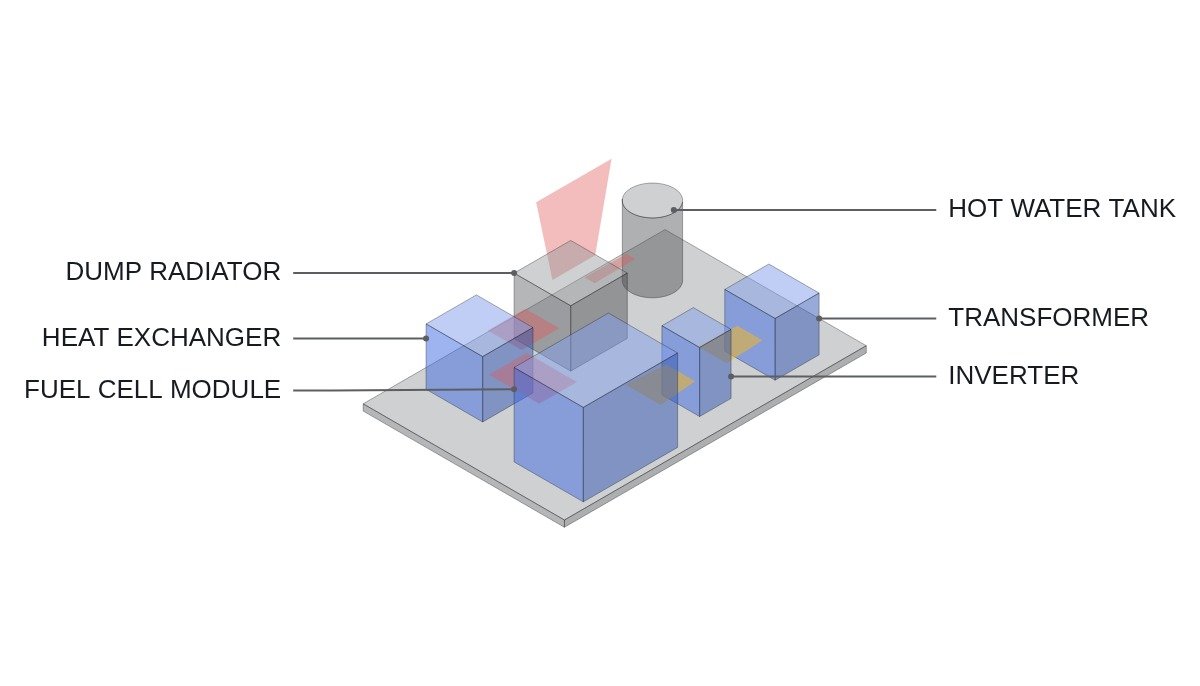
The catalogue overall efficiency of a CHP unit assumes all recoverable heat is used. What matters on site is that value multiplied by the share of recoverable heat that is actually consumed, the heat utilization factor u. Effective overall efficiency can be written as η_e + u × η_th, and when u is zero only electrical efficiency remains.
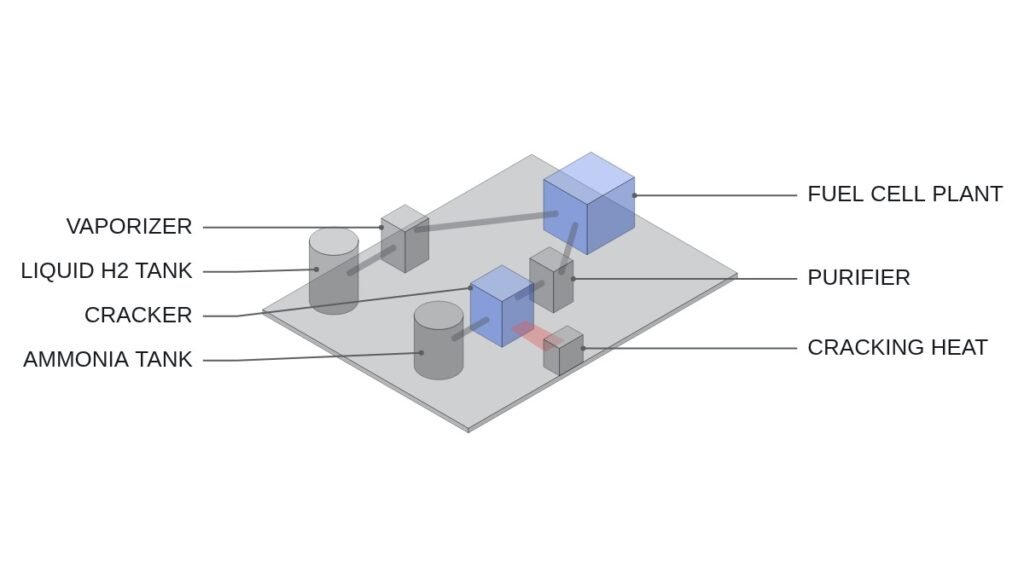
On a site without heat demand, unrecovered heat does not vanish. The stack still has to be cooled, so a dry cooler dumps that heat to atmosphere while its fans and circulation pumps draw auxiliary power. On a site that cannot sell heat, heat stops being a revenue stream and becomes a load that consumes auxiliary power.
Worked assumption — break-even by primary energy savings
The reference is the fuel needed to produce the same electricity and heat separately. Assumption: fuel input 1,000 kW (LHV), fuel cell electrical efficiency 42%, recoverable heat 40%, reference grid generation efficiency 50%, reference boiler efficiency 90%. Primary energy savings (PES) is calculated as 1 − 1 / (η_e / 0.50 + u × η_th / 0.90).
| Heat utilization u | Effective overall eff. | PES | Verdict |
|---|---|---|---|
| 100% | 82% | +22.1% | Saves |
| 50% | 62% | +5.9% | Small saving |
| 36% | 56.4% | approx. 0% | Break-even |
| 25% | 52% | -5.1% | Loses |
| 0% | 42% | -19.0% | Loses |
The key row is break-even. Since 0.42 / 0.50 = 0.84, electricity alone falls 16% short of the reference, and closing that 16% with heat requires 0.40 × u / 0.90 = 0.16, i.e. u ≈ 36%. A CHP unit whose electrical efficiency is below the reference grid only earns its place by selling more than a certain share of its heat, and that 36% moves whenever the reference efficiency assumptions change.
Where it wins, where it doesn’t
Current condition: a CHP-type fuel cell installed on a site with almost no heat demand, such as a small urban plot or a facility dominated by electrical load. After deployment: recovered heat goes to the dry cooler, u approaches zero, and the unit runs under the last-row condition of the table above. After auxiliary power, net export efficiency drops further below rating. Connecting logic: CHP economics rest on electricity sales plus heat sales; when one side goes to zero, electricity sales alone must carry fuel cost and stack replacement.
The winning sites are clear: those connected to a district heating network, or hospitals, hotels and process plants that use hot water all year, in other words sites with a base heat load that does not fall away in summer. There, u stays high all year and the unit runs close to the first-row condition.
Put a power-only high-efficiency unit through the same calculation and the result changes. Assumption: electrical efficiency 55%, recoverable heat 25%. Since 0.55 / 0.50 = 1.10, PES is about +9% even at u = 0. That is why the decision flips on sites without heat demand.
| Site type | Expected u | Recommended setup |
|---|---|---|
| District heating link | High all year | CHP type |
| Mainly winter heating | Large seasonal swing | Small CHP sized to minimum heat load |
| Mainly electrical load | Near zero | High-efficiency power-only type |
| Large cooling demand | Rises with absorption chiller | Decide after checking heat grade |
The row to watch in the second table is “mainly winter heating.” Annual heat demand may look sufficient, but once the summer heat load drops out, u is close to zero for that period. Sizing to the year-round minimum heat load rather than the annual average keeps u high all year, and taking the remaining electricity from the grid comes out ahead on primary energy.
Two burdens that follow on a site that cannot use heat
The first is carbon intensity. Assumption: natural gas emission factor about 0.20 kgCO2/kWh (fuel LHV basis). At 42% electrical efficiency that is about 0.48 kgCO2 per kWh of electricity, and the emissions can only be allocated between electricity and heat to the extent heat is used. At zero heat utilization the whole figure lands on electricity, so the CHP advantage also disappears in a carbon-based assessment.
The second is availability. Unlike a setup where the heat user takes part of the stack cooling duty, a site without heat demand puts the whole cooling duty on the dry cooler. If a cooler fan or circulation pump stops, coolant temperature rises and leads to derating or shutdown, so the heat-rejection system becomes the single path that sets generating availability. Cooler redundancy and heat-rejection margin at summer ambient temperatures should be confirmed at design stage.
Decision sequence
- Obtain the site’s hourly or monthly heat load curve. Look at the minimum first, not the annual total.
- Check that the fuel cell’s recovered heat grade meets the supply temperature of that heat load.
- Size the CHP unit to the minimum heat load and calculate annual u at that size.
- State the reference grid and boiler efficiency assumptions, then calculate PES and break-even u.
- If u falls short of break-even, compare against a high-efficiency power-only unit or grid supply.
- Make the final comparison on net exported power, including dry cooler fan and circulation pump auxiliary power.
Items to verify
- Reference grid generation efficiency and boiler efficiency used for comparison (reference values can differ by assessing body and scheme)
- Recovered heat supply temperature and dry cooler auxiliary power per product
- Heat sales contract price and whether seasonal offtake is obligatory
- Required heat source temperature and coefficient of performance when linked to an absorption chiller
Boundary conditions
There are conditions under which a CHP unit holds up even on a site without heat demand. First, when the grid’s carbon factor or tariff is so high that electricity itself carries great value. Then generating on site becomes the goal even at negative PES, and the decision basis moves from primary energy to supply reliability or tariff. Second, when an absorption chiller can turn the heat into cooling. On a site with year-round cooling demand, the premise of “no heat demand” collapses and u rises again.
Third, when backup power is part of the purpose. For a facility that must hold load through grid outages, availability and islanded operation come before efficiency, and that is a separate decision from whether to go CHP. Behaviour on grid separation is left as an item that requires waveform analysis and field measurement for each installation.
The single selection rule: if heat utilization calculated on the year-round minimum heat load exceeds break-even (about 36% under the stated assumptions), choose the CHP type; if it does not, choose a high-efficiency power-only unit.