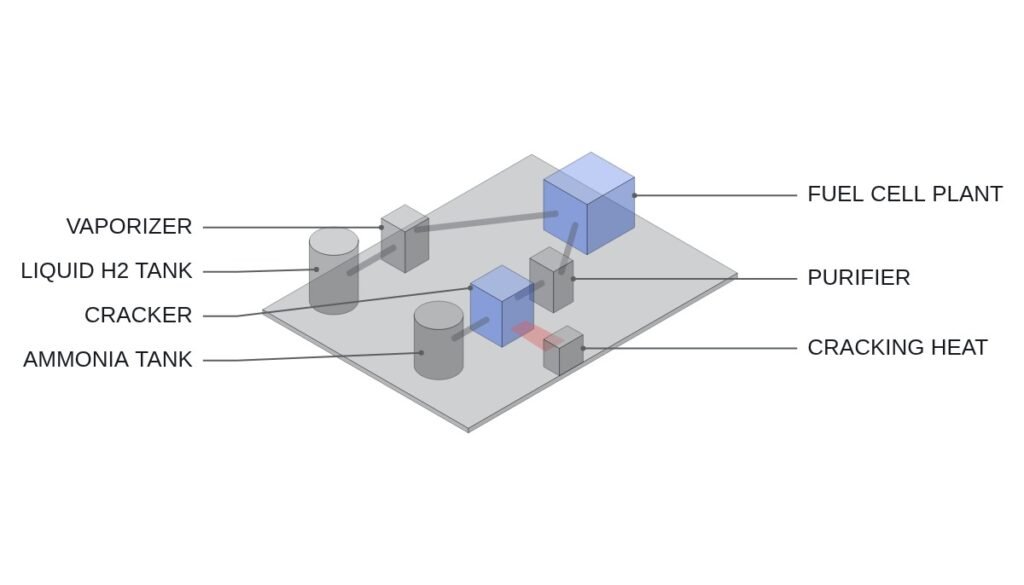
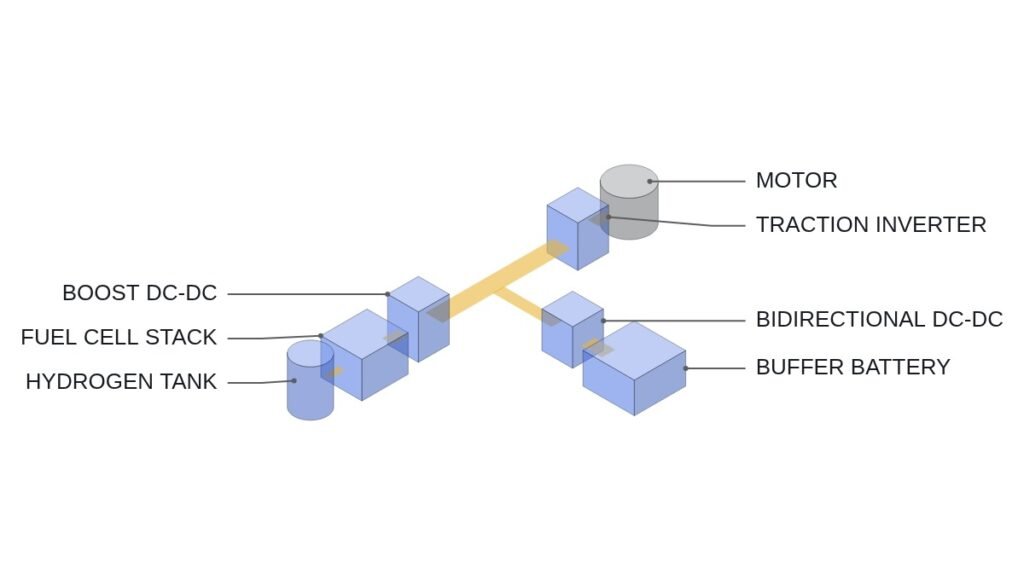
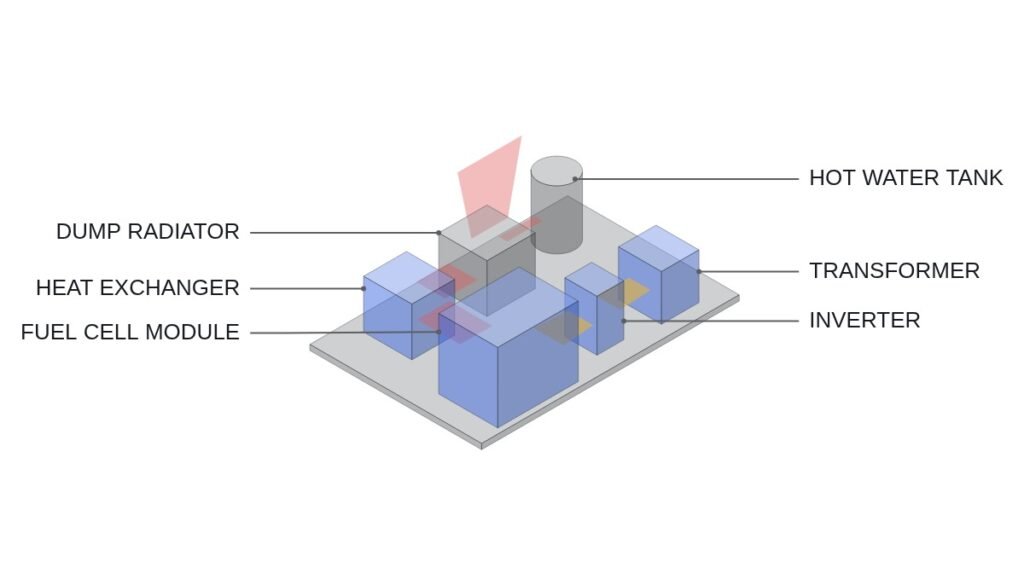
Fuel cells are often compared to batteries, but they work on a fundamentally different principle. A battery “stores” electricity, while a fuel cell “generates” electricity continuously as long as fuel is supplied.
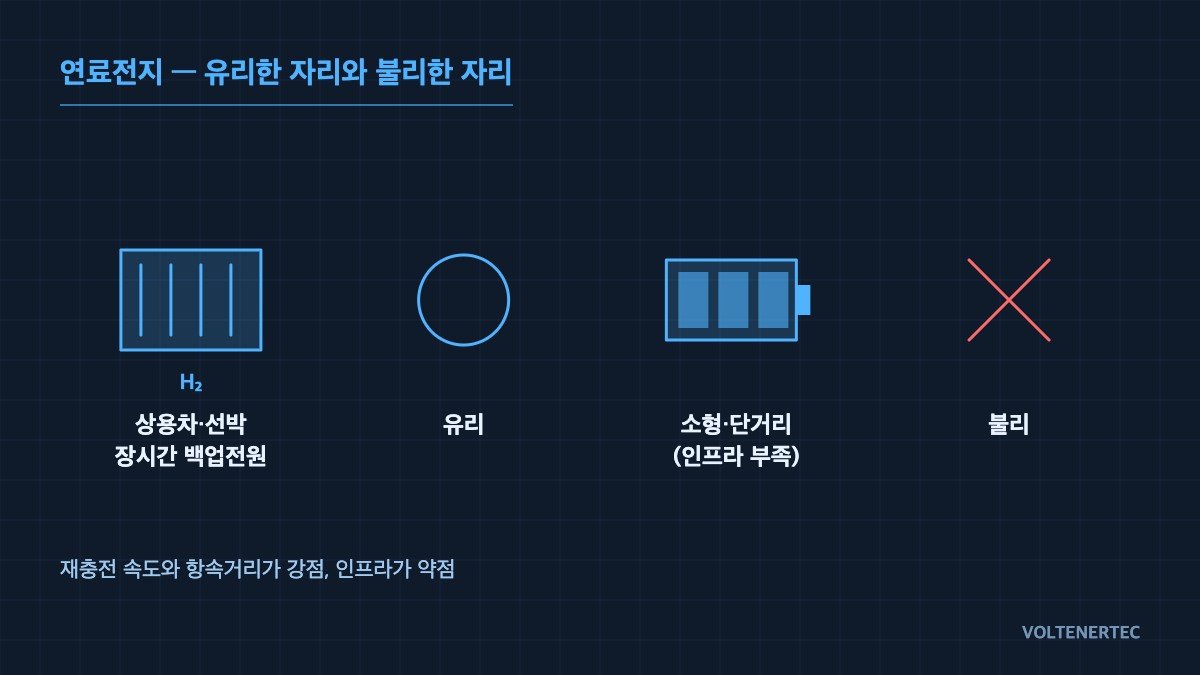
Where It Wins
| Use Case | Reason |
|---|---|
| Long-haul commercial vehicles & buses | Hydrogen refueling takes 3–5 minutes, far faster than battery recharging |
| Backup power (long duration) | Can sustain output for hours to days as long as fuel (hydrogen) is supplied |
| Ships & heavy equipment | Better range per weight than large batteries |
Takeaway: all three use cases need long operating time and short refueling time at once. The longer the operating time, the larger the fuel cell’s structural advantage.
Where It Struggles
Hydrogen refueling infrastructure is far sparser than battery charging infrastructure, and initial build-out costs are high. For short-range, small-scale mobility such as passenger cars, battery EVs lead on both infrastructure and cost.
Summary
Fuel cells are strongest in applications that must go “heavy, long-duration, and long-range.” In small-scale, short-range areas where infrastructure isn’t established, batteries still have the edge.
Where It Wins, Where It Struggles: Reading the Conditions
- Wins — long-duration backup power — Current condition: a facility facing long outages must ride through on battery capacity alone. → After applying: the stack provides power and hydrogen storage provides run time, so extending backup time only requires more fuel storage. → Link: power equipment and energy equipment are separate, so the cost of longer run time does not attach to the power equipment.
- Wins — large commercial vehicles — Current condition: the weight and charging time of large batteries restrict operation. → After applying: short refueling secures long operating time. → Link: in commercial operation, where downtime is cost, the difference in refueling time turns directly into economics.
- Struggles — short-range, small-scale use where infrastructure is lacking — Current condition: charging infrastructure already sits on the power grid. → After applying: adopting fuel cells requires building a separate hydrogen supply chain and stations. → Link: infrastructure cost is not offset by driving distance, so batteries come out ahead.
Electrical View: A Fuel Cell Alone Cannot Provide No-Break Power
A fuel cell stack takes time to reach rated output after start-up, and it follows sudden load changes more slowly than a battery. In practice, the configuration is therefore almost always a fuel cell combined with a battery (or UPS). The battery carries the interval right after an outage and sudden load steps; the fuel cell takes over the long run that follows. Stack output is DC and reaches the load through a DC/DC converter and inverter, and the response of that conversion stage must be confirmed from manufacturer data and field measurement.
When used as backup power, hydrogen leak detection, ventilation and the fuel shut-off valve must be interlocked with the electrical system. The leak detection signal must trip fuel shut-off and stack shutdown directly through a hardware circuit, not rely on the control software’s judgment alone.
Design of fuel cell backup starts with an operating time chart. Place each interval on the time axis, from outage detection, battery discharge start, stack start command and stack reaching rated output to the load-sharing handover, and confirm that the battery can carry the full load until the stack reaches rated output. The length of each interval differs by equipment and must be filled in from manufacturer data and commissioning measurements.
Character Comparison: Fuel Cell vs. Secondary Battery
| Item | Fuel cell | Secondary battery |
|---|---|---|
| Energy delivery | Generates as long as fuel is supplied | Releases only what is stored |
| Extending run time | Add fuel storage | Add cells |
| Following load steps | Slower, needs auxiliary source | Fast |
| Replenishment time | Short (refueling) | Long (recharging) |
| Infrastructure dependence | High (hydrogen supply chain) | Low (power grid) |
| Auxiliary safety equipment | Hydrogen leak detection, ventilation | Thermal-runaway protection |
Takeaway: fuel cells are strong on the run-time side and batteries on the response side. The design works best when the two are treated not as competitors but as a combination that splits roles within one system.
Checklist Before Adoption
- Have the required run time and refueling interval been set as operating conditions first?
- Have the hydrogen supply route (delivery or on-site production) and the siting conditions for storage been confirmed?
- Has battery or UPS capacity been sized separately for the start-up interval and load steps?
- Has the length of each interval on the operating time chart been confirmed by measurement during commissioning?
- If the stack fails to start, have the battery-only ride-through time and the alarm scheme been defined?
- Are hydrogen leak detection, ventilation and fuel shut-off built as a hardware interlock?
- Does the operating plan account for output loss from stack aging? (confirm with manufacturer data)
Boundary Conditions
The fuel cell’s advantage holds where run time is long and fuel supply is secured. The judgment flips in regions without a hydrogen supply chain, in applications where run time is short enough for battery capacity alone, and in facilities where no-break transfer is essential but there is no room for an auxiliary battery. The same applies when hydrogen procurement cost cancels out the run-time advantage.
Single selection criterion: choose a fuel cell only when the required run time is too long for battery capacity to cover and hydrogen supply is secured.
Related reading (Korean) — Hydrogen Fuel Cells vs. Lithium Batteries — Why Do They Take Different Approaches in the Same EV?