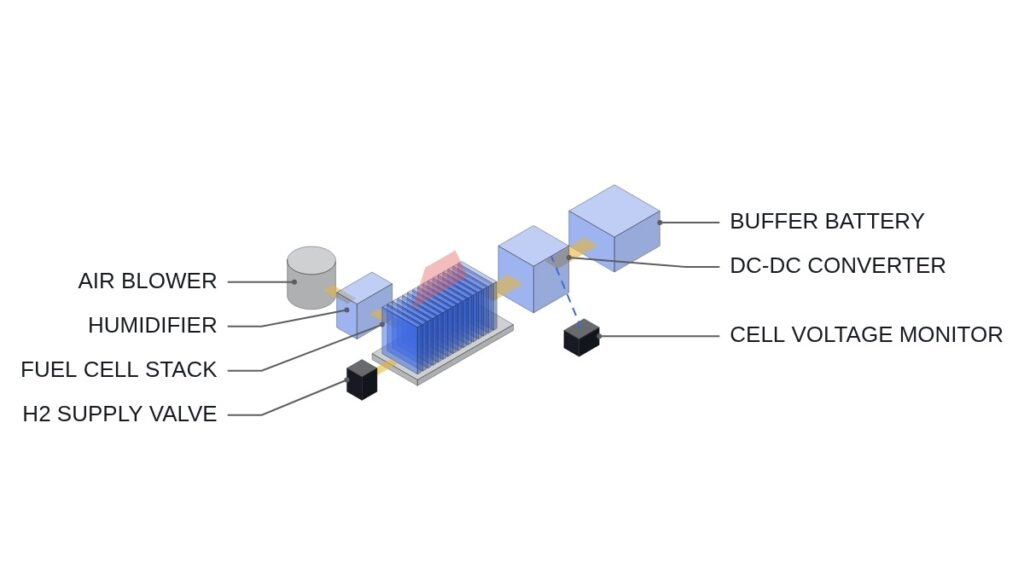
A BEV (battery electric vehicle) and an FCEV (fuel cell electric vehicle) both turn their wheels with an electric motor, but they differ in how they produce the electricity. A BEV charges its battery with electricity and uses it as stored, while an FCEV generates electricity on demand through the chemical reaction between hydrogen and oxygen in a fuel cell stack.
| Item | Battery EV (BEV) | Fuel cell EV (FCEV) |
|---|---|---|
| Energy source | Stored electricity | High-pressure hydrogen tank |
| Charging / refueling time | Slow charging: several hours; fast charging: tens of minutes | Hydrogen refueling approx. 3–5 minutes |
| Infrastructure | Chargers (relatively easy to deploy) | Hydrogen stations (heavy build cost and land burden) |
| Main applications | Passenger cars, small commercial vehicles | Heavy trucks and buses, long-haul commercial |
Why the use cases split — As a battery pack gets heavier, its energy-density advantage shrinks, while hydrogen only needs a tank that can withstand the pressure, so its weight advantage grows in large, long-haul commercial vehicles. In the passenger-car class, by contrast, BEVs keep the upper hand thanks to charging infrastructure that is already in place and lower energy-conversion losses.
In the end, the two technologies are less competitors than complements, with roles divided by vehicle class and driving range.
Reading the difference as an energy chain
From an electrical engineer’s point of view, the clearest way to see the difference is to trace the energy chain from the source to the motor. In a BEV, energy enters from the grid through a charger, is stored in the battery, and is drawn out through the traction inverter to the motor. Storage and conversion happen in the same component: the battery is both the tank and the power source.
In an FCEV, the tank and the power source are separate. The hydrogen tank stores energy as a chemical fuel, and the fuel cell stack converts it into electricity only when it is needed. That separation is the whole story behind the table above. Adding range to a BEV means adding battery, and every added cell brings its own mass. Adding range to an FCEV mainly means adding tank capacity, while the stack that sets the power rating stays the same.
The same separation explains the infrastructure row. A BEV charger is an electrical load on the distribution network, so it rides on grid capacity that already exists at most sites. A hydrogen station is a fuel-handling facility with its own storage, compression and safety perimeter, which is why build cost and land are the bottleneck rather than electrical capacity.
Where it wins, where it doesn’t
Current condition: passenger cars run relatively short daily distances, park for long periods, and can reach chargers almost anywhere electricity is available. After applying each option: a BEV fits this pattern with no new fuel supply chain, while an FCEV in the same role adds a hydrogen station dependency for a refueling-time advantage the driver rarely needs. Linking logic: where downtime is cheap and charging points are plentiful, the lower conversion loss of storing electricity directly wins.
Current condition: heavy trucks and buses carry large payloads over long routes, and time spent refueling is time taken out of service. After applying each option: a BEV has to carry a heavier battery for the same range, cutting into payload and requiring long charging stops, while an FCEV keeps its stack size and extends range through the tank. Linking logic: where mass and turnaround time drive the economics, separating the tank from the power source becomes the advantage.
Character comparison by operating profile
| Factor | Favors BEV | Favors FCEV |
|---|---|---|
| Daily distance | Short to medium, predictable | Long, continuous |
| Payload sensitivity | Low | High |
| Idle / parking time | Long, available for charging | Short, fast turnaround needed |
| Energy supply at depot | Existing grid connection | Hydrogen station on route or at depot |
| Conversion path | Direct storage, fewer steps | Fuel to electricity on board |
Read this table by operating profile, not by technology. No single row decides the choice; what matters is which rows the fleet actually sits on. A fleet that lands in the left column on most rows has little to gain from hydrogen, and a fleet that lands in the right column on payload and turnaround is paying a real penalty for staying on batteries.
Decision order
- Define the duty cycle first: daily distance, payload, and how long each vehicle is parked between shifts.
- Check the energy supply available at the depot or along the route: grid capacity for chargers, or access to a hydrogen station.
- Compare the time lost to charging with the time lost to refueling within the actual shift pattern, not in isolation.
- Only then compare vehicle and energy costs, since cost figures are meaningless for a vehicle that cannot complete the duty cycle.
Boundary conditions
The split described here holds only while the underlying conditions hold. If charging infrastructure for heavy vehicles becomes as easy to access as passenger-car charging, and depot schedules allow long charging windows, the BEV advantage moves up into commercial classes. Conversely, if hydrogen stations remain scarce on a given route, the FCEV advantage in heavy vehicles cannot be realized regardless of its weight benefit. The single selection criterion is this: choose the technology whose energy supply is actually reachable within the vehicle’s duty cycle.