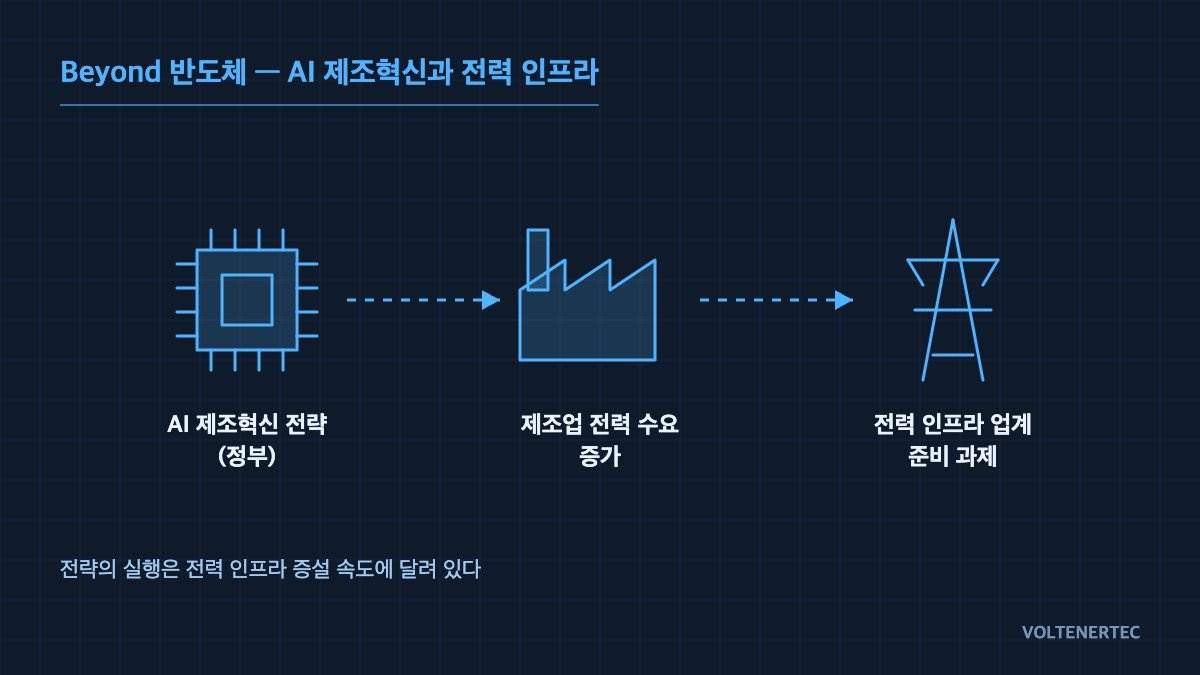
The government is pushing a “Beyond Semiconductors” strategy that extends its semiconductor-centred advanced-industry policy to manufacturing as a whole. The core idea is to roll out AI-based manufacturing process innovation plans one by one for each key industry, including steel, petrochemicals, shipbuilding, automotive and biotech.
| Item | Details |
|---|---|
| Core component R&D | New programme for the three core physical-AI components: actuators, sensors and robot hands |
| Humanoid deployment | Humanoids specialised for 10 key industries, targeting deployment of around 1,000 units per year |
| Target industries | Key industries across the board, including steel, petrochemicals, shipbuilding, automotive and biotech |
| Parallel policies | Regional economic revitalisation, plus a package of fiscal, tax, financial and regulatory improvements |
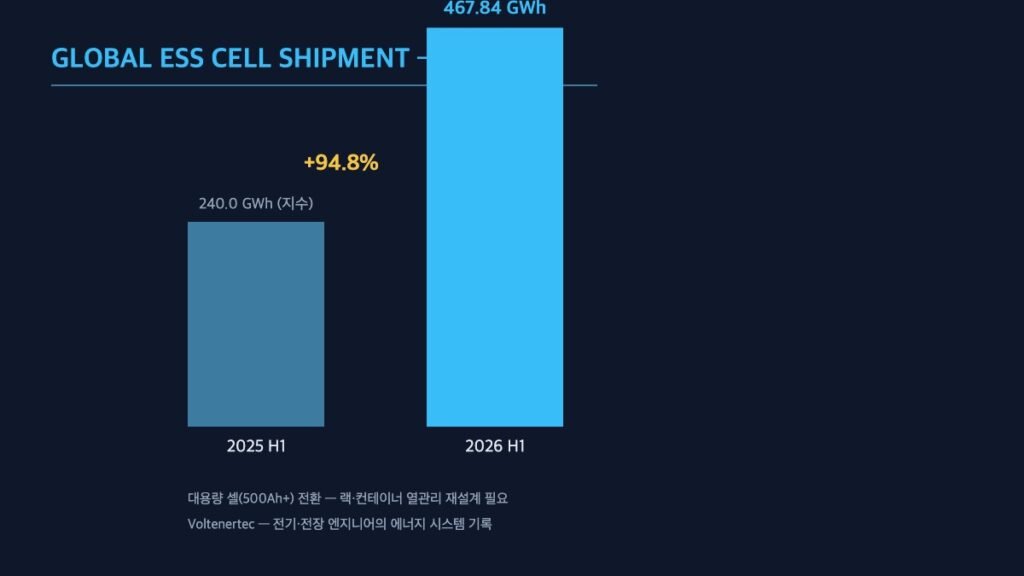
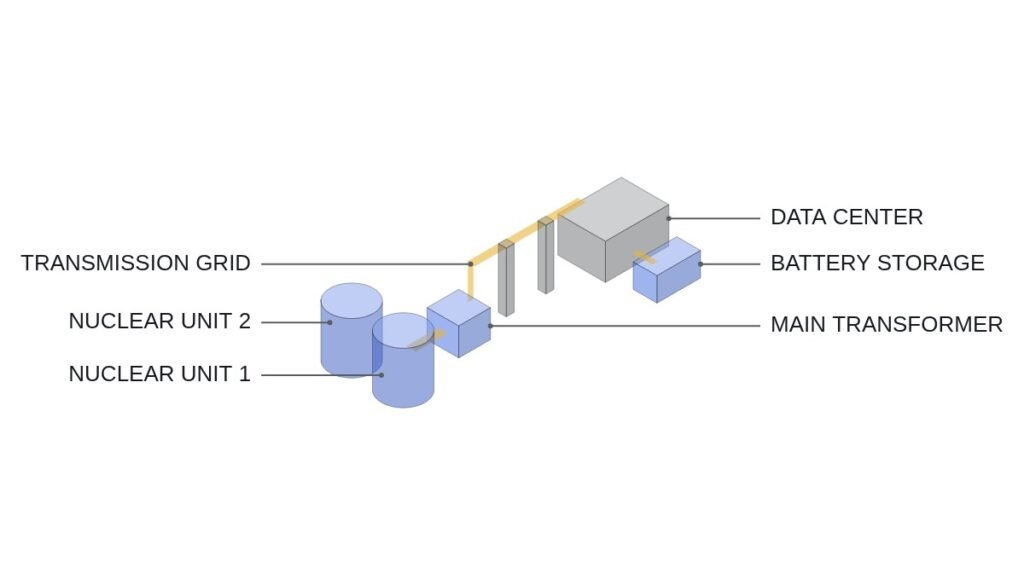
What it means from a power infrastructure standpoint — Once robots start going onto factory floors at scale, demand for more power infrastructure inevitably follows behind them. Power demand from AI data centres is already driving the ESS and PCS markets, and the same pattern is likely to repeat on the manufacturing floor. Rising power demand at the plant level could translate into demand for self-consumption ESS, industrial UPS and power conversion systems (PCS).
How quickly grid expansion and infrastructure investment in regional industrial complexes actually materialise looks set to be the first indicator of whether this strategy can be executed.
Reading the strategy from the switchboard side
A policy document talks about robots, components and industries. An electrical engineer reads the same document as a list of new loads that will eventually hang off a plant’s incoming feeder. Actuators, sensors and robot hands are all electrically driven, and a humanoid on a production line is, from the panel’s point of view, one more servo-driven load with its own control power, communication and safety circuits.
That shifts the question. The policy asks whether the robots can be built and deployed. The plant asks whether the existing incoming capacity, distribution boards and backup power can carry them without re-engineering the site. In most brownfield plants the second question is answered later than the first, which is exactly where schedules slip.
The strategy also names heavy process industries such as steel, petrochemicals and shipbuilding. These sites already run large motor loads and continuous processes, so what the robots add is not necessarily a large share of total demand but a different kind of load: many distributed, control-sensitive consumers that expect clean, uninterrupted supply. That is why the likely spill-over is into UPS, ESS and PCS rather than simply into bigger transformers.
Which equipment responds to which kind of demand
The three equipment groups named above do not respond to the same need. Treating them as one “power infrastructure” basket hides the fact that each one is justified by a different condition at the plant.
| Equipment | Need it answers | When it gets justified |
|---|---|---|
| Industrial UPS | Ride-through for control and robot controllers | When a momentary dip stops a line or corrupts a robot position |
| Self-consumption ESS | Shifting and shaving plant demand | When incoming capacity or demand charges become the constraint |
| PCS | Interface between DC storage and the AC network | Whenever an ESS is installed, sized by power rather than energy |
| Grid and substation expansion | Bulk capacity into the industrial complex | When plant-level measures cannot cover the added load |
The takeaway from the table is that plant-level equipment and grid-level expansion are substitutes only up to a point. UPS and ESS can buy time and flatten peaks, but if the regional network cannot deliver the bulk capacity, no amount of on-site equipment turns the strategy into running production lines. That is why grid expansion speed, not equipment orders, is the first indicator to watch.
What to check before a plant commits
- Confirm the safety interlock and emergency-stop design for any new robot cell first. Robot cells must keep hard-wired safety circuits; energy and backup decisions come after, never in place of, that design.
- Separate control power from motive power. Decide which loads must ride through a dip (controllers, safety PLCs, communication) and which can simply stop and restart. This defines the UPS scope.
- Check incoming capacity and existing demand profile. If added robot load pushes the plant against its contracted capacity, an ESS or a supply upgrade becomes a real option rather than a nice-to-have.
- Check the regional grid plan. Whether the industrial complex has scheduled network expansion determines whether on-site measures are a bridge or a permanent workaround.
- Treat power quality as unknown until measured. Many servo drives on one bus can change the harmonic and voltage profile of a plant; this requires waveform analysis and field measurement before any filter or equipment decision.
Boundary conditions
The link between this strategy and power-equipment demand holds only if deployment actually reaches the factory floor at scale. If the rollout stays at pilot level, robot loads remain small enough to be absorbed by existing plant distribution, and the expected demand for ESS, UPS and PCS does not appear. Likewise, if regional grid expansion is delayed, plant-level equipment may be bought as a stopgap, but the strategy itself stalls regardless. The single criterion to watch is this: whether grid and industrial-complex infrastructure investment is scheduled in step with robot deployment, because that is what decides whether the strategy becomes load on real switchboards.