Bottom line first. Google’s long-term power purchase agreement (PPA) with Finland’s Fortum for the Loviisa nuclear plant is not a contract to build a new plant; it gives investment certainty to the continued operation of units that started up in 1977 and 1981. As a power source for data centers, the strength of this approach is that it secures “a large baseload plant already connected to the grid” faster than anything else. In the gap before new nuclear or SMRs reach the grid, tying life extension and uprates at existing plants to a PPA wins on speed and certainty, and that advantage depends on whether the aging-plant investment is actually carried out.
What was reported
On September 9, World Nuclear News reported that Google signed a long-term PPA with Fortum covering up to 50% of the Loviisa plant’s capacity. The agreement starts in 2028 at reduced capacity and covers 50% of the plant’s capacity in 2030–2049. The article said the deal provides financial certainty for power uprates and lifetime extension until 2050.
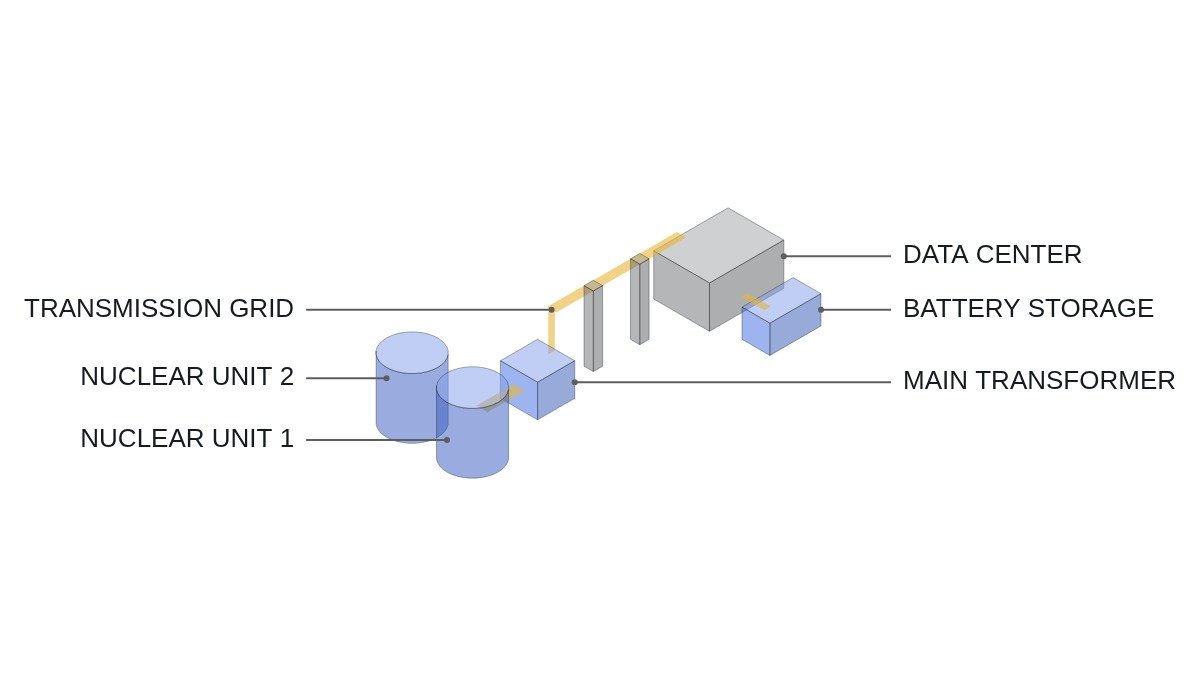
Loviisa, two VVER-440 pressurized water reactors, was Finland’s first nuclear plant and currently supplies more than 10% of the country’s electricity. Unit 1 has operated since 1977 and unit 2 since 1981; in February 2023 the Finnish government extended the operating licence to allow both units to generate until the end of 2050. Fortum is running a EUR 1 billion lifetime extension investment program, of which EUR 700 million of projects still lack an investment decision.
On output, a 38 MWe uprate is under way and expected to be completed in 2028, and the agreement is expected to enable a further 10 MWe increase. Google announced it will invest EUR 13 billion in Finnish data centers and supporting infrastructure over 2027–2028, with partnerships in Hamina, Muhos, Vaala and Kajaani. As a first step, Fortum signed an agreement with Google to optimize the battery storage system to be located at the Kajaani data center; the battery has a capacity of 94 MW, and Google will deliver it with a subcontractor.
Where it wins, where it doesn’t
Current conditions
What a large data center needs is large, steady power year-round and a grid connection to carry it. New nuclear takes a long time to license and build; renewables vary in output and must be paired with storage and backup. While waiting for new supply, a data center’s start date is tied to the power schedule.
What changes with a life-extension PPA
Tying continued operation of an existing plant to a PPA means the source is already connected, with operating history and capacity factor data on record. The buyer secures long-term price and volume; the generator gains grounds to commit the EUR 700 million not yet decided. The 38 MWe uprate plus the further 10 MWe add 48 MWe, an increment obtained with no new site and no new transmission line.
The connecting logic
The equipment significance of this deal is that “the PPA acts as the go-ahead condition for life-extension investment.” Extending an aging plant requires major component replacement and upgrades, and without a long-term offtaker the investment decision is delayed. When a buyer commits long-term volume, the capital decision moves forward, and the baseload that stays on the grid supports supply security for the whole system, not just the buyer.
Comparing ways to secure data center power
| Approach | Time to power | Supply profile | Main risk |
|---|---|---|---|
| Existing nuclear life-extension PPA | Fast (already connected) | Baseload, year-round | Aging-plant investment, planned outages |
| New nuclear / SMR PPA | Slow | Baseload, year-round | Licensing, construction schedule |
| Renewable PPA + storage | Medium | Variable, needs storage | Time mismatch, storage size |
| On-site battery storage | Fast | Short-duration power support | Limited energy |
What stands out is that the first and fourth rows appear together in this announcement. The nuclear PPA covers annual energy, and the 94 MW battery at Kajaani covers short-duration power swings and grid services; the two are not competitors but split energy (MWh) and power (MW) between them. Data center power design makes the most sense when it combines an annual energy source with separate equipment for instantaneous power support in this way.
The deal structure in numbers
| Item | Reported | Calculation / reading |
|---|---|---|
| Start of operation | Unit 1 1977, unit 2 1981 | Both around 70 years of operation by end-2050 |
| 50% PPA period | 2030–2049 | 20 years |
| Uprates | 38 MWe under way + 10 MWe expected | 48 MWe in total |
| Life-extension investment | EUR 1 bn total, EUR 700 m undecided | 70% undecided |
| Google investment | EUR 13 bn (2027–2028) | Data centers and infrastructure |
The fourth row shows the execution risk most clearly. With 70% of the life-extension investment still undecided, the PPA’s 20 years of supply rest on that investment being made. For the buyer, the investment decision schedule is the first item to check, ahead of contracted volume. From the generator’s side, starting at reduced volume in 2028 can be read as matching the uprate construction period, promising less volume until the uprate is complete. That the 38 MWe uprate targets completion in 2028, the same year the contract starts, supports this reading.
What buyers and equipment engineers should check
- Investment decision schedule: confirm when the undecided EUR 700 million of projects will be decided and how PPA volume adjusts if the decision slips.
- Planned outage impact: with two units, one unit in outage cuts available capacity by nearly half. Build the source of replacement power during outages into the contract.
- Physical delivery path: a PPA is a financial contract; the actual power flows through the grid. Check transmission constraints and regional price differences between the plant and the data centers.
- Uprate impact: whether the 48 MWe uprate fits within generator, main transformer and transmission capacity, or needs reinforcement, is an item to verify.
- Role of on-site storage: separate the operating purpose of the 94 MW battery (grid services, load smoothing, backup support) so its role does not overlap with the nuclear PPA.
Boundary conditions
The case for an existing-plant life-extension PPA reverses under the following conditions. First, when upgrades to aging equipment cause longer outages than expected; reduced availability during the life-extension investment period becomes a supply gap for the buyer. Second, when the plant and the data centers are far apart on the grid and transmission constraints bind; the power has been bought financially, but physically it is exposed to local grid conditions. Third, when changing regulatory requirements demand additional safety investment that undermines the economics of continued operation.
The single decision rule is this: a life-extension nuclear PPA takes priority over a new-build PPA only when the plant’s life-extension investment decisions are confirmed before the contract period begins.
References
- World Nuclear News, “Google signs up for electricity from Finnish nuclear power plant”, 2026-09-09, https://www.world-nuclear-news.org/articles/google-signs-up-for-electricity-from-finnish-nuclear-power-plant