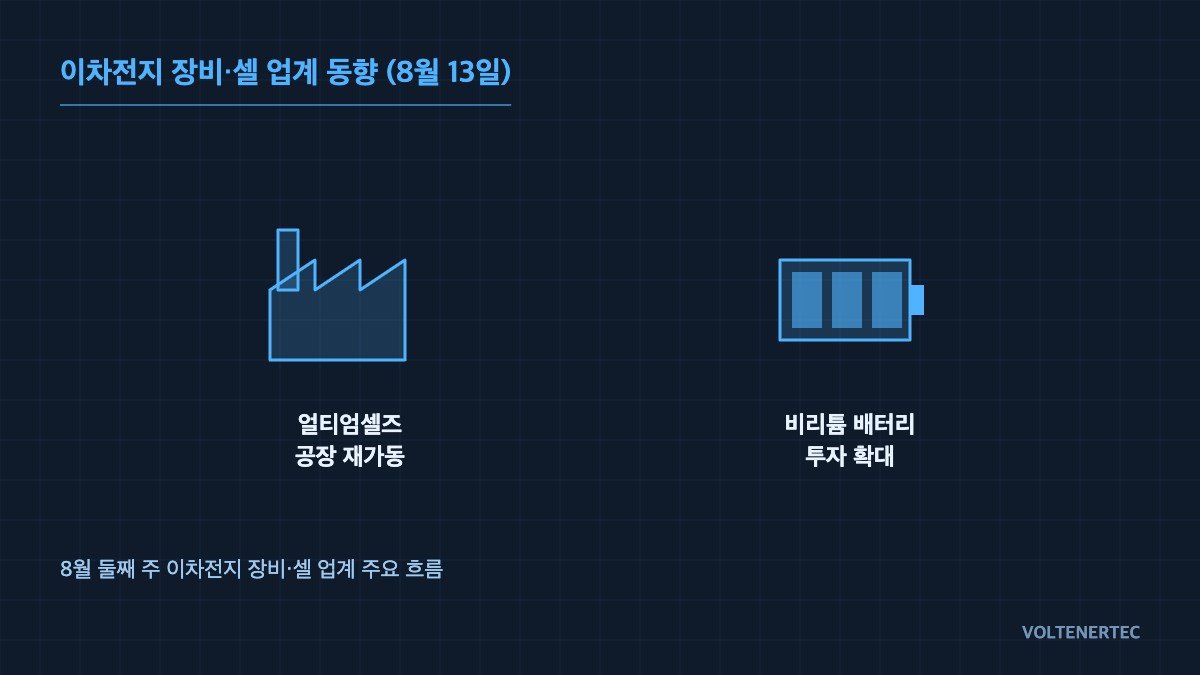
The second week of August brought a run of notable news from the battery equipment and cell industry. Second-quarter earnings recovery at equipment makers, the restart of a U.S. battery plant, and a funding round for a non-lithium battery startup: taken together, they show a direction that runs across the whole supply chain.
| Company | Details |
|---|---|
| PNT (equipment) | Q2 revenue KRW 117.6 billion (1,176억 원, up 3.66% year on year); amid equipment delivery delays and fixed-cost pressure, copper foil, LFP and cathode active material lines expected to contribute in the second half |
| SFA (equipment) | Q2 operating profit up 37.3% year on year; first-half new orders KRW 507.9 billion (5,079억 원, up 56%); portfolio expanding into AI robotics, semiconductors, fuel cells and subsea cables |
| GM and LG Energy Solution (cells) | Ultium Cells plant in Ohio restarted after 7 months, about 1,400 workers returning; the Tennessee plant is being repurposed for ESS |
| Cosmos Lab (cells) | Raised KRW 22 billion (220억 원) in a Series A; targeting AI data centers and long-duration ESS with an aqueous zinc-halogen non-lithium battery |
Implications from an energy storage perspective: the keyword running through this week’s news is “application split.” Automotive battery plants are dividing their capacity between EV cells and ESS production as EV demand adjusts, and new battery companies are aiming at AI data centers and ESS from day one with non-flammable, long-duration materials rather than lithium-ion. This shows that the battery industry is no longer organized along a single axis of “batteries for EVs” but is being reshaped around several axes: EVs, ESS, and power sources for data centers. The equipment makers’ portfolio expansion (fuel cells, subsea cables and so on) can be read as an extension of the same trend.
In the short term, the pace of EV demand recovery will set utilization at cell plants. Over the medium to long term, the key question is whether storage demand from ESS and data centers establishes itself as a new growth axis for the battery industry.
What the application split means for power system design
For an engineer who specifies storage rather than manufactures it, the restart in Ohio and the repurposing in Tennessee point to one practical consequence: ESS projects will increasingly receive cells from lines that were originally laid out for automotive products. The cell may be the same family, but the system around it is not. An EV pack is designed around a vehicle BMS, a vehicle thermal system and a vehicle duty cycle. A stationary ESS is designed around a PCS, a site-level fire and ventilation scheme, and a grid-driven duty cycle.
That gap has to be closed at the system level. When the cell source changes, the BMS parameters, thermal management limits and the protection coordination between rack, PCS and grid breaker all need to be confirmed against the new supplier’s data, not carried over from a previous project.
The Cosmos Lab funding shows the other side of the split. An aqueous zinc-halogen chemistry is a different electrochemical system, so voltage window, charge and discharge behavior and state-of-charge estimation all differ from lithium-ion. For a data center or long-duration ESS buyer, the question is not only whether the chemistry is safer but whether the PCS, BMS and monitoring stack can be adapted to it without redesigning the protection scheme from scratch.
Character comparison: three supply routes for storage
| Aspect | EV-origin line | Dedicated ESS line | Non-lithium (aqueous) |
|---|---|---|---|
| Design origin | Vehicle duty cycle | Stationary duty cycle | Stationary from the start |
| Supply maturity | Established lines | Growing through conversions | Early stage, startup-led |
| Integration effort | Re-validate BMS and thermal limits | Standard ESS integration | New BMS logic and PCS matching |
| Main draw for buyers | Volume and price | Fit to grid duty | Non-flammability, long duration |
| Main risk | Mismatch with stationary use | Depends on EV demand swings | Limited field track record |
The implication is that “application split” is not only a business trend but also an engineering workload. Each route shifts the integration burden to a different place, so the choice of cell supplier should be made together with the BMS, PCS and protection design, not handed over as a procurement decision after the system is laid out.
What to watch next
- Whether the Tennessee repurposing leads to published ESS-specific cell or module specifications, which will show how far the product has been adapted for stationary use.
- Whether the equipment makers’ orders in fuel cells and subsea cables show up in their order books over the coming quarters, confirming that the diversification is real and not only a stated plan.
- For non-lithium chemistries, whether system-level safety test results and field installation cases become available, since buyers of data center storage will ask for both.
- The pace of EV demand recovery, which remains the main variable for cell plant utilization in the short term.
Items to verify
- □ Cell origin and production line for any ESS bid, and whether the cell datasheet is written for stationary duty
- □ BMS parameter set supplied by the vendor for the specific cell, not a generic template
- □ Compatibility of a new chemistry’s voltage window with the selected PCS
- □ Available system-level test documentation for the offered product
Boundary conditions
The reading above assumes the application split continues. If EV demand recovers quickly, automotive plants may pull capacity back from ESS, and the diversified supply that storage buyers are counting on could narrow again. Non-lithium chemistries face a different boundary: without an accumulated field record, their non-flammability advantage may not be enough to win projects where operators need predictable performance over many years. The single criterion for a storage buyer is this: choose the supply route whose integration burden your BMS, PCS and protection design can absorb, not the one with the most attractive headline.