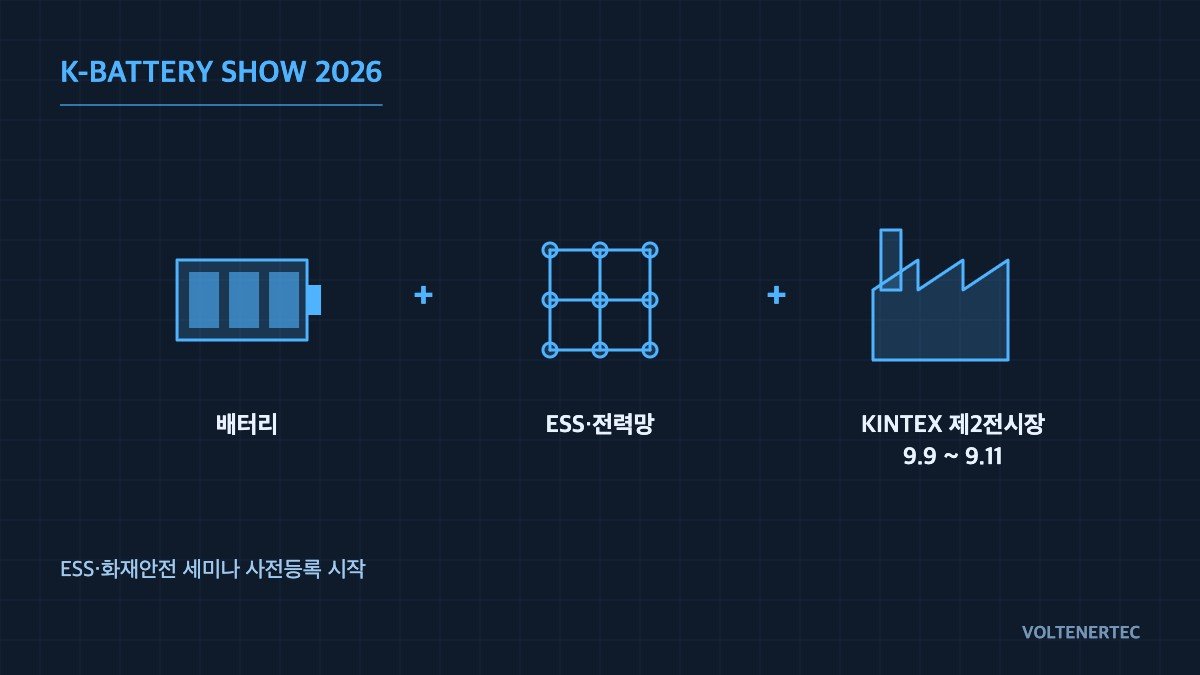
K-BATTERY SHOW 2026, one of Korea’s leading exhibitions for batteries, ESS and power grids, runs from September 9 to 11 in Hall 7 of KINTEX Exhibition Center 2. With ESS & EV TECH held alongside it, it is worth a look for people working in power systems and renewable energy.
| Item | Details |
|---|---|
| Dates / venue | 2026.9.9 (Wed) – 9.11 (Fri), KINTEX Exhibition Center 2, Hall 7 |
| Co-located events | K-Mtech 2026 / ESS & EV TECH |
| Main seminars | ESG and climate crisis, fire safety, diagnostics and recycling (K-BATTERY DAY) / semiconductor investment and ESS materials, parts and equipment (THE ELEC, free) / international lithium battery EV fire safety (SFPE) |
| Participant benefits | Export voucher support, innovation awards, B2B export consultations |
For readers in power systems and ESS, the September 10 fire safety session and the SFPE international seminar (pre-registration KRW 150,000, until September 3) are the most relevant. Seminar applications are available after pre-registering for K-BATTERY SHOW.
Why the fire safety track matters most from a systems standpoint
Most of what is on display at a battery show is cells, modules and materials, which are the concern of the people who make batteries. For the people who design and operate ESS installations, the more useful content tends to be about what happens around the battery: detection, suppression, ventilation, separation and the sequence that connects them.
Fire safety in an ESS is not a single device but a chain. A cell anomaly has to be detected, the detection has to be turned into a trip signal, the trip has to isolate the battery from the PCS and the grid, and suppression and ventilation have to act on a defined timeline. Each link is designed by a different discipline, and failures often occur at the handoffs between them. A seminar that focuses on fire safety is one of the few places where these disciplines discuss the same event from their own sides.
The SFPE session is framed around EV fire safety, but much of the underlying physics of lithium battery fires, such as how thermal runaway propagates and how gases accumulate, carries over to stationary storage. The difference is in scale and confinement: an ESS container or battery room holds far more cells in an enclosed space than a vehicle, which makes propagation and gas management more important, not less.
Seminar tracks by relevance to role
The table below maps the announced seminar tracks to the roles that will find them most useful. It is a qualitative guide, not a ranking of the sessions.
| Track | Most relevant to | What to take away |
|---|---|---|
| Fire safety (K-BATTERY DAY) | ESS designers, operators | Detection-to-isolation sequence, suppression approach |
| Diagnostics and recycling | Operators, asset managers | State-of-health assessment, end-of-life planning |
| ESS materials and parts (THE ELEC) | Procurement, supply chain | Supplier landscape for ESS components |
| EV fire safety (SFPE) | Fire protection, safety engineers | Thermal runaway behavior, test and response practice |
| ESG and climate crisis | Planning, policy | Regulatory and disclosure direction |
The takeaway from this table is that the tracks divide along the life cycle of an installation: design and safety at the start, procurement in between, and diagnostics and recycling toward the end. Choosing sessions by the stage of your current project gives more usable content than choosing by topic popularity.
What to check on the exhibition floor
Exhibition booths are built to present products at their best. A short list of practical questions helps turn a booth visit into information that is useful for an actual project.
- □ Ask where the trip path is — for any ESS product, ask how a thermal or voltage anomaly leads to battery isolation, and whether that path is hardwired or depends on communication with a controller.
- □ Ask what the fire test covered — confirm which standard the fire test was run to and at what level (cell, module, unit), rather than accepting a general “fire-tested” claim.
- □ Ask about communication loss behavior — what the battery system does when BMS communication with the PCS or site controller is lost; a defined safe state is a basic requirement.
- □ Ask about diagnostics access — what cell-level data the operator can actually read, and in what format, because this decides how well the system can be maintained.
- □ Ask about end-of-life handling — whether the supplier has a take-back or recycling arrangement, which affects the total cost of the installation.
Any answer about communication-related behavior, such as data loss or delays in the field, should be treated as a starting point rather than a guarantee; actual performance requires waveform analysis and field measurement at the installed site.
Boundary conditions
The exhibition is most valuable to power systems and ESS readers when they go with a specific project question, such as a fire safety design choice, a supplier shortlist or a diagnostics requirement, and use the seminars and booths to test it.
The value drops when the goal is only a general survey of the industry, since most of the floor is devoted to cell and materials technology that has little bearing on system design decisions. Pre-registration deadlines also matter: seminar access depends on registering for the show first, and the paid SFPE seminar had an earlier cutoff than the show itself.
The single selection criterion: attend the fire safety and SFPE sessions if your work involves designing or operating ESS installations; otherwise, the exhibition floor alone is unlikely to change a system-level decision.