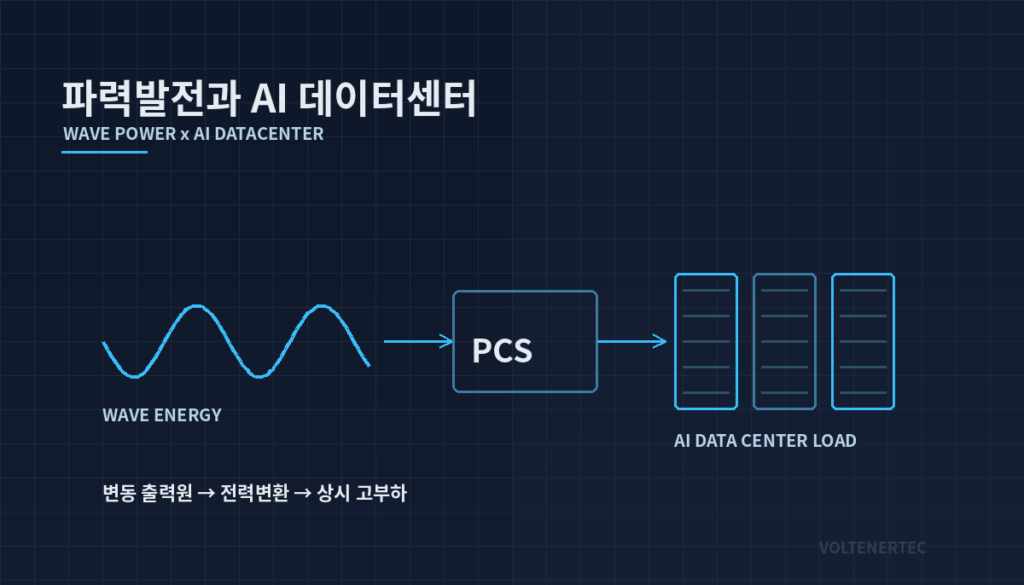
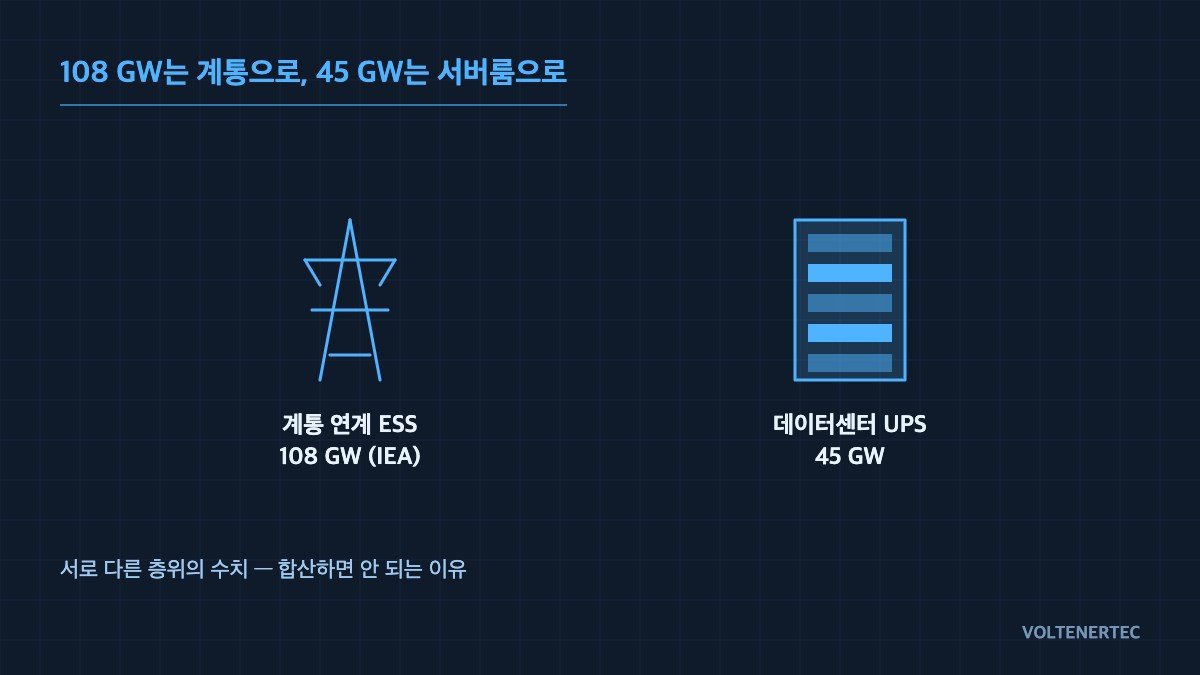
Bottom line first: when you read 2025 battery installation figures, do not add 108 GW and 45 GW together. The first number is grid-side storage; the second is load-side backup. On an electrical engineer’s single-line diagram the two attach at different points and are held to different performance requirements. The first is judged by discharge duration (h); the second by transfer time (ms).
This post lays out, side by side, the IEA figures published in the first half of 2026, what was on show at InterBattery 2026, and the outlook for the residential market.
1. IEA figures: grid and load grew at the same time
| Category | New in 2025 | YoY | Position | Key metric |
|---|---|---|---|---|
| Battery storage | 108 GW | +40% | Grid side (about 80% utility-scale) | Discharge duration (h), response speed |
| Battery-based UPS | 45 GW | +30% | Load side (mainly data centres) | Transfer time (ms), backup time (min) |
Takeaway: A phrase like “153 GW in total”, adding the two figures, does not stand up. The 45 GW of UPS is not equipment that shifts energy in time; it is capacity standing by to bridge the moment of an outage. Converted to annual discharged energy, it is too small to compare with grid storage, while its response-speed requirement is far harsher. When citing the statistics, state the position and the metric together to avoid misreading. (Source: IEA Global Energy Review 2026)
One more item is often left out. The IEA states that about 80% of new battery capacity in 2025 was utility-scale, with the rest being commercial and residential BTM (Behind-the-Meter). If you only quote the growth rate of the residential ESS market, you misplace where the volume actually sits.
2. InterBattery 2026: cell makers gave data centres their own line-up
The thing to watch at InterBattery 2026, held at COEX in March 2026, was not form factor but segmentation by application. Here is what the three Korean makers put forward.
| Company | Technology shown | Target application |
|---|---|---|
| Samsung SDI | Pouch-type all-solid-state battery samples (mass production targeted for H2 2027), ultra-high-power cells for UPS and BBU, fire-prevention AI software SBI (Samsung Battery Intelligence) | Humanoids and physical AI, data centres |
| LG Energy Solution | JF2 DC LINK 5.0 ESS solution (LFP), LMR battery (co-developed with GM) | ESS for AI power demand, EVs |
| SK On | Pouch CTP (module stage eliminated), large-surface cooling (LSC) CTP, immersion-cooled pack co-developed with SK Enmove | EV packs, applications with heavy thermal management demands |
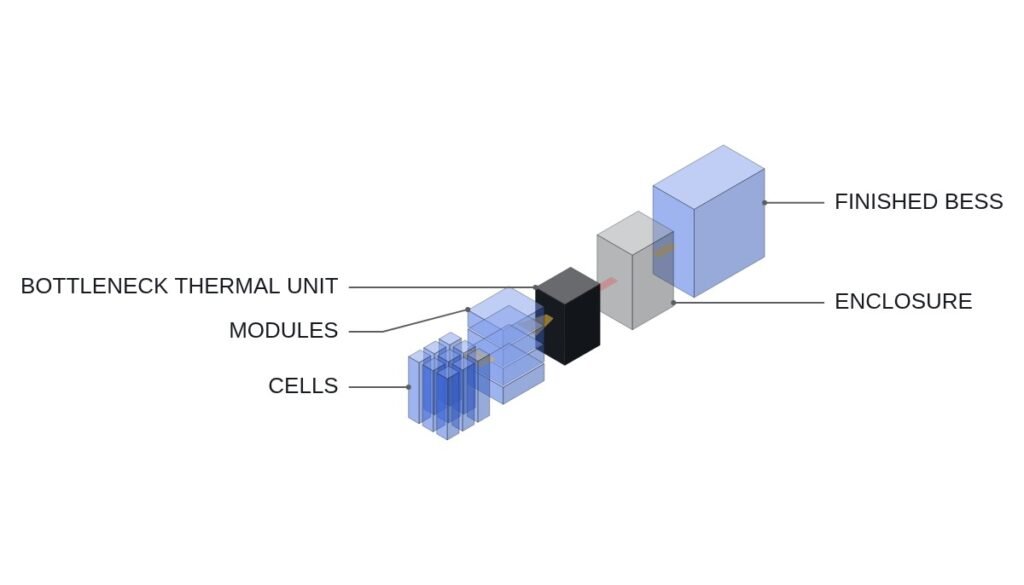
Takeaway: The common thread running through all three companies’ announcements is not chemistry but thermal management and fault diagnosis. Immersion cooling, large-surface cooling and fire-prevention AI came out under different names, but they target the same problem. The more accurate reading is that as cell-level improvements approach their limits, competition has moved to thermal and monitoring design at pack and system level. For those of us who work with equipment, that is a welcome direction, because performance in this area is decided not by materials but by sensor placement and interlock design.
3. Residential ESS outlook: 3-6 kW has become the standard slot
| Item | Value |
|---|---|
| 2026 market size (forecast) | About USD 86.1 billion |
| CAGR | 18.3% (2026-2036) |
| 2036 forecast | About USD 462.3 billion |
| Leading capacity band | 3-6 kW, 54.6% share as of 2026 |
Takeaway: The fact that 3-6 kW takes the majority is, before it is a market statistic, a baseline for PCS rating selection. Read it alongside the fact that contracted demand for Korean homes is typically around 3 kW, and this band looks less like a decision about “how much battery to install” and more like a decision about “how much can be drawn within the incoming breaker rating”. Power (kW) is constrained before capacity (kWh). (Source: Future Market Insights, Residential Solar Energy Storage Market)
4. Wrapping up: three sources in one sentence
Compressed to one line, the 2025-2026 trend reads like this. As incremental battery demand has moved from EVs to data centres and the grid, the focus of technology competition has also moved from energy density to thermal management and fault diagnosis. All-solid-state took the headlines, but with mass production targeted for H2 2027 and robots and wearables as the first applications, the task we will actually handle in the field over the next two years is still cooling and monitoring lithium-ion packs.
5. Boundary conditions
The reading above holds when the published 2025 results and 2026 forecasts are taken at face value. It becomes shaky in the following cases.
- Market research forecasts vary widely between firms. Different firms put different sizes and growth rates on the same residential storage market. Do not close an investment decision on a single firm’s figure
- The 45 GW of UPS is tightly linked to new data centre build plans. If the pace of AI infrastructure investment is adjusted, this item will react first
- All-solid-state mass production dates are announced targets, and there is a repeated history of delays due to materials and process issues
Field checkpoints
- When citing statistics, always label grid side versus load side. A summed figure means nothing
- When reviewing residential ESS, check the PCS rating (kW) and incoming breaker capacity before kWh
- When reviewing ESS fire countermeasures, check the number and placement of temperature sensors and the shutdown sequence before the materials section