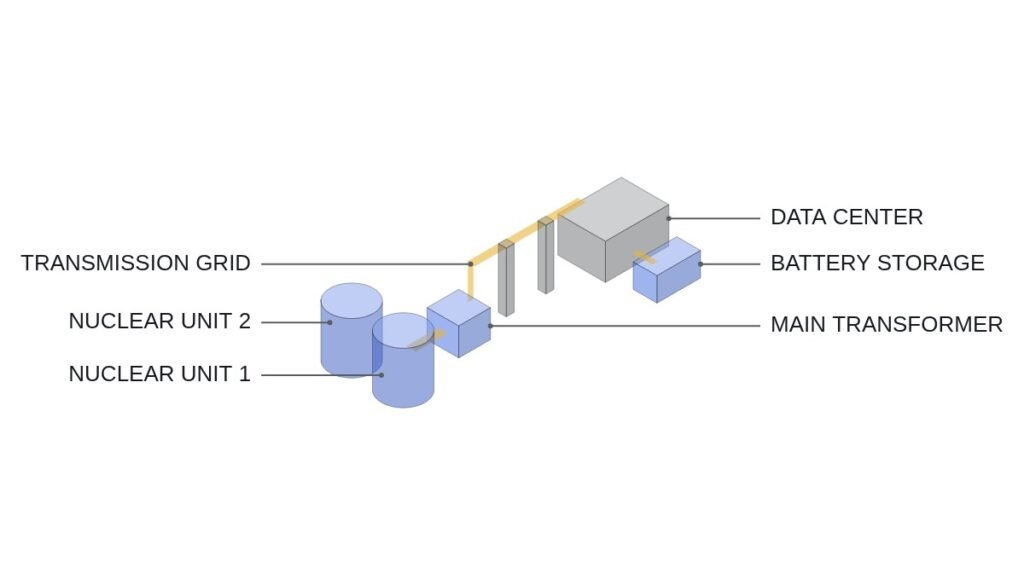
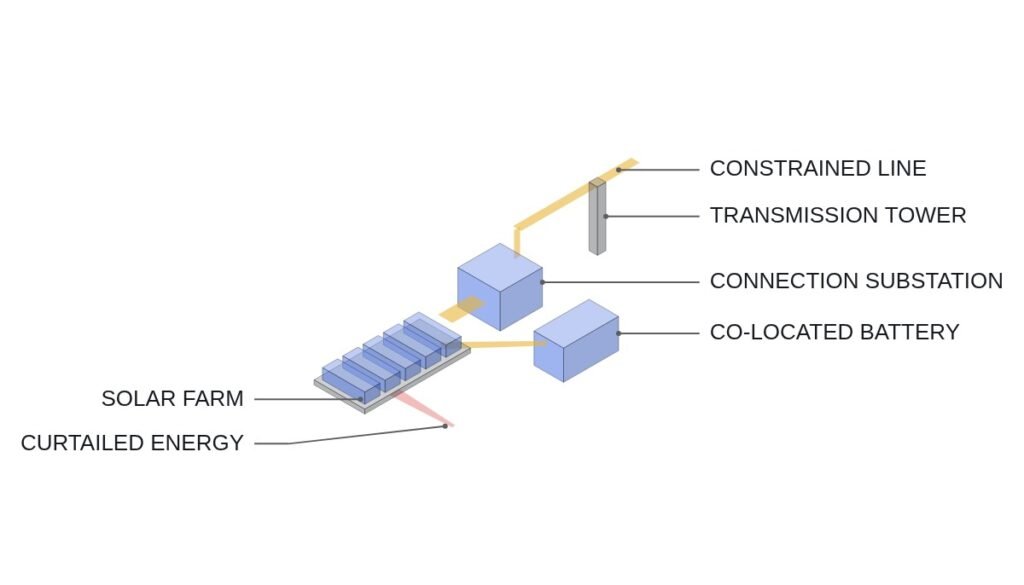
To put the conclusion first: ultra-fast charging pays off only at sites with high vehicle turnover where charging is not spread across the day. At homes and low-load sites where vehicles sit overnight, it gains you almost nothing, however much cell performance improves. A cell that can accept 15C does not mean the charging station can deliver 15C. The bottleneck has moved from the cell to the incoming supply equipment.
The assumption this post breaks
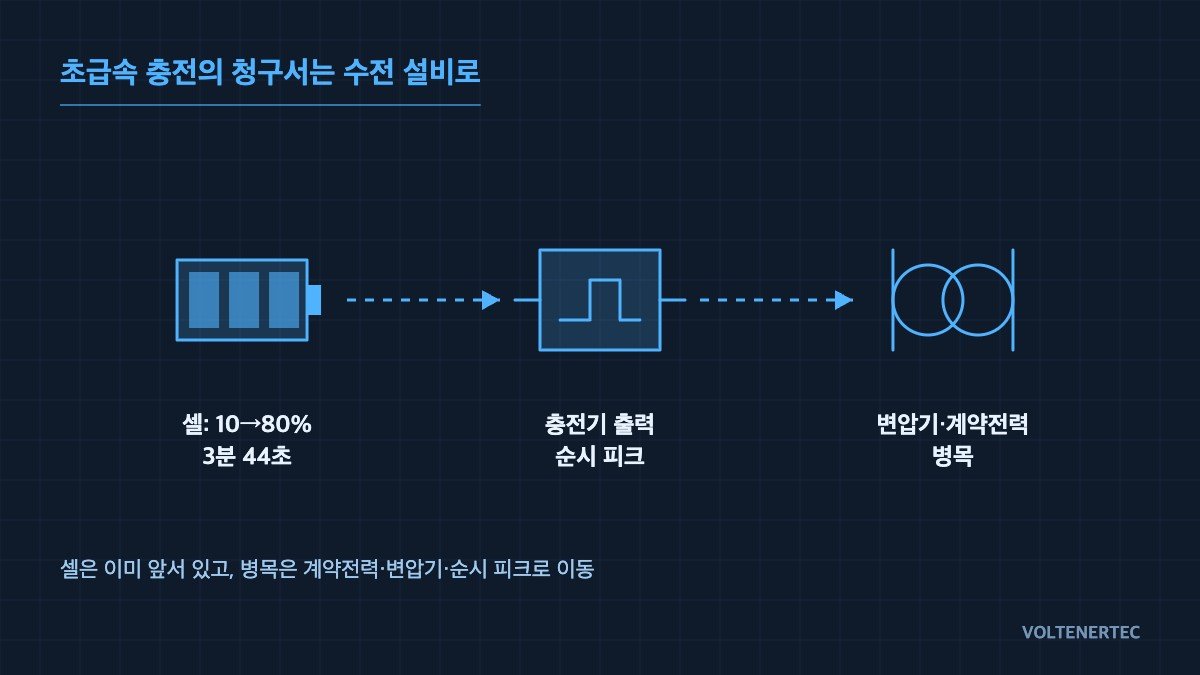
“Faster cell charging means shorter charging time” is only half right. The cell only sets the upper limit of what it can accept. Actual charging time is decided by the charger’s rated output, the site’s contracted demand, transformer capacity, and the instantaneous peak created by the number of vehicles charging at once. The better the cell specs get, the more it is the ground-side equipment that fails to keep up with that limit.
Current conditions: the cell has already pulled ahead
CATL took a 39.9% share of the global battery market in the first half of 2026, and 54.3% combined with BYD. Its supply volume was 242.7GWh, up 25.3% year on year. Over the same period LG Energy Solution supplied 52.6GWh for an 8.6% share (down from 9.6% in 2025). The overall market was 608.5GWh, with 20% growth.
The technology figures are more direct. CATL’s third-generation Shenxing battery was unveiled with a maximum charge rate of 15C and 10-80% in 3 minutes 44 seconds. That means filling 70% SOC in 224 seconds, which works out to an average C-rate of about 11.25C (a simple calculation from the published figures). Meanwhile, both CATL and BYD have all-solid-state slated for small-volume pilot production in 2027, with mass production after 2030. In other words, what the field will face for the next several years is not all-solid-state but these ultra-fast liquid-electrolyte cells.
What changes once applied: power demand hits the supply contract
This is where the electrical calculation starts. Assuming a 100kWh pack, putting in 70% SOC in 224 seconds requires an average power of about 1,125kW. The peak is higher than that. And that is for one vehicle. Connect four at the same site simultaneously and the average alone is 4.5MW, with the instantaneous peak above it.
The problem is that this load is not continuous but a pulse lasting a few hundred seconds. Contracted demand is set by the peak and transformer capacity is decided by the peak, yet utilisation is low. You buy equipment sized for the peak and pay tariffs based on the peak, while the energy you actually sell does not scale with it. On top of that come the voltage dips, harmonics and power factor degradation caused by abrupt load connection and disconnection. These items vary widely with site conditions, so they require waveform analysis and field measurement.
Connecting logic: so the decision criterion changes
The policy direction also leans toward the cell side. In August 2026 the government put forward a total of KRW 4.2 trillion in induced investment through regulatory improvements for semiconductors, secondary batteries and biotech, but the secondary battery share is KRW 100 billion, centred on allowing resource recycling businesses into the Gumi and Pohang national industrial complexes. On the tax side, LG Energy Solution executive director Kim Nam-ho is at the stage of asking to “add direct refunds to the domestic production promotion tax credit, which is the most realistic option.”
In short, both support and technology competition are concentrated on cell manufacturing. The cost of a charging station’s supply equipment is still left to the operator. That is why the profitability of ultra-fast charging is decided not by cell specs but by the site’s power conditions.
Comparison table: where it wins
| Item | High-turnover commercial and logistics hubs | Homes and low-load sites |
|---|---|---|
| Vehicle dwell time | Short (turnover is revenue) | Long (8-10 hours overnight) |
| Required C-rate | High (3-6C or more in practice) | Low (0.2-0.3C is enough) |
| Charger output class | Several hundred kW and above | 3.3-11kW class |
| Impact on contracted demand | Large, peak sets the contract | Small, absorbed in overnight low-load hours |
| Transformer and supply upgrade | Usually required | Usually not required |
| Equipment utilisation | High (repeated peaks) | Low, but the load itself is small |
| Value of ultra-fast cells | Recoverable | Hard to recover |
There is one thing to read from the table. The value of ultra-fast charging comes not from cell performance but from whether the time saved can be turned into revenue. At sites that do not sell time, the ultra-fast cell premium and the supply upgrade cost remain as pure losses.
Boundary conditions where the advantage flips
Look at three things.
First, the ratio of instantaneous peak to contracted demand. Once the peak exceeds contracted demand, transformer replacement and breaker re-selection come as a package. Whether this ratio exceeds 1 is effectively the break-even point.
Second, whether there is an ESS buffer. Put an ESS in front and the load the grid sees is smoothed, so contracted demand can be set close to the average rather than the peak. In exchange, ESS investment and cycle degradation are added, so this only works where the demand charges and upgrade costs saved by peak shaving exceed the total cost of the ESS.
Third, the number of charging sessions per day. With few sessions, utilisation of expensive equipment drops, and even at the same site a larger number of slow chargers becomes the better choice.
Add one safety condition to this. In the ultra-fast range, overcurrent and overtemperature interlocks take top priority, and these interlocks and the emergency off (EMO) circuit must remain hard-wired.
One selection criterion
First calculate how many times current contracted demand the site’s simultaneous-charging instantaneous peak is. At 1x or below, ultra-fast charging can be introduced now. Above 1x, reviewing an ESS buffer before adding more chargers gives the shorter payback period.