China’s next-generation battery market has been forecast to reach USD 299.8 billion (about KRW 400 trillion) in 2031. Three axes are singled out as growth drivers: solid-state batteries, BESS (battery energy storage systems) and EV demand in emerging markets. To state the conclusion first, these three axes carry different power infrastructure requirements, so lumping them together as one “battery market” means missing the real investment priorities.
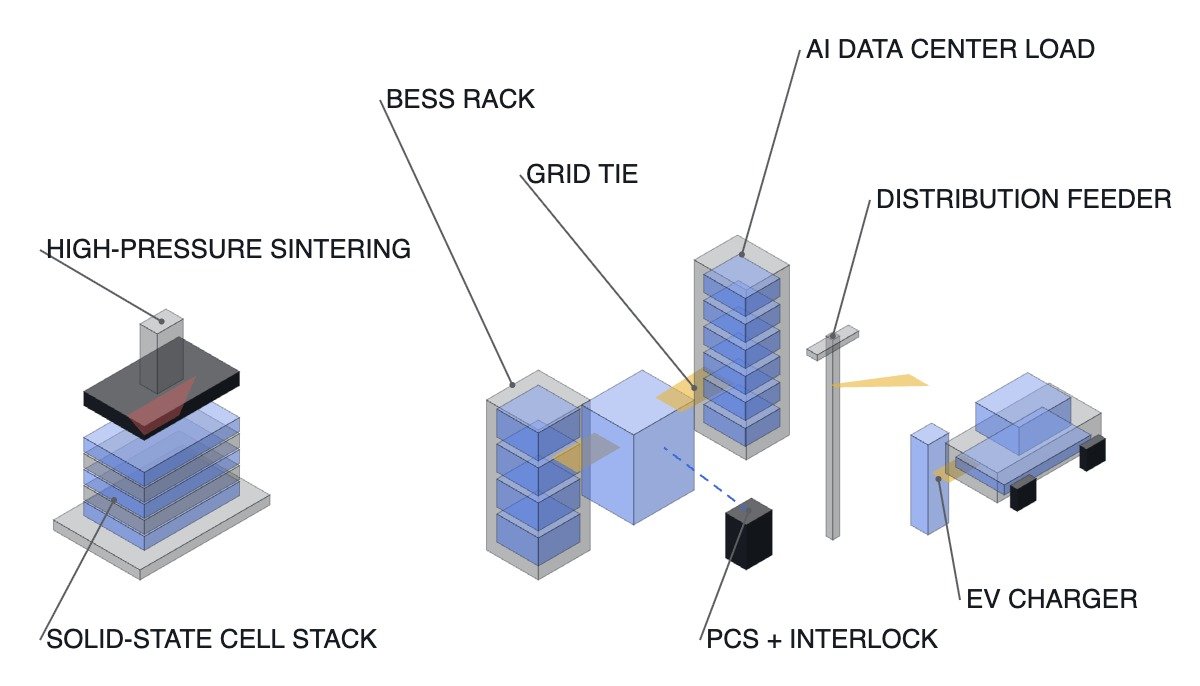
Comparing the power infrastructure requirements of the three axes
| Item | Solid-state batteries | AI data center BESS | Emerging-market EV demand |
|---|---|---|---|
| Core driver | Higher energy density and safety | Handling AI server power peaks | Rollout of charging infrastructure |
| Infrastructure bottleneck | Mass-production process (high-pressure sintering, etc.) | Grid interconnection and response speed | Distribution network capacity |
| Investment horizon | Mid to long term (after mass production) | Short term (responding to immediate demand) | Mid term (infrastructure must come first) |
The table shows that the axis with the shortest investment horizon, and with its bottleneck concentrated on grid interconnection and response speed, is BESS; the solid-state and emerging-market EV axes only see demand realized once upfront infrastructure investment — mass production and distribution network expansion — is complete, and that is where the priorities split.
Specific figures for this table could not be confirmed, so the comparison is limited to item names. Actual mass-production timing, grid interconnection standards and similar details need to be verified.
Implications from an electrical engineer’s standpoint
Of the three axes, the one with the most immediate effect on grid interconnection design is BESS. AI data center power peaks occur on a minute scale, while the response speed of the utility grid often cannot keep up, so BESS ends up playing the buffer role. In this buffer design, it is frequently observed in practice that the response time of the PCS (power conversion system) and interlock logic becomes the bottleneck rather than the specifications of the battery cells themselves. Solid-state batteries are a favorable candidate for BESS in terms of safety, but mass-production cost and process yield remain unconfirmed variables.
Why the three axes require different power equipment
Even with the same battery, the equipment attached before and after it differs depending on where it is connected. Solid-state is still a matter inside the factory, that is, of manufacturing equipment. Emerging-market EVs are a matter of chargers and distribution networks, that is, of customer-side equipment. Only BESS is a matter of grid-side equipment, that is, of the PCS, transformer and breaker configuration. Merge the three axes into one demand curve and this difference disappears.
| Item | What must be in place before demand is realized | Equipment-side criterion |
|---|---|---|
| Solid-state | Mass-production process and yield | Pressure-holding conditions and process takt of pressing and sintering equipment |
| AI data center BESS | Grid connection capacity and permitting | PCS response time, grid interconnection protection coordination |
| Emerging-market EVs | Charging infrastructure and distribution network capacity | Customer transformer capacity, simultaneous charging load |
What this table says is that the bottlenecks of the three axes hang on the approval processes of different organizations. Solid-state is unlocked by the manufacturer’s internal decisions, but BESS and emerging-market EVs depend on the approval speed of grid operators and local governments. No matter how large the market forecast, demand will not be realized faster than that approval speed.
Why the BESS axis is classed as short term
The issue with the load that AI data centers create is its rate of change more than its size. When compute jobs pile up, the load rises in steps, and it is difficult to follow those steps with the output adjustment of grid generators. So the buffer is attached on the load side. What actually determines the response here is not the output characteristics of the cells but the decision time of the PCS control loop and the protective interlock.
From a design standpoint, the order is clear. Fix the protection coordination and interlock conditions first, match the PCS response within those conditions, and choose the cell specifications last. If you fix the cell specifications first instead, the protection settings have to follow the cells, and conflicts with grid-side requirements arise.
Specific values for the response times and settings mentioned here differ by grid code and by project, so they are not given in this post. This requires waveform analysis and field measurement.
How to break down the forecast when reading it
- Scope — Depending on whether it covers cells only or also packs, PCS and installation, the same market can differ by a factor of two or more. This was not confirmed in the original article.
- Regional attribution — If revenue of Chinese companies is not distinguished from installations within China, export volumes are double-counted.
- Overlap among the three axes — BESS exported to emerging markets can be counted on both axes.
Boundary conditions
- The forecast of USD 299.8 billion in 2031 is a projection by a specific research firm, and the methodology behind it (scope: cells only, or up to full systems) was not confirmed in the original article.
- The statement that “AI data center BESS is a core driver” is consistent with the broad trend of surging data center power demand, but the announcement itself did not present grounds in the form of specific projects or orders.
- Emerging-market EV demand must also be read with the point that it is not complete on battery demand alone without accompanying investment in charging infrastructure.
Original article: Global Economic, “‘KRW 400 trillion market by 2031‘… China’s next-generation batteries expand with a ‘solid-state, BESS, emerging markets’ triad,” 2026-09-16 (in Korean)