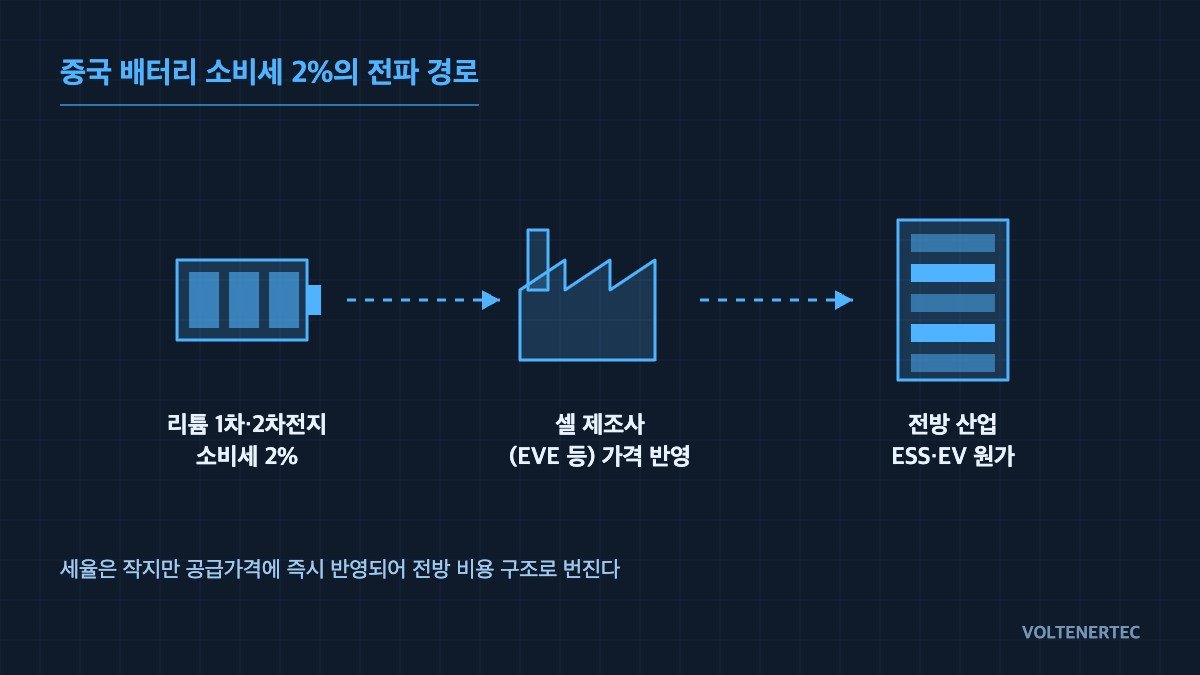
From September, China is imposing a 2% consumption tax on lithium primary batteries and lithium-ion secondary batteries. EVE Energy has already decided to pass it straight through to its supply prices. The rate is small, but it comes with conditions that could affect the cost structure of downstream industries.
Current condition: Lithium primary and secondary batteries have until now been supplied without a separate consumption tax.
After the change: From 1 September, a 2% consumption tax is added to the pre-tax supply price, rising to 4% from September next year. Sodium-ion and all-solid-state batteries are exempt until the end of 2028.
Connecting logic: Not only consumer battery buyers but also customers for traction batteries and ESS batteries may be affected, so the tax burden could spread into downstream industries such as electric vehicles and ESS.
Scope comparison
| Battery type | Consumption tax |
|---|---|
| Lithium primary / lithium-ion secondary | 2% from 2026-09 (4% from 2027-09) |
| Sodium-ion / all-solid-state | Exempt until end of 2028 |
What this table says: The exemption design is effectively a policy lever to encourage a shift to next-generation batteries. The difference in tax rate can act as an incentive for technology transition.
Where the tax lands in an ESS cost structure
For a power systems engineer, the relevant question is not the tax itself but which line of a project budget absorbs it. In an ESS, the battery is only one of several cost blocks. The PCS, transformer, switchgear, enclosure, HVAC, fire suppression and EMS are all procured separately, and none of them is covered by this tax. The tax attaches to the battery supply price, so its effect on a full system is diluted by the share of the battery in the total.
That dilution works differently for different project types. In a short-duration ESS, where power conversion equipment is large relative to stored energy, the battery is a smaller share of the budget. In a long-duration ESS, where the same PCS rating sits on top of much more stored energy, the battery share rises and so does exposure to a battery-only tax. The same 2% therefore does not mean the same thing to a frequency-response project and to a multi-hour shifting project.
The step to 4% in September next year matters more for procurement timing than for the rate itself. Projects that sign supply contracts, take delivery and close out within the 2% window face a different cost basis from projects whose battery deliveries slip past September next year. Delivery schedule becomes a cost variable, not just a construction variable.
Who absorbs it: a qualitative comparison
| Position | Ability to pass on | Main exposure |
|---|---|---|
| Cell maker, tight supply | High | Little in the short term |
| Cell maker, oversupply | Low | Margin or market share |
| ESS integrator, fixed-price EPC | Low once signed | Delivery slipping into the 4% period |
| ESS integrator, price-adjustable contract | Medium | Negotiation with the owner |
| Project owner | None (end of chain) | Higher capital cost per kWh |
This table shows that the tax does not stop at the cell maker. Where the supplier can pass it on, it moves to the integrator; where the integrator is locked into a fixed price, it becomes the integrator’s margin problem; otherwise it ends up in the owner’s capital cost. The contract structure, not the tax rate, decides who pays.
What to check in a procurement
- Identify whether the battery supply is quoted before tax or tax-inclusive, and whether the quote was issued before or after 1 September.
- Check the battery delivery date against the step to 4% in September next year, and whether a slip would move deliveries across that line.
- Check whether the supply contract has a clause that passes tax changes through to the buyer.
- Confirm the chemistry being procured. Sodium-ion and all-solid-state products fall under the exemption until the end of 2028; lithium-ion products do not.
- Separate the battery share from the rest of the system budget, so that the tax effect is calculated on the right base rather than on the total project cost.
Managing cost changes from the integrator side
The tool an integrator has is the quote structure. If battery rack pricing and PCS/BOP pricing are quoted separately, a price adjustment clause for tax changes can be attached to the battery line alone, which keeps the negotiation with the owner narrow and clear. With a single lump-sum quote, a tax change spills over into renegotiating the whole contract. Requiring the pre-tax battery price and the tax amount on separate lines at the request-for-quotation stage gives a clear basis for later settlement.
The operating phase matters too. Cells bought later for augmentation to maintain capacity can fall under the same tax. Augmentation purchases after September next year will be at the higher rate, so for projects with an augmentation plan, whether the tax is reflected in the operating cost model, not only in capital cost, is an item to verify.
Boundary conditions
EVE Energy has said that its current order volume exceeds production capacity, so a price adjustment of around 2% is unlikely to lead to fewer orders. In other words, companies with tight supply can easily pass the tax into prices, but for companies in oversupply the same measure could translate into a loss of market share.
The exemption incentive also has a limit. It only changes a buyer’s choice where a sodium-ion or all-solid-state product already meets the project’s technical requirements; a tax difference does not make an unsuitable chemistry suitable. The single criterion that decides the impact on a given company is whether its supply is tight enough to pass the tax on.