The conclusion first. For large-capacity ESS, where the rack-level target capacity must be met with the fewest series-parallel connections, prismatic cells have the edge. For small to mid-size ESS that borrows the EV mass-production format as-is to lower cell cost, 46-series cylindrical cells have the edge. This article compares the two only from the BMS and cooling-interface perspective, not from the standpoint of mechanical strength or manufacturing methods.
46-series for EVs, prismatic for ESS — a format split that is hardening
In the industry, “46-series cylindrical for EVs, prismatic for ESS” has already become the consensus phrase. Samsung SDI is expanding 46-series cylindrical production for its GM joint-venture plant, while adoption of large-capacity prismatic cells is growing in the ESS battery rack market. For an electrical engineer, this split is not a matter of taste in cell shape; it is where the BMS design burden and the cooling interface design diverge.
Where it wins — prismatic
Current condition: A single ESS rack typically targets a capacity of several hundred kWh, and as the number of cells in series and parallel grows, the number of BMS cell voltage and temperature monitoring channels grows in proportion.
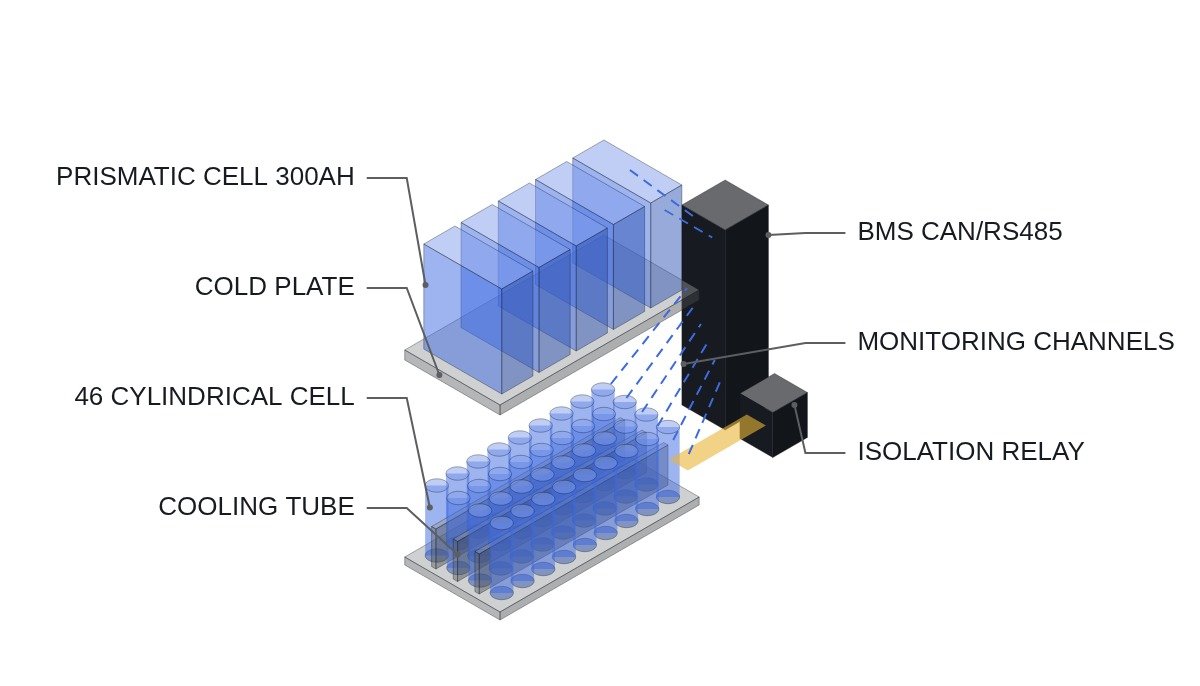
After applying it: Adopting large-capacity prismatic cells (for example, the 300Ah class) reduces the number of cells per series string for the target capacity, which lowers both the number of BMS monitoring channels and the CAN/RS485 communication polling load.
Connecting logic: A lower communication load leaves room to shorten the data sampling period, which can improve cell balancing responsiveness and anomaly detection speed (the delay in detecting a temperature threshold being exceeded).
Where it doesn’t — 46-series cylindrical
Cylindrical cells, on the other hand, let ESS share the mass-production advantages of a standardized EV format, which makes their cell price competitive. Because of their geometry, cylindrical cells are known to delay heat propagation to neighboring cells for longer than prismatic cells when an individual cell goes into thermal runaway, which can buy time for early fire detection and response. However, this is a cell-level characteristic, and measured values can differ depending on the pack- and rack-level cooling design (whether a liquid-cooled cold plate is used), so I do not state it as settled — checking measured data is recommended.
Comparison table
| Item | Prismatic | 46-series cylindrical |
|---|---|---|
| Cell capacity tendency | Large capacity (200–300Ah class) | Small to mid capacity, standardized format |
| Series-parallel layout | Fewer cells per string | More cells per string |
| BMS channel density | Low | High |
| Cooling interface | Easy to secure cold-plate contact area | Requires cooling-tube or module-level design |
| Cell price competitiveness | Depends on ESS-dedicated production scale | Shares EV mass production |
As the table shows, cell format selection is decided by “BMS communication load design” before “fire safety.” In field practice the fire safety issue gets the attention, but the real bottleneck at the early design stage is the channel count and the communication cycle time.
What channel count means inside the BMS
The channel count in the table is not an abstract figure. Each cell voltage and temperature point is a signal that must be measured, digitized, passed up through the module-level monitoring units and polled by the rack-level controller over CAN or RS485. The more points there are, the longer one full polling cycle becomes for a given bus, and the older the newest reading of any given cell is at the moment a decision is made.
This is why the format choice reaches the protection side as well. An interlock that opens the disconnect relay on an over-temperature condition can only act on a reading the controller has actually received. A longer polling cycle does not change the threshold, but it changes how late the threshold crossing is seen. The comparison between the formats is therefore also a comparison of how much time margin the communication design leaves for the interlock. The actual cycle time of any given bus depends on the devices and wiring, so it requires waveform analysis and field measurement rather than a calculated value.
The cooling interface follows a similar logic. A flat prismatic face offers a direct contact surface for a cold plate, while a cylindrical cell’s curved surface needs cooling tubes or module-level structures to achieve contact. From the electrical side, this changes where temperature sensors are placed and how representative each sensor is of the cells around it — which again feeds back into how many temperature channels the BMS needs.
Character comparison from the rack designer’s side
| Aspect | Prismatic | 46-series cylindrical |
|---|---|---|
| Where design effort goes | Thermal contact at a large cell face | Managing many cells and channels |
| BMS polling burden | Lighter per rack | Heavier per rack |
| Temperature sensor placement | Fewer, larger cells to cover | More cells per sensor to represent |
| Supply-side advantage | ESS-specific cell designs | EV-standard volume |
| Early fire-response margin | Depends on rack cooling design | Cell-level propagation delay, subject to measurement |
Read together, the two tables point to the same place: the prismatic advantage lives in the control and communication layer, the cylindrical advantage lives in the supply chain and at the individual cell level. Which one matters more depends on whether the project’s constraint is BMS design capacity or cell purchase cost.
Check items before fixing the cell format
- □ Fix the rack-level target capacity first, then derive the series-parallel layout for each candidate format.
- □ Count the BMS voltage and temperature channels that each layout requires.
- □ Confirm whether the chosen CAN/RS485 architecture can poll that channel count within the cycle the protection logic needs; confirm by measurement rather than assumption.
- □ Check how the cooling structure (cold plate or cooling tubes) fits each format, and where temperature sensors can be placed.
- □ Treat the cylindrical heat-propagation delay as a cell-level characteristic and request measured data at the pack and rack level.
- □ Confirm that the over-temperature disconnect interlock is part of the design for either format, independent of which one is chosen.
Boundary conditions — where the advantage flips
If a 46-series cylindrical design fills the target capacity by increasing the number of parallel strings per rack, the BMS channel-count advantage disappears. In other words, the real selection criterion is not the “cell format” but the “series-parallel design approach relative to the rack’s target capacity.” When designing the fire interlock, either format needs logic that opens the disconnect relay when the pack temperature exceeds its threshold, and this safety interlock must not be bypassed by software alone.
Conversely, if the project’s dominant constraint is cell purchase cost rather than BMS design capacity, the judgment tilts toward cylindrical cells despite the heavier channel load. The single selection criterion is this: for the series-parallel layout that fills the rack’s target capacity, does the BMS polling cycle fit within the time margin the over-temperature interlock requires?
References: Digital Daily, “46-series for EVs, prismatic for ESS becoming mainstream” (2026-04); Samsung SDI patent US11888172B2 “Battery Pack with Obliquely Arranged Cells and Cooling Channels”; US7680613B2 “Battery Management System (BMS) and Driving Method Thereof”; US20170110773A1 “Battery Module Including a Cooling Plate with Embedded Cooling Tubes”