To put the conclusion first: grid impact assessments for data centers in the Seoul metropolitan area resulted in only 4 approvals out of 195 applications between August 2024 and June 2025 (a 2.1% approval rate), so waiting is effectively the default. The AIDC Special Act, taking effect in February 2027, exempts projects from this assessment altogether, but only for sites outside the metropolitan area. For developers who want to bring their construction start forward, reviewing a move outside the metropolitan area first is favorable under a wider range of conditions than checking spare capacity in the metropolitan area. Still, an exemption from the assessment does not remove the burden of interlock and protective relay design.
1. Where it wins — outside the metropolitan area, under the AIDC Special Act
Current condition: 60% of data center sites and 70% of data center power demand are concentrated in the Seoul metropolitan area. Only 4 of 195 grid impact assessment applications in the metropolitan area were approved (2.1%), and the combined 9.36GW required by 150 new data centers seeking supply by 2030 is about 4.7 times the total receiving capacity currently in operation (1,986MW).
Change after application: The AIDC Special Act, passed by the National Assembly plenary session on May 7, 2026 and taking effect in February 2027, exempts AI data centers outside the metropolitan area from the grid impact assessment and introduces a special provision for direct PPAs with power producers and a 150-day timeout rule for permitting.
Connecting logic: From an electrical design perspective, the exemption means the review wait disappears; it does not mean the protective relay and interlock design requirements are waived. Because construction can start without waiting, the interlock logic needs to be fixed even more carefully at the early design stage.
2. Where it doesn’t — staying in the metropolitan area, targeting a start before February 2027
The reasons data centers cluster in the metropolitan area (customer proximity, telecom infrastructure) remain valid after the Special Act takes effect. The Act takes effect in February 2027, so until then the metropolitan area stays under the 2.1% approval-rate condition. In the short term (2026-2028), on-site generation with LNG fuel cells or gas turbines is the realistic alternative — the IEA has analyzed that even in the United States, 15-27GW of on-site gas generation could be installed by 2030 because of grid connection delays. Developers who need to start construction before 2027 should first review a design that bypasses grid interconnection itself with an on-site generation plus ESS combination, rather than waiting in the metropolitan interconnection queue.
3. Comparison table
| Item | Waiting in the metropolitan area | Outside, under the AIDC Special Act |
|---|---|---|
| Grid impact assessment | Required (2.1% approval rate) | Exempt |
| Permitting deadline | None specified | 150-day timeout rule |
| Power procurement | Supply from the KEPCO grid | Special provision for direct PPAs with power producers |
| Tax credit | Not applicable | Up to 15% for large firms, up to 25% for SMEs (under discussion) |
| Effective date | Currently in force | February 2027 |
Implication: The dividing point in the table is not whether the assessment is exempted but the effective date. The first thing to confirm is that projects which must start construction before February 2027 cannot yet receive the institutional benefits of the Special Act.
4. Checklist — interlock items to review before starting interconnection design
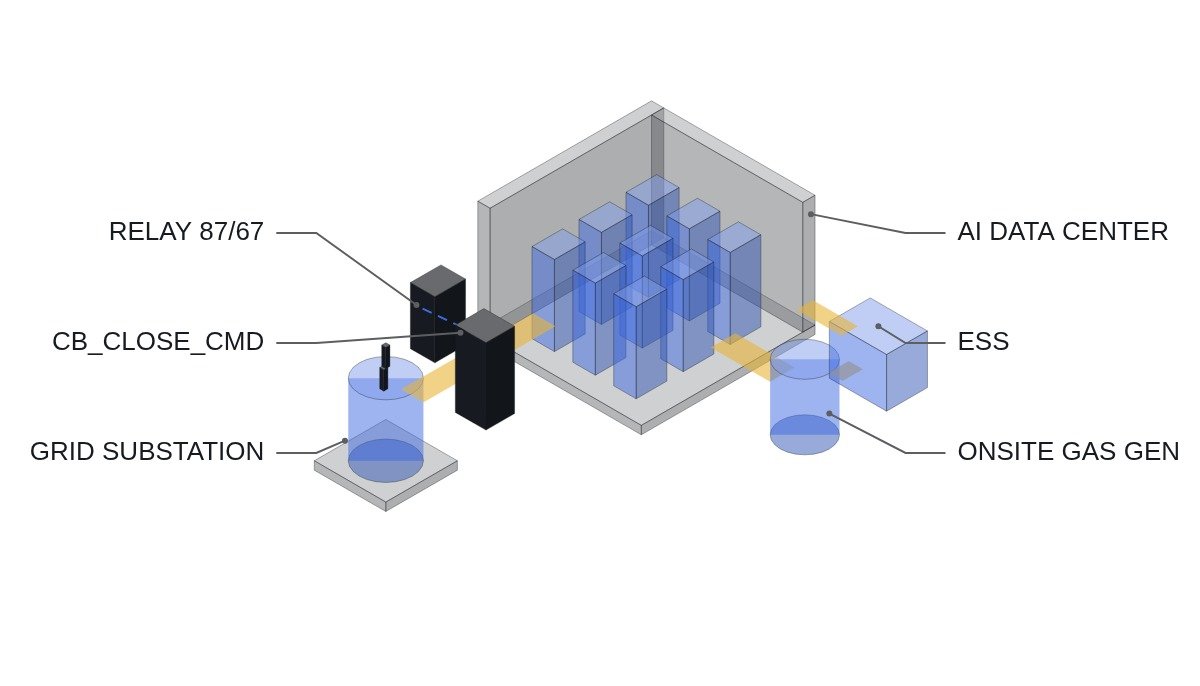
Check the safety interlock conditions first. CB_CLOSE_CMD (breaker close command) is executed only when all of the signals below are TRUE; if any one is FALSE, an interlock must be raised and an alarm displayed on the upper-level HMI.
| I/O tag | Type | Operating condition note |
|---|---|---|
| SIG_GRID_SYNC_OK | BOOL, DI | Grid synchronization detection signal. CB closing prohibited before phase and frequency match is confirmed |
| INTLK_PROT_RELAY_TRIP | BOOL, DI | Protective relay (87/67) trip interlock. Forces the upper-level sequence to stop when a trip occurs |
| SIG_COMM_HEALTH_OK | BOOL, DI | Remote protective relay communication channel healthy signal. Prevents spurious trips on communication loss; judged separately on the condition that two or more remote signals agree |
| SIG_PPA_METER_SYNC | BOOL, DI | Direct PPA metering synchronization signal (when the non-metropolitan provision applies) |
| EMO_HW_STATUS | BOOL, DI | Status of the emergency-off hardware circuit — software bypass strictly prohibited; remains hardwired |
5. Boundary conditions
If the SIG_COMM_HEALTH_OK signal gives false readings because of communication errors or noise, the interlock must not be released arbitrarily without measured waveform analysis — requires waveform analysis and field measurement. Also, even outside the metropolitan area, if the local distribution network has no spare capacity, grid interconnection can be delayed regardless of the Special Act. In that case, the advantage presented in this comparison is reversed.
References
- Korea Data Economy News, “[In-depth report] Analysis of data center power demand scenarios in the 12th Basic Plan for Electricity Supply and Demand — 2026-2030 supply gap outlook”, 2026-05-21
- AIDC Special Act (passed by the National Assembly plenary session on 2026-05-07, effective 2027-02)
- Patent: US11705723B2 (University of Toronto, “System and method for protection of an electrical grid”, granted 2023-07-18) — a communication-reliability-based protection logic that decides breaker tripping on the condition that signals from two or more remote directional protective relays agree. Directly related to the SIG_COMM_HEALTH_OK design logic above