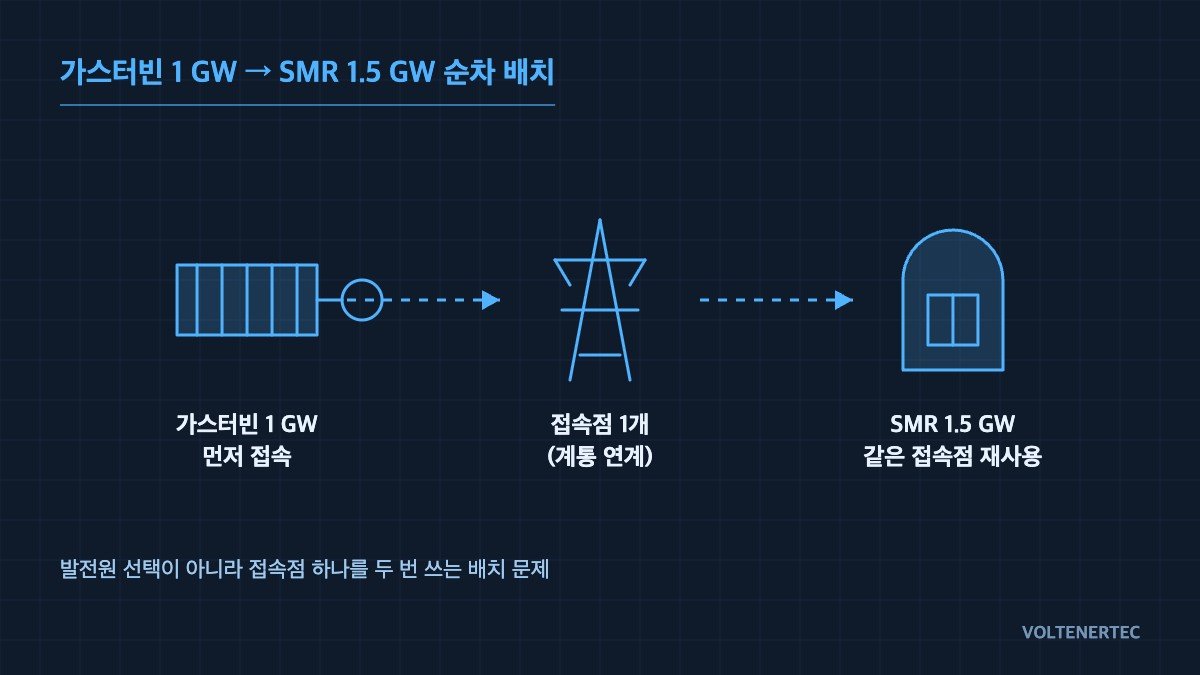
To state the conclusion first: the Texas contract combining 1 GW of gas turbines with 1.5 GW of small modular reactors (SMRs) is not a choice of “nuclear or gas.” It is a sequential deployment designed to use one grid connection point and one site twice. It splits two questions across two different kinds of plant — how soon the power must be secured (speed) and where fuel costs should be locked in twenty years from now (cost structure) — and it is worth considering in regions where securing connection capacity binds before the cost of generation does.
1. What the contract says
Blue Energy and GE Vernova advanced to the next stage an agreement to deploy, in Texas, two gas turbines (about 1 GW) combined with up to five BWRX-300 SMRs (about 1.5 GW), for a total of 2.5 GW. The final investment decision (FID) is targeted for 2027. In other words, what is fixed today is the site and the configuration, not reactor construction.
Two background conditions matter. First, gas turbine lead times have stretched beyond three years, and the order backlog at a major supplier has built up to around 70 GW. Second, with part of the federal long-distance transmission corridor designations cancelled, it has become harder to count on wide-area transmission expansion. Both generators and lines now have to wait in line.
2. Where it wins — regions where connection capacity is the bottleneck
The current condition is this. Large loads need power within two to three years, but new interconnection studies take longer than that, and transmission reinforcement takes longer still. Here, connection capacity becomes a scarce resource in its own right, independent of generation cost.
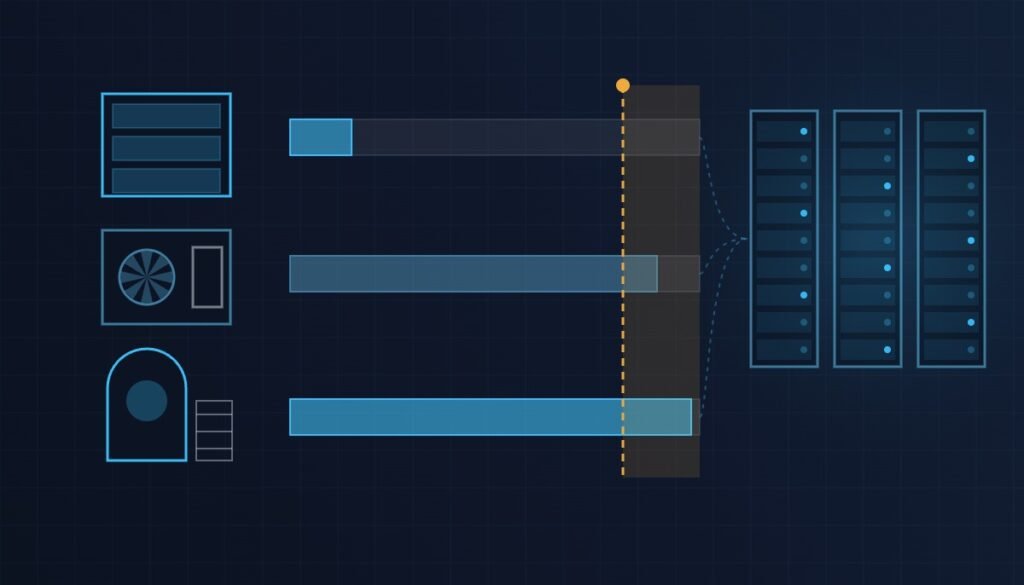
Applying sequential deployment changes the picture as follows. The gas turbines come in first, physically occupy the connection capacity and start producing revenue. The SMRs then enter the same site in sequence, shifting a substantial part of generation toward a source with low fuel-cost volatility. The interconnection study is taken once, for 2.5 GW from the start, and the capacity is filled in along the time axis.
The connecting logic is here. The real benefit of this approach is not lower generation cost but spreading permitting and interconnection schedule risk across two technologies. If the SMR schedule slips, the business does not stop outright; gas alone still supports a minimum revenue structure.
3. Where it doesn’t — regions where gas is already cheap and fast
The opposite condition is just as clear. In a region where gas is easy to procure, turbine delivery slots are secured and carbon regulation pressure is weak, adding SMRs only increases total capital cost and the permitting burden. SMRs depend on repeated construction of a standard design to shorten build times, and early units do not fully receive that benefit. This configuration is closer to a combination that holds because “gas cannot be obtained” or “carbon cannot be increased.”
4. Comparison by source — from the standpoint of securing supply for load
| Item | Gas turbine (CC) | SMR (BWRX-300 class) | Wait for grid |
|---|---|---|---|
| Supply start | Relatively fast if 3+ year turbine delivery is secured | Long including licensing; more uncertain for early units | Tied to transmission reinforcement schedule |
| Unit size | Additions in the hundreds of MW | Repeated modules of about 300 MW | N/A |
| Fuel cost exposure | Directly linked to gas price | Low fuel share; capital cost dominates | Linked to grid tariffs |
| Load following | Excellent | Baseload-oriented; following is limited | N/A |
| Carbon regulation risk | High (possible long-term stranded asset) | Low | Neutral |
| Main source of delay | Equipment delivery | Licensing, early-unit learning | Permitting, land, cost allocation |
What to read from the table is that the three columns are not substitutes for one another. Because the sources of delay sit in different places — equipment, licensing and transmission respectively — layering two of them reduces the variance of the overall schedule. What this contract targets is not the average cost but the variance of the schedule.
5. One more point from the grid-operations side
Around the same time, China’s Haiyang Unit 3 (CAP1000) completed hot functional testing, and the US Northwest regional plan proposed 11 GW of new generation together with 5 GW of storage by 2032. The direction is the same: large baseload plant and storage resources are starting to be handled within the same planning table.
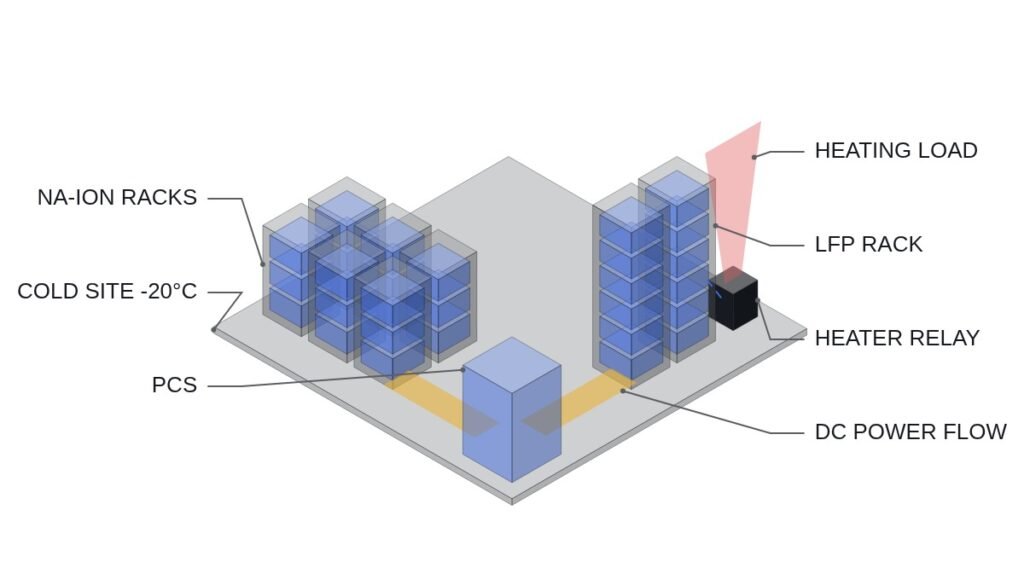
In practical terms, as the share of baseload plant grows, load following and spinning reserve move over to storage resources. If the location and connection method of battery storage (BESS) are not decided together at the SMR site design stage, the same connection point will have to be reopened later.
6. Boundary conditions and selection criterion
The point at which this configuration’s advantage flips is clear. If the SMRs are delayed or scaled back at the FID stage, the project gets locked into gas alone. The connection capacity has already been filled with gas, and if carbon regulation tightens, the stranded-asset risk remains within the payback period. Sequential deployment spreads risk, but it is also a structure that pays up front for the risk that the follow-on plant never arrives.
So the criterion narrows to one question: does the business case hold with the gas-only configuration if the follow-on SMRs are cancelled? If it does, sequential deployment is a rational way to spread risk; if it does not, it is not a hybrid but a single bet placed entirely on the SMR schedule. It is safer to decide by the answer to this question than by the contract structure.
References
- Blue Energy and GE Vernova advance gas-plus-nuclear collaboration — World Nuclear News
- Hot functional tests completed at Haiyang Unit 3 — World Nuclear News
- Gas turbine backlog of 70 GW and transformer capacity expansion — Utility Dive
- US DOE cancels three national transmission corridor designations — Utility Dive
- Northwest power council proposes 11 GW of new generation and 5 GW of storage — Utility Dive