To state the conclusion first: there are two ways to use heat from the ground, converting it to electricity with geothermal power, or using it directly as heat with a ground-source heat pump. What separates them is not the equipment but resource temperature. Where a high-temperature resource has been confirmed, geothermal power becomes weather-independent baseload. But making electricity from medium- or low-temperature resources outside volcanic zones means a small temperature difference, a low theoretical efficiency from the outset, and deep-drilling risk on top. In such regions, underground heat is worth most as a heat-pump source rather than for power, especially when it lowers electricity demand during cold-snap peaks.
Where It Wins, Where It Doesn’t
Under current conditions, building heating and cooling is handled mainly by fuel boilers or air-source heat pumps. Air-source units are simple to install, but their performance is tied directly to outdoor temperature. Heating load peaks on the coldest day, exactly when the heat source, outdoor air, is coldest, so efficiency drops and power consumption rises.
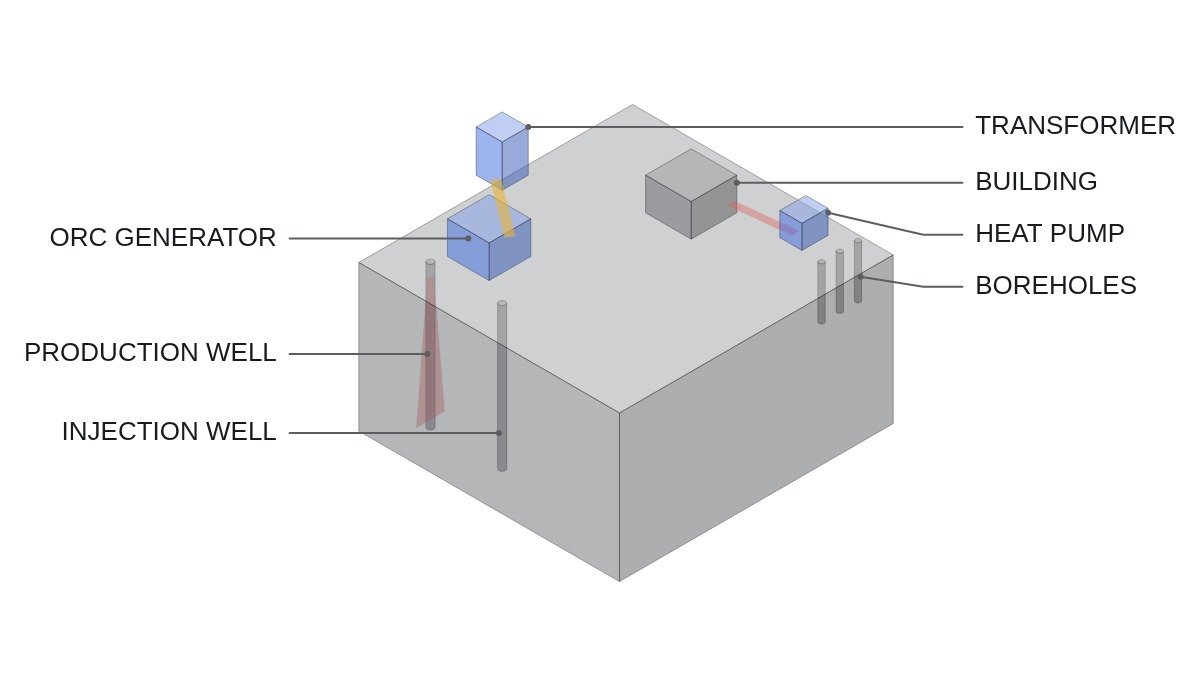
A ground-source heat pump moves the heat source from outdoor air into the ground. Below a certain depth, ground temperature varies little with the seasons, so even in midwinter it offers a heat source warmer than outdoor air. In summer it becomes a heat sink cooler than outdoor air. The added cost is up front: borehole drilling and construction of the ground heat exchanger.
Geothermal power is a different problem. It has to lift hot geothermal fluid to drive a steam turbine or an organic Rankine cycle (ORC) turbine, so the resource must be hot enough and drilling must go deep. Once a high-temperature resource is confirmed, it becomes baseload with steady output year-round; drilling while the resource is still uncertain leaves the developer carrying the full cost of exploration failure.
The connecting logic is this. For the same underground heat, the lower the temperature, the more physically favorable it is to use it as heat rather than convert it to electricity. Power generation extracts work from a temperature difference and loses heavily at low temperatures, whereas a heat pump turns a small temperature difference into a high coefficient of performance (COP).
The Two Approaches Through Their Thermodynamic Limits
On the power side, the ceiling is Carnot efficiency, η = 1 − Tc / Th (absolute temperature). Assumption: geothermal fluid at 150 °C (423 K), cold side at 30 °C (303 K). Then η = 1 − 303/423 ≈ 28.4%, and a real ORC plant falls well below this ceiling because of heat-exchanger, pump, and turbine losses. With a cooler resource the ceiling itself drops further.
On the heat-pump side, the ceiling is the ideal heating COP = Th / (Th − Tc). Assumption: heating supply water at 35 °C (308 K). Calculated by source temperature, the results are shown in the table below. Real COP is much lower because of compressor and heat-exchange losses, but this calculation does show how far the ceiling moves with source temperature.
| Heat source | Source temp. | Ideal COP |
|---|---|---|
| Outdoor air (cold snap) | −10 °C (263 K) | 308/45 ≈ 6.8 |
| Outdoor air (assumed winter mean) | 0 °C (273 K) | 308/35 ≈ 8.8 |
| Ground (assumed) | 15 °C (288 K) | 308/20 = 15.4 |
What the table says is not about annual average efficiency but about the gap on the coldest day. As outdoor temperature falls, the air-source ceiling keeps dropping while the ground source barely moves. During cold-snap peaks, when heating power demand bunches up, a ground-source heat pump produces the same heat with less electricity, and that difference lowers both the site’s contracted demand and the grid’s peak load.
What to Watch on the Power System Side
A heat pump is not a generator but an electrical load. Put many heat pumps in a large building or complex, and compressor inrush current at start-up and harmonics from inverter drives affect the service equipment. Sequence starts to avoid simultaneous starting, and check harmonic impact where inverter compressors dominate; the actual distortion requires waveform analysis and field measurement.
Ground heat exchangers have a long-term thermal imbalance problem. A cooling-dominated building dumps heat into the ground every summer and takes less back in winter, so ground temperature creeps up year by year; a heating-dominated building pulls it down. This accumulation slowly erodes COP, so the annual heating-cooling balance must be calculated at design stage and ground-loop fluid temperature monitored as a long-term trend in operation.
| Item | Geothermal power | Ground-source heat pump |
|---|---|---|
| Resource needed | Hot fluid or hot rock | Shallow ground heat |
| Drilling depth | Deep | Shallow boreholes |
| Output | Electricity (baseload) | Heating and cooling |
| Performance metric | Thermal efficiency | COP |
| Main risk | Exploration failure, induced seismicity | Ground thermal imbalance |
| Grid effect | Adds a generating source | Cuts peak load |
The two share a name but play opposite roles on the grid. Geothermal power is equipment that adds supply; a ground-source heat pump is equipment that cuts demand. Which one wins should be recast as whether the region is short of baseload generation or of winter peak margin.
The Social Risk of Deep Drilling
Geothermal power outside volcanic regions leads to enhanced geothermal systems (EGS), which inject water into deep rock to create artificial heat-exchange pathways. High-pressure fluid injection in that process carries a risk of induced earthquakes. In Korea, a government investigation panel concluded in 2019 that the 2017 Pohang earthquake was triggered by fluid injection at a nearby geothermal power demonstration project, and since then deep geothermal projects have had to pass the test of public acceptance before the technical one.
A shallow ground-source heat pump only exchanges heat in closed-loop boreholes within a few hundred metres, so it is far removed from that kind of risk. Instead, grouting quality to prevent groundwater contamination and borehole spacing design become the core of construction quality.
Decision Sequence
- Confirm whether resource-temperature data from actual drilling exists for the area. If not, treat any power study as an exploration project.
- If power generation is under study, put the induced-seismicity management plan and local acceptance process ahead of everything else in the schedule.
- If a heat pump is under study, calculate annual heating/cooling load and cold-snap peak load separately.
- Calculate peak-power reduction versus air-source units and reflect the savings in contracted demand and service equipment.
- Calculate ground thermal imbalance and decide borehole count and spacing and whether an auxiliary heat source is needed.
Items to verify are kept separate. All temperatures and COP values in this article are assumptions for comparison, not the ground temperature of any specific area or the actual COP of any unit. Real values must be confirmed through an on-site thermal response test and manufacturer performance data.
Boundary Conditions
The ground-source heat pump advantage flips when heating and cooling loads are small or run hours are short, leaving too few hours to recover the drilling cost. In mild climates where cold snaps are rare, the peak gap versus air-source narrows and the advantage weakens. Buildings heavily skewed toward either cooling or heating lose long-term performance without auxiliary equipment.
The geothermal power advantage holds only when a high-temperature resource has been confirmed by drilling. It then becomes a rare renewable source with weather-independent year-round output; before confirmation it should be handled as an exploration project, not a power project.
The single decision criterion is this: if drilling measurements show a resource hot enough to run a power cycle, build geothermal power; if not, use the ground as a heat-pump source, not for power.