When the number of renewable generators is small and the market is just forming, a direct subsidy scheme (FIT, feed-in tariff) has the advantage. Conversely, once bidders multiply and the hosting capacity of substations and transmission lines emerges as the bottleneck, an auction scheme has the advantage. The shift in renewable subsidy policy recently summarized by the IEA follows this boundary line closely, and the reason many countries are cutting direct subsidies and moving to auctions ultimately comes down to managing the fiscal burden.
Where it wins: conditions that favor direct subsidies
Current condition: the market is in its early formation stage, with few participating developers, and technology risk and upfront investment are high enough that attracting private capital at all is the key issue. At this stage, a scheme that guarantees a fixed price per kWh generated over a long period (typically 15–20 years) is decisive in getting projects through lenders’ project finance (PF) review.
Change after applying it: with guaranteed fixed revenue, new developers enter and deployment accelerates. However, the government’s fiscal burden accumulates in direct proportion to added capacity, and because the support price is fixed at the time of contract even if market prices fall, adjusting it after the fact is difficult.
Connecting logic: once the deployment target is largely met, the accumulated fiscal burden becomes a political issue, which in turn creates pressure to switch to auctions. Both domestic and international cases have followed this sequence.
Where it doesn’t: conditions that favor auctions
Current condition: enough competing developers exist for price competition to work, and the hosting capacity of substations and transmission lines acts as a real constraint on new projects.
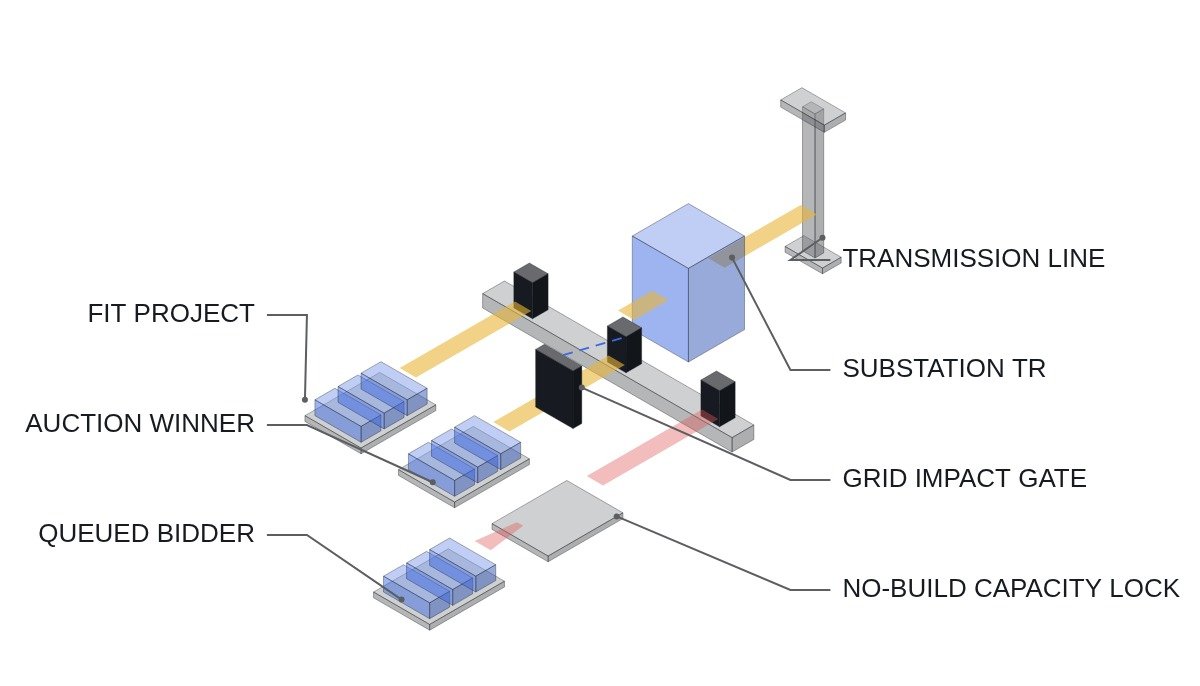
Change after applying it: competitive bidding among developers drives award prices down and reduces government spending. At the same time, the no-build risk grows, where a developer that bid too low abandons the project before completion; when this happens, grid connection capacity ends up tied up for a long time as a side effect.
Connecting logic: to reduce no-build risk, schemes are being reinforced by raising performance bonds and making a prior grid impact assessment a bid qualification requirement.
| Item | Direct subsidy (FIT) | Auction |
|---|---|---|
| Best-fit stage | Early market, few developers | Many competitors, grid capacity constraints emerging |
| Fiscal burden | Accumulates with added capacity | Relatively reduced by competitive bidding |
| Price discovery | None (fixed price) | Yes (competitive bidding) |
| Main risk | Deteriorating fiscal soundness | No-build after low bid |
| Grid impact assessment | Individual review after the fact | Can be required up front as bid qualification |
As the table shows, the dividing line between the two schemes comes down to two questions: does competition actually work, and is grid hosting capacity a binding constraint? In a situation like Korea’s, where the approval rate of grid impact assessments for data centers in the Seoul metropolitan area has fallen to 2.1%, even an auction scheme has a structural limit: unless the grid impact assessment is set as a precondition before bidding, only the bidding war overheats while the actual completion rate does not rise.
Boundary conditions: when this conclusion flips
In areas near substations where hosting capacity is extremely limited, auctions can actually backfire. While a low-bid winner that failed to secure financing delays construction, that substation’s connection capacity stays locked up in the winner’s name. Lower-ranked developers are blocked from entering because no capacity is left, and the paradoxical result is that deployment proceeds more slowly than it would under direct subsidies. Under these conditions, a hybrid scheme that mixes auctions and direct subsidies while making grid impact assessment approval the first-priority bid qualification outperforms a pure auction. Reduced to a single criterion, the final basis for choosing should be not “does competition work” but “is the risk of grid capacity hoarding under control.”
References
- IEA, Global Energy Review — trends in renewable subsidy policy transition
- KDI Economic Information Center, global renewable energy market status and 2030 deployment outlook (IEA)
- Today Energy, Korea LCOE analysis projects solar as the cheapest generation source by 2030
- US Patent US8527389B2, Bidding for energy supply to resellers and their customers