Bottom line first. In warehouse forklifts, the ground where fuel cells beat lithium-ion is narrower than it looks. Fuel cell forklifts were strong because of the lead-acid battery swap room and swap time, and lithium-ion opportunity charging (topping up during breaks) has erased most of that reason. Two decision variables remain: can the energy used in a shift be put back during the stops within that shift, and can the service equipment absorb the coincident charging peak created when the whole fleet breaks at the same time. Only in large three-shift warehouses where one of those is blocked does a fuel cell justify its plant investment.
Where it wins, where it doesn’t
Here is the current state. A lead-acid forklift had to have its whole battery swapped after each shift. Swap room floor space, swap equipment, an inventory of spare batteries on charge, and the labour and time for swapping were all operating cost. The fuel cell forklift removed all of that with a 2 to 3 minute refuel, which is why the case held up in large multi-shift warehouses.
Lithium-ion changes the picture. Because partial charging costs lithium-ion far less cycle life than lead-acid, trucks can be plugged in during meal and rest breaks. Spare batteries and the swap room disappear, so the cost items fuel cells used to eliminate are eliminated by lithium-ion too. What remains for the fuel cell is narrower: “operations stay stable even when stop time is short or everyone stops at once”.
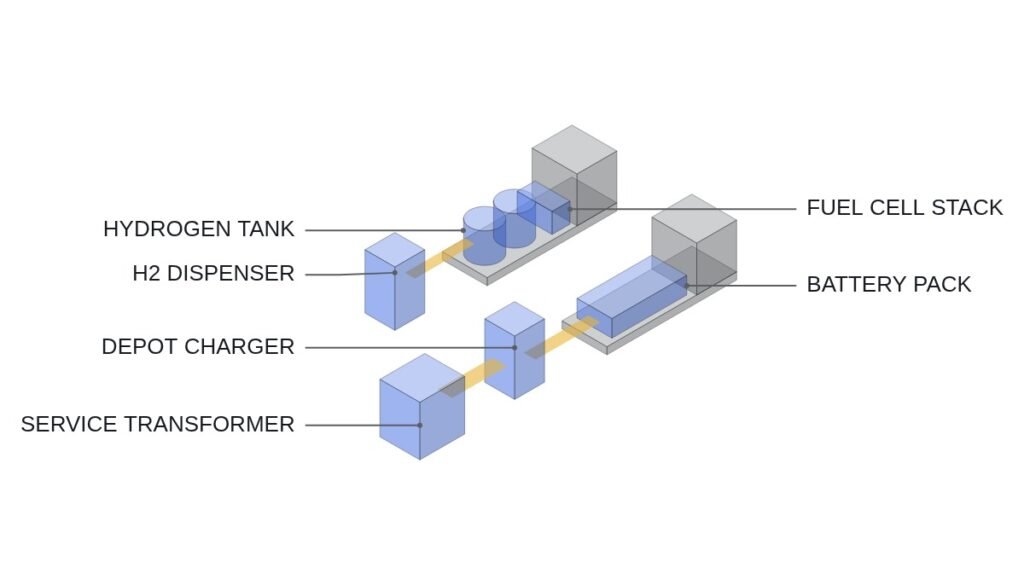
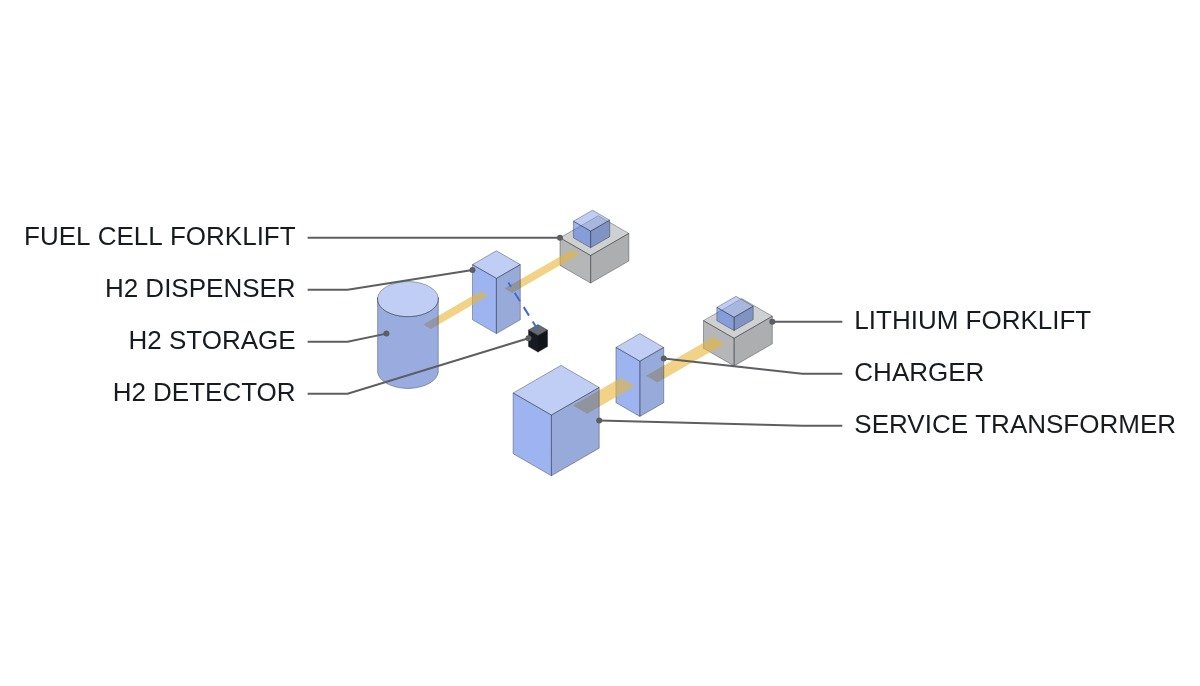
Adopting fuel cells shifts things in the other direction. Hydrogen storage and a dispenser move into or next to the warehouse, and the surrounding area becomes subject to hazardous area classification. On the electrical side you add explosion-protected equipment selection and shutdown interlocks tied to ventilation and hydrogen detection. The charging peak goes away, but the list of things to manage grows.
The connecting logic: lithium-ion’s weakness is not the battery itself but the warehouse operating conditions of stop time and service capacity, and the fuel cell’s strength is that it sidesteps those conditions. If you can solve them by adjusting operations, choose lithium-ion. If you cannot, choose fuel cells.
Energy balance per shift
Look at one truck’s balance per shift with assumed values. Assumptions: counterbalance forklift average power 4 kW (travel, lifting and idle averaged over the full 8-hour shift), so 4 × 8 = 32 kWh per shift. Usable lithium-ion pack capacity 30 kWh. Under these conditions the pack cannot quite last a full shift; it needs at least 2 kWh during in-shift stops, and 32 kWh to hand the next shift a full pack.
Assume in-shift stop time: 45-minute meal, two 10-minute breaks and a 15-minute handover, 80 minutes in total. With a 25 kW charger and 20 kW effective power, 80 minutes delivers 20 × 80 ÷ 60 ≈ 26.7 kWh. Using 32 kWh and putting back 26.7 kWh leaves a deficit of about 5.3 kWh per shift, about 16 kWh after three shifts. A 30 kWh usable pack hits its lower limit during the first shift of day two.
There are three ways to close that deficit: a larger pack, a more powerful charger, or longer stops. The first two cost money; the third costs productivity. A fuel cell truck under the same conditions refuels in 2 to 3 minutes per shift, so no deficit arises at all. Assuming 50% stack system efficiency and a hydrogen lower heating value of 33.3 kWh/kg, 32 kWh per shift needs 32 ÷ 0.5 ÷ 33.3 ≈ 1.9 kg of hydrogen.
Comparison by warehouse operating condition
| Operating condition | Lithium-ion | Fuel cell |
|---|---|---|
| 1 shift, idle overnight | Wins. Overnight charge covers it | Loses. Refuelling plant is overkill |
| 2 shifts, gap between | Wins. Charge in the gap | Loses. No advantage |
| 3 shifts, staggered breaks | Usually wins. Check the deficit | Neutral |
| 3 shifts, simultaneous breaks | Loses. Coincident charging peak | Wins. No peak |
| Site where service can’t grow | Loses. No room for chargers | Wins. Small service impact |
| Small fleet (a few trucks) | Wins | Loses. Fixed refuelling cost too high |
Only two rows favour the fuel cell, “3 shifts, simultaneous breaks” and “service can’t grow”, and both are warehouse conditions that have nothing to do with battery performance. A fuel cell forklift study is therefore not a vehicle comparison; it starts by checking the break schedule and the spare service capacity.
Coincident charging peak and the service
The first number the electrical lead should calculate is the coincident charging peak at meal time. Assumptions: 60 forklifts, 25 kW chargers. If the whole fleet eats during the same 45 minutes, 25 × 60 = 1,500 kW, or 1.5 MW, lands at once. If the existing warehouse service was sized for lighting, HVAC and conveyors, that peak easily exceeds transformer capacity.
This peak can be cut by operations rather than plant. Split meal times into three groups by zone and the number of trucks charging at once drops to 20, so the peak becomes 500 kW. Add a total charging power cap in the charger management system and allocate power to the lowest-SOC trucks first, and the peak falls further. The thing to weigh against the cost of fuel cells is not the price of a lithium-ion truck but the cost of re-arranging breaks and capping charging power, and that is the core point of this article.
| Plant item | Lithium-ion | Fuel cell |
|---|---|---|
| Energy supply plant | Chargers, service | H2 storage, dispenser |
| Service peak impact | Large (trucks × charger kW) | Small (refuelling plant load) |
| Hazardous area classification | Normally not required | Required for storage and fuelling |
| Additional interlocks | Charger overtemp, earth monitoring | H2 detection, ventilation-linked trip |
| Reference standards | IEC 62619 (industrial lithium safety) | IEC 62282 series, NFPA 2, IEC 60079-10-1 |
The takeaway from the second table is that fuel cells remove the service peak at the price of bringing hazardous areas and interlock scope inside the warehouse. The circuit that hardwire-trips the refuelling plant supply on a hydrogen detection signal, and its link to the ventilation system, must be fixed at the design stage before adoption; it is not something to handle in the control program alone.
Decision sequence
- Get energy used per shift (kWh) for each truck from the WMS or vehicle telematics. If there is no data, fit meters to a few pilot trucks and collect for one to two weeks.
- Tabulate the stop schedule per shift (meals, breaks, handover) by zone.
- Multiply stop time by effective charging power to get the energy put back per shift, and compute the deficit against usage.
- Multiply the number of trucks charging at once by charger rating to get the peak, and compare it with transformer headroom.
- If there is a deficit or the peak overflows, first calculate whether staggered breaks and a charging power cap solve it; consider fuel cells only if they do not.
Items to verify: average forklift power varies widely with lift frequency, load weight, travel distance and floor gradient. The figures here are assumptions used to show the procedure and must be replaced with measured values.
Boundary conditions
Lithium-ion’s advantage flips under these conditions. First, when the break schedule cannot change. If labour agreements or process synchronisation require everyone to break at the same time, the coincident peak cannot be cut by operations. Second, when a transformer upgrade is impossible because of site or grid conditions. Third, cold storage. At low temperature lithium-ion charge current is limited, effective charging power drops, and less energy goes back in during the same stop. Fuel cells have their own difficult cold-start conditions, so both require field measurement at the actual temperature.
On the other side, fuel cells drop out if hydrogen supply is tied to a single contract or there is no room for a storage area on site.
A single selection criterion to close. If, after staggering breaks and capping charging power, a per-shift energy deficit remains or the coincident charging peak still exceeds transformer headroom, choose fuel cells; otherwise choose lithium-ion.