Bottom line first. Choosing 700 bar (70 MPa) or 350 bar (35 MPa) for a hydrogen station is not a matter of “higher pressure is better” but of whether the tanks of the vehicles it serves are squeezed for volume. Passenger cars, with little room in the body for cylinders, effectively require 700 bar. Buses and depot-based commercial vehicles, with room to spare for cylinders, do better at 350 bar on equipment rating and pre-cooling burden. Doubling the pressure does not double storage density and barely raises the theoretical compression energy, so the real cost difference comes from pre-cooling plant and high-pressure equipment rating rather than compression energy.
Where it wins, where it doesn’t
Start with the current state. Station planning usually begins from the convention “cars at 700, commercial at 350”. The convention is not wrong, but without knowing why it holds, decisions wobble where it does not fit, such as 700 bar commercial trucks or hubs with a mixed fleet. The reason is a trade between volume constraints on the vehicle and equipment burden at the station.
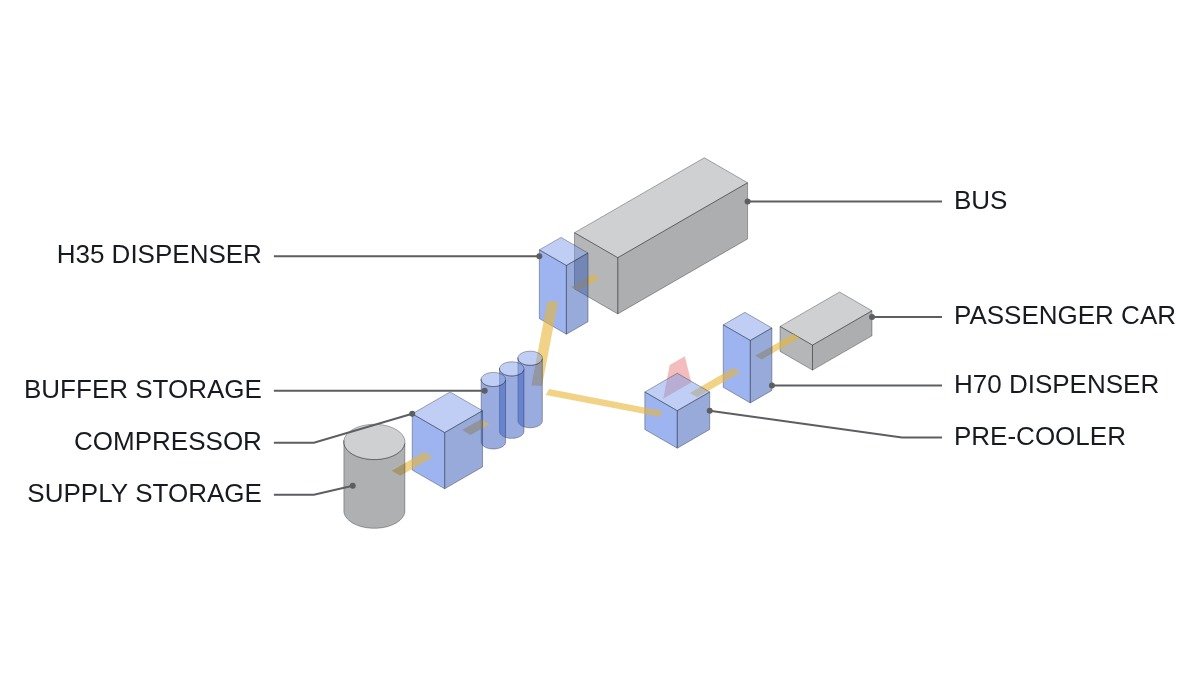
Go to 700 bar and the vehicle’s internal tank volume shrinks. In return, the station needs higher-pressure compression and storage stages, and to keep cylinder temperature down during a fast fill it must pre-cool the hydrogen below zero. Under SAE J2601 fast-fill conditions for passenger cars, the pre-cooling temperature class is around −40 °C, and that pre-cooler takes a large share of the station’s electrical load and maintenance list.
Go to 350 bar and the vehicle’s tank gets bigger, but the station’s equipment rating drops and, depending on the protocol applied, operation with relaxed pre-cooling becomes possible. Large commercial vehicles have room in the body for cylinders and can accept the larger tank. Roof-mounted cylinders on buses are the classic example.
The connecting logic: 700 bar moves the vehicle’s volume problem onto the station as an equipment problem, and 350 bar does the reverse. Whichever side has more spare volume sets the pressure.
What doubles when the pressure doubles
At high pressure hydrogen departs from ideal gas behaviour and density rises more slowly than pressure. At 15 °C, compressed hydrogen density is about 24 kg/m³ at 350 bar and about 40 kg/m³ at 700 bar: twice the pressure, about 1.7 times the density. Assumption: a passenger car carrying 6 kg needs about 250 L of internal cylinder volume at 350 bar and about 150 L at 700 bar, a 100 L difference. In a passenger car body, 100 L swallows the whole boot or rear seat space.
Apply the same calculation to a heavy truck. Assumption: 47 kg on board needs about 2.0 m³ at 350 bar and about 1.2 m³ at 700 bar. The 0.8 m³ difference is large in absolute terms, but in a large body where cylinders can sit behind the cab or along the frame rails, it can often be absorbed. The fact that the meaning of the volume difference depends on body size is the first basis for choosing pressure.
What about compression energy? Using an ideal-gas isothermal approximation, the theoretical compression work per kg is (R·T ÷ M) × ln(p2 ÷ p1). Assumptions: T = 288 K, supply pressure 20 bar. R·T ÷ M ≈ 8.314 × 288 ÷ 0.002016 ≈ 1.19 MJ/kg ≈ 0.33 kWh/kg, so compression to 350 bar is 0.33 × ln(17.5) ≈ 0.94 kWh/kg and to 700 bar 0.33 × ln(35) ≈ 1.17 kWh/kg. Doubling the pressure raises the theoretical compression work by only about 24%. Real compressor efficiency and real-gas effects make both values larger, but they do not reverse the ratio between the two pressures. Looking for the cost of a 700 bar station in compression power is looking in the wrong place.
Item-by-item comparison
| Item | 350 bar | 700 bar |
|---|---|---|
| Storage density (15 °C) | About 24 kg/m³ | About 40 kg/m³ |
| Theoretical compression work (from 20 bar) | About 0.94 kWh/kg | About 1.17 kWh/kg |
| Fill pre-cooling | Can be relaxed per protocol | Required for fast fill |
| Equipment pressure rating | Lower | Higher (compression, storage, dispenser) |
| Main vehicle demand | Buses, depot commercial vehicles | Passenger cars, some commercial |
The takeaway is that the difference between the two pressures sits in the pre-cooling and equipment rating rows, not the energy rows. A 700 bar station’s cost and maintenance burden come from the pre-cooler and high-pressure equipment rating rather than compression power, so the station’s electrical design should check the pre-cooling chiller’s continuous load and starting conditions first.
Choice by vehicle mix
| Station type | Vehicle demand | Recommended setup |
|---|---|---|
| Urban public | Mostly passenger cars | 700 bar with pre-cooling |
| Bus depot | Many of one model, sequential overnight fills | 350 bar |
| Freight hub | Mixed models, many commercial trucks | Survey on-board pressure first, consider dual pressure |
| Mixed public | Cars and commercial mixed | Dual-pressure dispenser |
The hardest row in this table is the freight hub. Commercial trucks can carry either 350 bar or 700 bar systems depending on the model, so before defaulting to 350 bar, survey the on-board pressure of the vehicles that will actually arrive. If the fleet mix is uncertain, a dual-pressure dispenser is a way to keep options open at a higher initial cost.
Decision sequence
- Survey the on-board pressure and capacity (kg) of each vehicle model the station will serve.
- Work out daily dispensed quantity (kg/day) and back-to-back fills (interval between vehicles at peak). The more back-to-back fills, the larger the pre-cooling and buffer storage capacity.
- If there is 700 bar demand, check pre-cooler power, the cooling loop and fast-fill protocol requirements.
- Confirm hydrogen quality requirements (ISO 14687) and the scope of the fuelling protocol (SAE J2601 family) by vehicle model.
- Fix, at the layout drawing stage, the safety circuit that hardwire-trips compressor and dispenser power and the supply valves on hydrogen or fire detection signals.
Items to verify: the on-board pressure trend for heavy commercial vehicles, pre-cooling requirements for 350 bar fills and the electrical load of each station component vary by vehicle model, protocol version and manufacturer, so they are not fixed as numbers here. Density and compression work are approximations with the calculation shown.
Boundary conditions
The rule “350 bar if there is spare volume” flips under these conditions. First, when a long-haul commercial vehicle’s range requirement exceeds the space available in the body. If the needed kg cannot fit on board at 350 bar, even heavy vehicles move to 700 bar. Second, when the station already has 700 bar equipment. Then serving 350 bar vehicles through reduced-pressure supply may cost less than adding equipment. Third, bus depots with a very large number of back-to-back fills. Even at 350 bar, back-to-back fast fills make cylinder temperature management a constraint again, so the need for pre-cooling must be confirmed by measurement.
A single selection criterion to close. If the vehicles served can hold their required on-board quantity (kg) within body space at 350 bar, choose 350 bar; if any part of the demand comes from vehicles that cannot, choose 700 bar or a dual-pressure setup.