The conclusion first. Choosing a nuclear cooling method is not a question of whether once-through seawater or a cooling tower is cheaper; it is a question of how much the temperature of the ultimate heat sink and constraints on water use cut summer output. Once-through seawater draws a large volume of water, uses it once, and returns it, which keeps condenser vacuum favorable, but it requires a coastal site and carries the operating risks of thermal discharge and debris at the intake.
A cooling tower makes an inland site possible, but its heat rejection is tied to ambient wet-bulb temperature, it consumes water by evaporation, and when river flow and temperature limits apply, it leads to summer derating. If a coastal site can be secured, once-through seawater wins. If proximity to load or savings in grid reinforcement outweigh the benefits of a coastal site, an inland site with cooling towers wins.
Where it wins, where it doesn’t
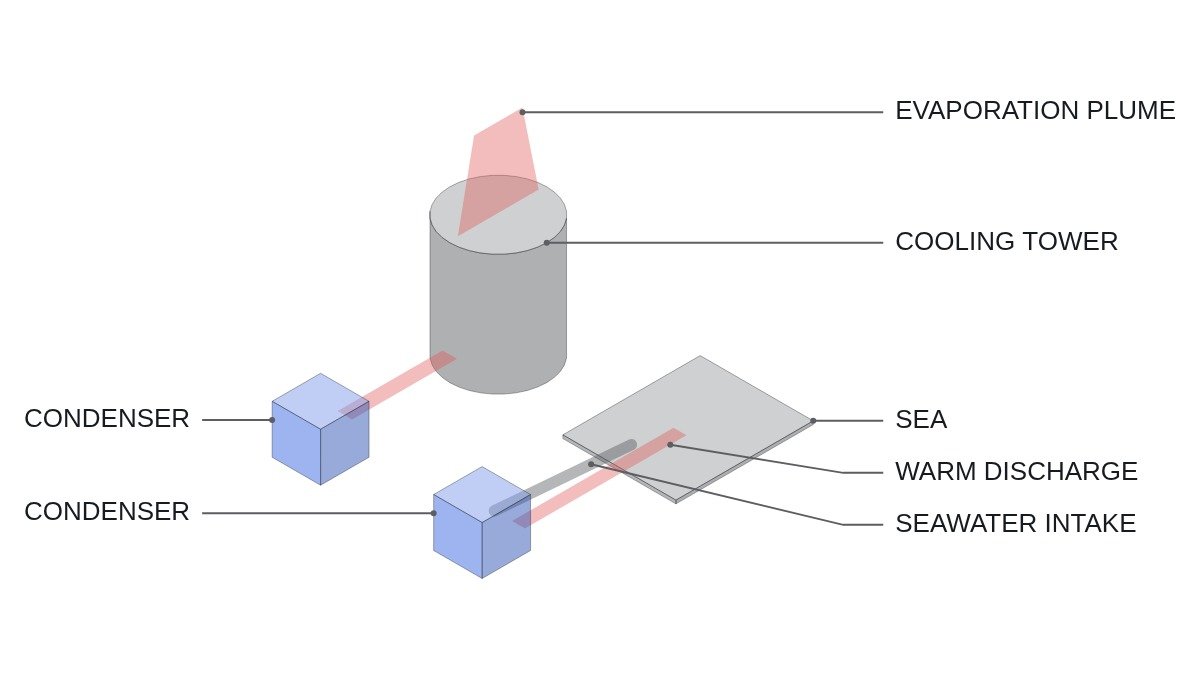
Start with the current conditions. A light water reactor has roughly one-third efficiency, so it must reject in the condenser heat equal to about twice its electrical output. Condenser pressure falls as cooling water temperature falls, and the lower the condenser pressure, the more work the turbine extracts. Cooling water temperature is, in effect, one of the variables of generating efficiency. All nuclear plants in Korea are coastal and use seawater once-through.
With a cooling tower, heat goes to the atmosphere. A wet tower evaporates part of the water to remove heat, so the lowest temperature cooling water can reach is tied to ambient wet-bulb temperature. On hot, humid summer days, cooling water temperature rises, condenser pressure rises, and electrical output falls at the same reactor thermal power. Water lost to evaporation must also be made up from a river or lake. In countries with many inland riverside plants, such as France, output reductions due to summer river temperature and discharge temperature limits have recurred.
The connecting logic: once-through cooling buys the condition “water is unlimited” to gain efficiency and simplicity, and pays by tying the site to the coast. A cooling tower gains siting freedom but takes on two weather-dependent variables: summer output and water consumption. For a grid whose demand peaks in summer, the key point is that these variables cut output exactly when it is needed most.
Cooling water flow and evaporation
For a sense of scale, here is the calculation structure. Assumptions: 1,000 MWe electrical output, 33% efficiency. Rejected heat is 1,000 × (1 − 0.33) ÷ 0.33 ≈ 2,030 MW.
For once-through cooling, assuming a 7°C cooling water temperature rise and a specific heat of 4.0 kJ/kg·K, the required flow is 2,030 MW ÷ (4.0 kJ/kg·K × 7 K) ≈ 72,500 kg/s, on the order of 70 tonnes per second. For a wet cooling tower, if all of this heat were removed as latent heat of evaporation (assumed about 2.4 MJ/kg), the upper bound on evaporation would be 2,030 MW ÷ 2.4 MJ/kg ≈ 846 kg/s. In reality sensible heat transfer, drift, and blowdown also play in, so design conditions must be used, but this calculation alone shows the difference: once-through “borrows a lot and gives it back,” while a cooling tower “draws less but consumes it.”
| Item | Once-through seawater | Wet cooling tower |
|---|---|---|
| Siting | Coast required | Inland possible (water source needed) |
| Heat rejection limit | Seawater temperature | Ambient wet-bulb temperature |
| Water use | Large withdrawal, little consumption | Small withdrawal, evaporative consumption |
| Summer effect | By seawater temperature rise | Derating possible from wet-bulb and river limits |
| Main operating risk | Debris intrusion, thermal discharge limits | Water shortage, discharge temperature limits |
| Auxiliary power | Circulating water pumps | Pumps + fans if mechanical draft |
The takeaway: both methods get worse in summer, but by different amounts and for different reasons. For once-through cooling the main effect is gradual efficiency loss as seawater warms; a cooling tower can add output limits from water-use rules on top of efficiency loss. Both are “summer derating,” but the first is a predictable gentle curve, while the second cuts output in steps the moment a regulatory threshold is reached, which places a different burden on the grid operator.
Auxiliary power and intake equipment through an electrical engineer’s eyes
The cooling system takes a large share of station auxiliary power. Both once-through and tower systems need high-capacity circulating water pumps, and a mechanical-draft tower adds many fan motors. A natural-draft tower has no fans but needs a huge structure. In station power design these loads affect starting sequence and bus allocation, and fan staging can also be a way to secure summer output.
The operating risk of once-through cooling comes from the intake. When debris such as jellyfish or seaweed arrives in large volume, intake screen differential pressure rises sharply, circulating water flow drops, condenser vacuum worsens, and in severe cases output is reduced or the unit shuts down. So an alarm scheme that watches screen differential pressure, circulating water pump current, and condenser vacuum together, plus automatic start conditions for screen wash equipment, matter. Alarm setpoints depend on site marine conditions and are not given here, and whether pump current fluctuations come from debris or electrical causes requires waveform analysis and field measurement.
Decision sequence
- Confirm whether the candidate site is coastal, or if inland, whether a water source for tower makeup is available year-round.
- Assess the likelihood of tower derating from peak summer wet-bulb temperature and river temperature limits.
- Confirm whether the grid peaks in summer. For a summer-peaking grid, weigh the tower’s derating risk more heavily.
- For a coastal site, review thermal discharge limits, the history of debris at the intake, and screen equipment capacity.
- Compare the added transmission line cost of a coastal site against the reduced grid reinforcement cost of an inland site.
Items to verify
- The cooling water flow and evaporation above are scale calculations based on assumptions; actual values must be derived from the condenser design temperature rise and tower design conditions.
- Thermal discharge standards and river discharge temperature limits differ by country and water body and must be checked against the site’s environmental permit conditions.
- Separate from the circulating water system, the ultimate heat sink that removes heat from safety-related equipment follows the safety analysis and is outside the scope of this comparison. Changing the circulating water method does not relax the requirements on safety-related cooling systems.
Boundary conditions
The advantage of once-through seawater flips under two conditions. First, when there is no suitable coastal site, or it is far from load so that transmission line cost and lead time exceed the siting benefit. Second, when thermal discharge rules tighten to the point that once-through intake and discharge conditions are hard to meet.
Conversely, the cooling tower’s advantage collapses on a summer-peaking grid where river flow is unstable or discharge temperature limits are strict, making repeated derating likely at the time power is most needed.
The single selection criterion: an inland cooling-tower plant wins only when the expected summer-peak derating and water supply cost of the tower are smaller than the added transmission cost of a coastal site.