The key point first. In a window where power demand driven by megaprojects grows faster than the construction and licensing lead time of nuclear plants, it is better to settle early, within the year, whether new reactors will be included; in a window where expanding renewables and ESS alone leaves enough room to readjust demand, it is better to prioritize social consensus through public deliberation. According to the “2040 Power Demand Re-forecast” released on August 20, 2026 by the Ministry of Climate, Energy and Environment and the steering committee for the 12th Basic Plan for Electricity Supply and Demand, the 2040 target peak load is 158.4–165.0 GW, up 26.6–26.8 GW from the figure presented in April. This increase is equivalent to 19 new reactors (APR1400) with a capacity of 1.4 GW each.
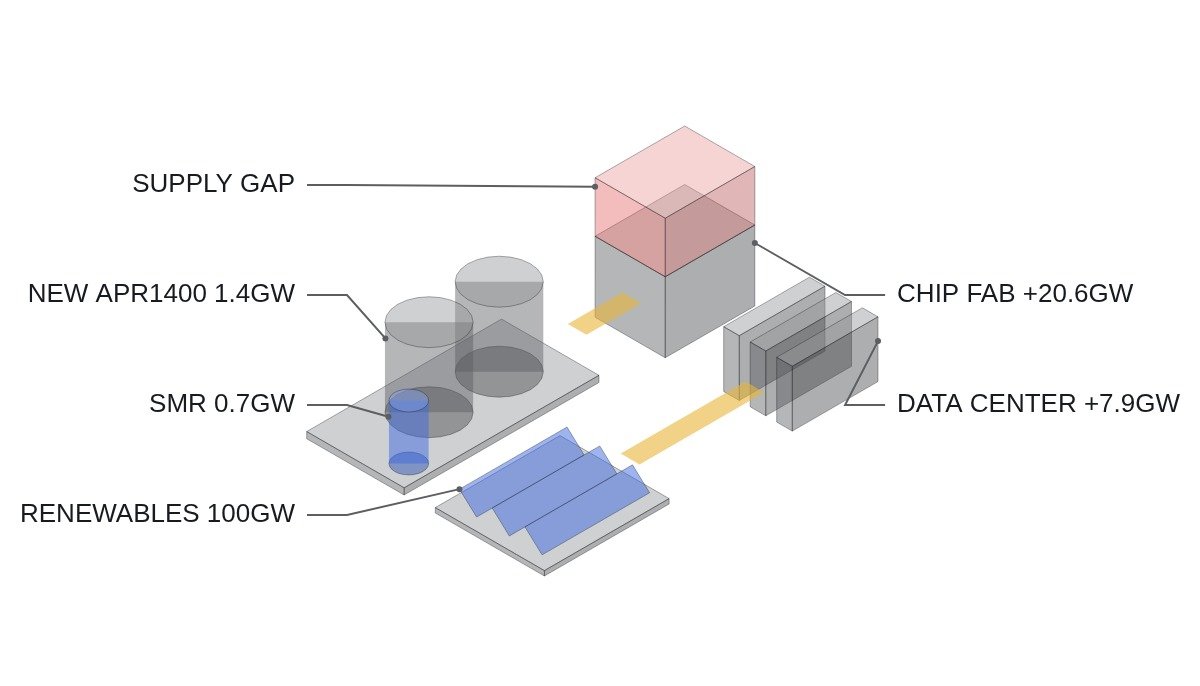
The epicenter of the demand surge is advanced industry. Compared with the April forecast, semiconductors added 20.6 GW and data centers 7.9 GW. By the Korea Energy Economics Institute’s estimate, additional demand totals 38.4 GW, including 18.4 GW from AI data centers and 20 GW from semiconductor clusters, amounting to about 260 TWh of annual consumption. Yet the Ministry of Climate, Energy and Environment, the responsible ministry, has left the question of including new reactors to public deliberation; it plans to collect opinions in August–September, prepare a government proposal around October, and finalize the plan within the year.
Where it wins: settling new reactors early
Current condition: the 2040 target peak load rose by the capacity of 19 reactors in just four months, and a large reactor typically takes more than 10 years even after the main equipment contract is signed, and much longer once site selection and licensing are included. In practice, Shin Hanul Units 3 and 4 take 10 years and 7 months from the main equipment contract (March 2023) to the construction deadline (October 2033).
Change after applying it: even if new reactors are included in the 12th Basic Plan within the year, according to KEPCO’s Q2 2026 investor presentation, the actual grid entry of two large reactors (2.8 GW) would be in 2037–2038, and the SMR demonstration portion (0.7 GW) in 2035–2036.
Connecting logic: even a decision made now brings capacity online only in the late 2030s, so delaying the decision further does not push the supply gap back; the gap simply remains. In other words, settling early does not eliminate the gap; it minimizes it.
Where it doesn’t: deliberation first, cautious approach
Current condition: the government has already announced a concrete blueprint to raise renewable capacity from 30 GW to 100 GW by 2030 and to phase out 60 coal-fired plants by 2040.
Change after applying it: even if 100 GW is reached by 2030, annual output would be only about 150 TWh, including 105 TWh from solar and 49 TWh from wind, which is less than 60% of the additional 260 TWh of demand. Filling the gap with renewables and ESS alone, without nuclear, would require a far larger build-out than currently planned.
Connecting logic: renewables alone leave a large shortfall, so the cautious position cannot be a complete alternative. The case for caution rests instead on the risk that a hasty decision made amid local acceptance conflicts could lead to construction delays and lengthen the lead time even further.
Comparison table
| Item | Settle new reactors early | Deliberation first, cautious |
|---|---|---|
| Response to demand increase | Directly covers the 19-APR1400 equivalent | Partial coverage via 100 GW renewables (under 60% of added demand) |
| Capacity entry timing | Large reactors 2037–2038, SMR 2035–2036 | Not applicable (renewables can be added on a relatively short timeline) |
| Lead time risk | Possible delay if site selection is contested | Supply gap fully exposed if demand readjustment fails |
| Policy stability required | 10+ years of policy consistency needed | Renewable blueprint already fixed; only nuclear is in flux |
As the table shows, neither option can fully meet roughly 260 TWh of new demand on its own. The real issue, then, is not whether nuclear is included but “when the decision is made,” and the longer the decision is delayed, the more the risk of a supply gap in the late 2030s accumulates.
Boundary conditions: where the advantage flips
This re-forecast was calculated from surveys of corporate investment plans, including early completion of the Yongin cluster, development of a Honam-region cluster, and fab expansions in Pyeongtaek and Cheongju. If semiconductor cluster construction is delayed or data center investment plans are scaled back, the 26.6 GW increase itself may be revised down, and in that case the advantage of settling new reactors early loses its basis. It is also worth noting that modular manufacture and assembly of reactor buildings and cores can shorten some on-site construction lead time (US Patent US11,746,550, modular manufacture, delivery, and assembly of nuclear reactor building systems), but this only shortens the schedule after construction starts; it does not remove the site selection and licensing period itself. The final selection criterion is “how robust is the feasibility of the investment-plan survey figures.”
Frequently asked questions
Q. Where did the 26.6 GW increase in the 2040 power demand re-forecast come from?
The main drivers are increases of 20.6 GW from semiconductors and 7.9 GW from data centers compared with the April forecast. The Korea Energy Economics Institute estimated total additional demand of 38.4 GW, including 18.4 GW from AI data centers and 20 GW from semiconductor clusters.
Q. What is the basis for the “19 reactors” conversion?
It is 26.6 GW divided by one new 1.4 GW-class reactor (APR1400). The actual supply contribution depends on the capacity factor.
Q. Can settling new reactors early prevent a gap in the late 2030s?
Because the site selection and licensing period remains, the gap risk accumulates the later the decision is made. Modular construction only shortens the schedule after construction starts; it does not eliminate the licensing period.
References: New Daily, “Megaprojects move at blitz speed while nuclear drifts in deliberation … the collapsing K-nuclear timeline” (2026-08-21) / Ministry of Climate, Energy and Environment and the 12th Basic Plan for Electricity Supply and Demand steering committee policy forum (2026-08-20) / US11,746,550, Modular manufacture, delivery, and assembly of nuclear reactor building systems