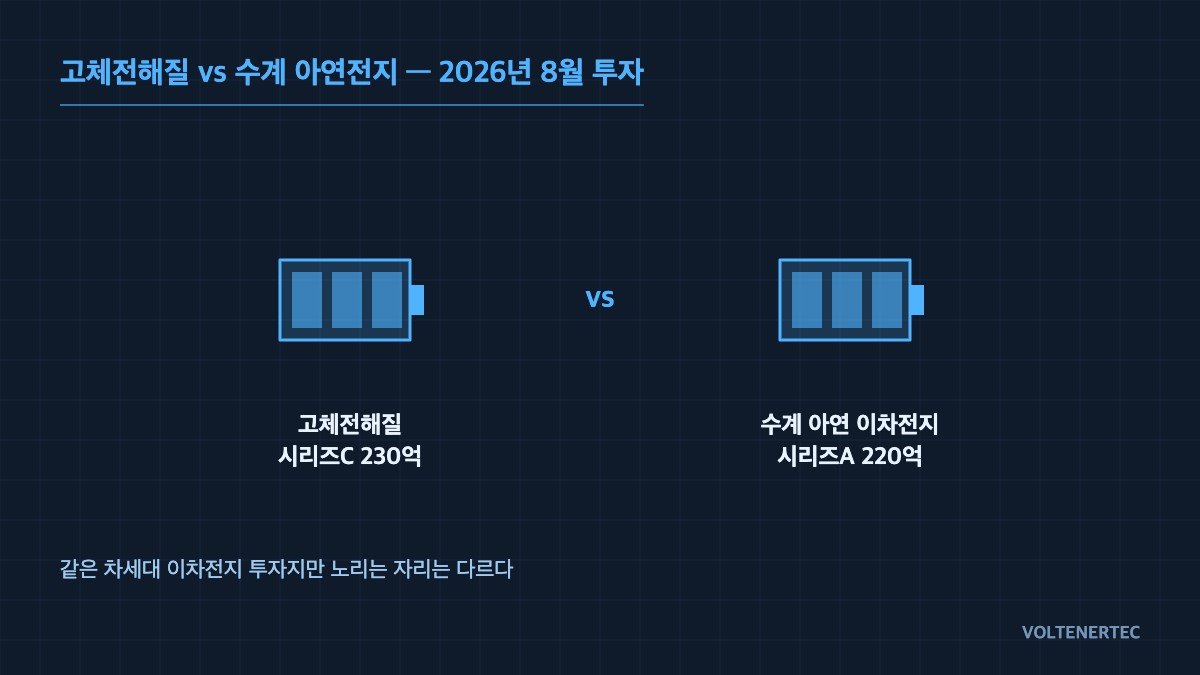
In August 2026, a solid-electrolyte company raised a KRW 23 billion Series C, and an aqueous zinc secondary battery company raised a KRW 22 billion Series A. Both count as “next-generation secondary battery” investments, but they are aimed at different positions.
| Item | Solid electrolyte | Aqueous zinc battery |
|---|---|---|
| Strengths | Energy density, improved fire safety | Cost, inherent safety |
| Weaknesses | Interfacial resistance, mass-production cost | Low energy density |
| Where it wins | High-energy-density applications such as EVs | Stationary storage such as ESS |
| Where it doesn’t | Near-term cost competitiveness | Lightweighting for mobility |
By investment size alone the two look similar, but solid electrolyte is at Series C (a follow-on round) while aqueous zinc is at Series A (an early round), so it is worth noting that the two technologies sit at different stages of maturity altogether.
Reading the two strategies from the system side
The table compares cell chemistries, but the reason they end up in different positions becomes clearer when you look at what each one asks of the system around it. A battery is never installed alone; it comes with a BMS, thermal management, protection devices and, in stationary use, fire detection and suppression. Each chemistry shifts the burden among those components differently.
A solid electrolyte targets energy density and improved fire safety. In a vehicle, energy density is the constraint that everything else follows, because every kilogram and every liter of pack volume competes with the rest of the vehicle. Improved fire safety is valuable there as well, but the investment case rests on packing more energy into the same space. The weaknesses listed, interfacial resistance and mass-production cost, are problems of the cell and the factory, not of the installation.
Aqueous zinc targets cost and inherent safety, and accepts low energy density. In a stationary ESS, the site usually has more floor area than a vehicle has pack volume, so lower energy density turns into a larger footprint rather than a disqualifying limit. What the stationary operator gains is a lower dependence on fire-related interlocks and suppression as the first line of defense, because the electrolyte itself is water-based. The investment case rests on cost per unit of stored energy and on how much safety equipment the site can simplify.
Where it wins, where it doesn’t
Current condition: mobility applications are limited by weight and volume, while stationary applications are limited by cost and site safety. After applying each technology: a solid electrolyte, once its production cost comes down, adds energy density to a vehicle pack without adding space; an aqueous zinc battery lets a stationary site trade floor area for lower cost and a simpler safety profile. Linking logic: each technology wins where its weakness is cheap to absorb. Low energy density is cheap to absorb on a site with space; high production cost is easier to absorb in a product where density commands a premium.
Character comparison by installation
| System factor | Solid electrolyte | Aqueous zinc |
|---|---|---|
| Binding constraint it relaxes | Space and weight | Cost and fire risk |
| Constraint it tightens | Near-term cost | Footprint |
| Where risk sits | Cell interface and factory yield | Site area and energy density |
| Natural buyer | Vehicle and pack makers | Stationary storage operators |
| Funding stage (Aug 2026) | Series C | Series A |
The implication of this table is that the two technologies are not competing for the same customer. A solid electrolyte is judged by a vehicle maker who cares about density; aqueous zinc is judged by a storage operator who cares about cost and safety per site. Comparing them head-to-head on one metric misses that each is being measured by a different buyer.
What to check when evaluating either one
- Identify the application first: mobile or stationary. This decides whether energy density is a hard constraint or a trade-off.
- For stationary use, check whether the site can accept a larger footprint before comparing chemistries.
- Check which safety functions the chemistry changes in practice. The protection devices, disconnects and hardwired safety circuits required by the applicable IEC and NEC rules still apply regardless of chemistry.
- Read the funding stage as a maturity signal: a Series A technology carries more uncertainty about production scale than a Series C technology.
What a stationary system designer should look at first
Even with an aqueous electrolyte, cell voltage monitoring, overcharge protection and DC disconnect design all remain. What the chemistry changes is the premise of the fire scenario and, with it, the scale of ventilation, suppression and separation design. In general, a chemistry with a lower nominal cell voltage needs more cells in series to reach the same DC link voltage, which adds cell voltage monitoring channels and connection points. The actual cell voltage and series configuration are items to confirm from the supplier specification.
A chemistry comparison should therefore be made not from a cell datasheet but as a list: if the site switches to this chemistry, which items in the site safety design are removed or reduced, and which items grow.
Boundary conditions
The positions in this post can shift. If the mass-production cost of solid electrolytes falls far enough, they become candidates for stationary storage as well, where their fire-safety improvement would count. If a stationary site is short on land, the footprint penalty of low energy density can outweigh the cost advantage of aqueous zinc. And because the two companies are at different funding stages, their timelines to volume production are not directly comparable. The single selection criterion is this: choose the chemistry whose weakness costs the least in the specific installation.