Let me start with the conclusion. In a period when overseas (particularly US) raw material supply routes are being narrowed by policy, building domestic recycling capacity based on the volume of end-of-life batteries generated in Korea (expanding in-house pre-treatment and hydrometallurgical facilities) has the advantage. In a period when domestic end-of-life battery volume is not large enough to support facility utilisation, diversifying non-US supply routes has the advantage. The US Department of Commerce, using its Defense Production Act authority, will from 27 August 2026 enforce a rule requiring black mass and tungsten scrap — key raw materials for battery recycling — to be offered for sale to US buyers first. Exceptions require prior approval from the authorities.
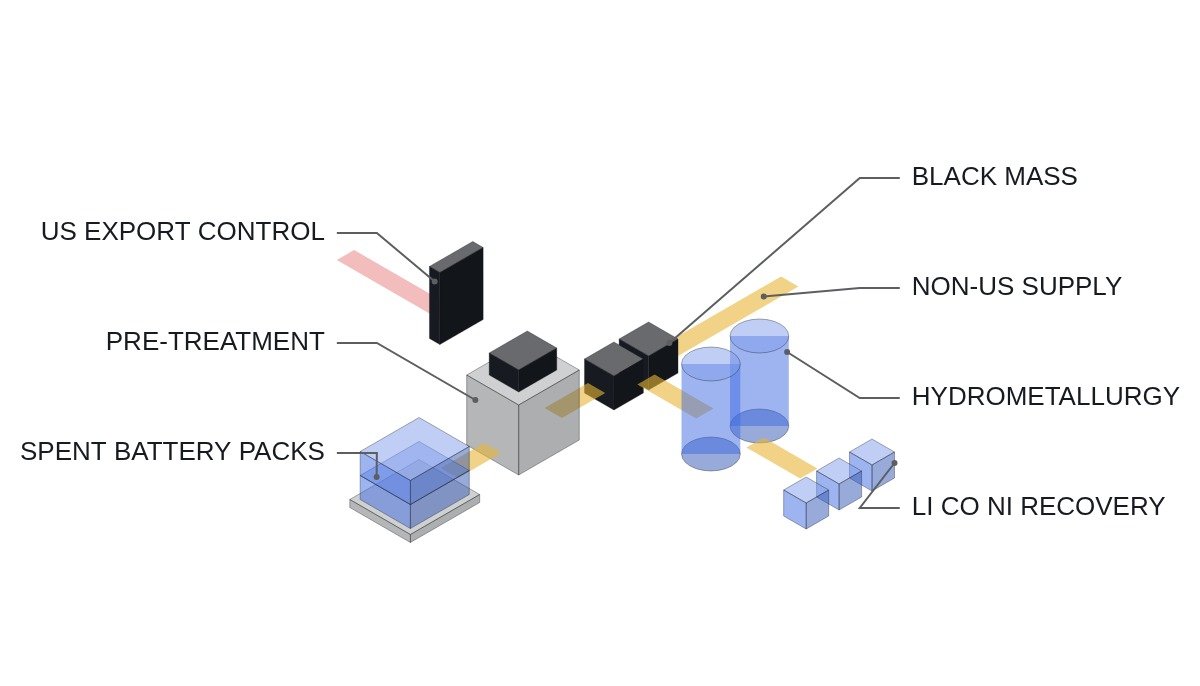
Black mass is shredded end-of-life battery material containing lithium, cobalt and nickel, and is a core material in battery recycling. At the same time, US Customs and Border Protection has tightened importer information verification: importers and customs brokers must update their customs declaration form (Form 5106) information by 18 September 2026, and failure to register by the deadline may result in customs delays or penalties. In Korea, the Ministry of Climate, Energy and Environment is working to improve recycling standards for black mass generated from used batteries and manufacturing process residues.
Where it wins: in-house domestic recycling
Current condition: With the US mandating that black mass and tungsten scrap be sold first to domestic buyers, black mass supply routes that passed through or were bound for the US are effectively closed without prior approval.
After the change: If the end-of-life battery and black mass volumes generated in Korea are absorbed by domestic hydrometallurgical (pre-treatment) facilities, raw material supply can be secured regardless of US export control risk, and policy support can be expected in combination with the government’s improved black mass recycling standards (wider recognition of valuable materials such as cobalt).
Connecting logic: Because this is a period in which raw material supply risk is resolved and policy support overlaps, the judgement that now is the right time to invest in domestic hydrometallurgical facilities holds.
Where it doesn’t: supply route diversification
Current condition: Because of the time lag in EV adoption, domestic end-of-life battery volume is not yet large enough to supply bulk scrap reliably. Recovering the CAPEX of hydrometallurgical facilities presupposes a stable supply of scrap.
After the change: If facilities are expanded pre-emptively without the raw material volume to back them, losses can actually grow because of low utilisation. Diversifying to non-US supply routes such as Europe and Southeast Asia allows volume to be secured in the short term outside the reach of US export controls.
Connecting logic: Until domestic generation volume can support it, supply route diversification is a lower-risk choice than building in-house facilities.
Comparison table
| Item | In-house domestic recycling | Supply route diversification |
|---|---|---|
| Raw material supply stability | Unaffected by US policy changes | Dependent on non-US routes, volume variability |
| Initial CAPEX | High (new hydrometallurgical facilities) | Low (expansion of existing supply channels) |
| Policy risk | Consistent with improved domestic recycling standards | Exposed to regulatory changes in third countries |
| Utilisation precondition | Requires sufficient domestic scrap volume | Not applicable (external supply) |
As the table shows, in-house recycling has the advantage in policy alignment but carries the precondition of raw material volume, while diversification can be executed immediately but carries a separate risk of regulatory change in third countries.
Boundary conditions: where the advantage reverses
The US measure allows exceptions with prior approval, so the actual strength of the export control may vary depending on how approvals are administered. If controls are eased or exceptions are granted widely, the relative advantage of domestic in-house recycling weakens. And if domestic end-of-life battery volume grows more slowly than expected, securing utilisation for hydrometallurgical facilities becomes difficult and the CAPEX payback period lengthens. The final selection criterion is “whether domestic end-of-life battery volume grows faster than the facility CAPEX payback period,” and immediate in-house investment has the advantage only when this condition holds.
References: Global Economic, “The US has become a raw material black hole… warning light for the K-battery supply chain” (2026-08-23, citing a 2026-08-20 report by law firm Foley & Lardner) / Hello T, “Ministry of Climate improves recycling standards for spent battery black mass… cobalt also recognised as a valuable material” / US12,500,282, Method and system for extracting black mass from spent lithium ion batteries