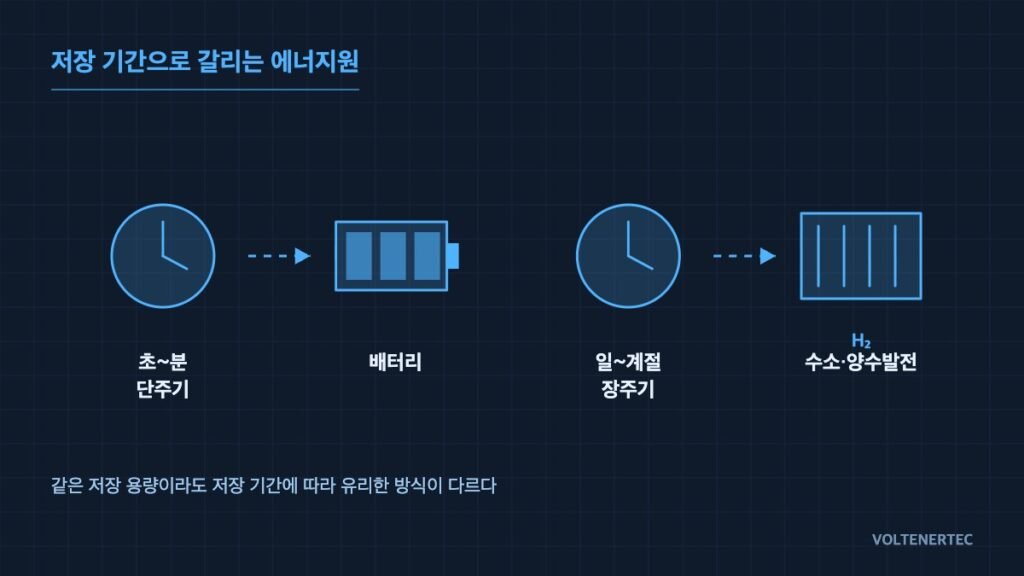
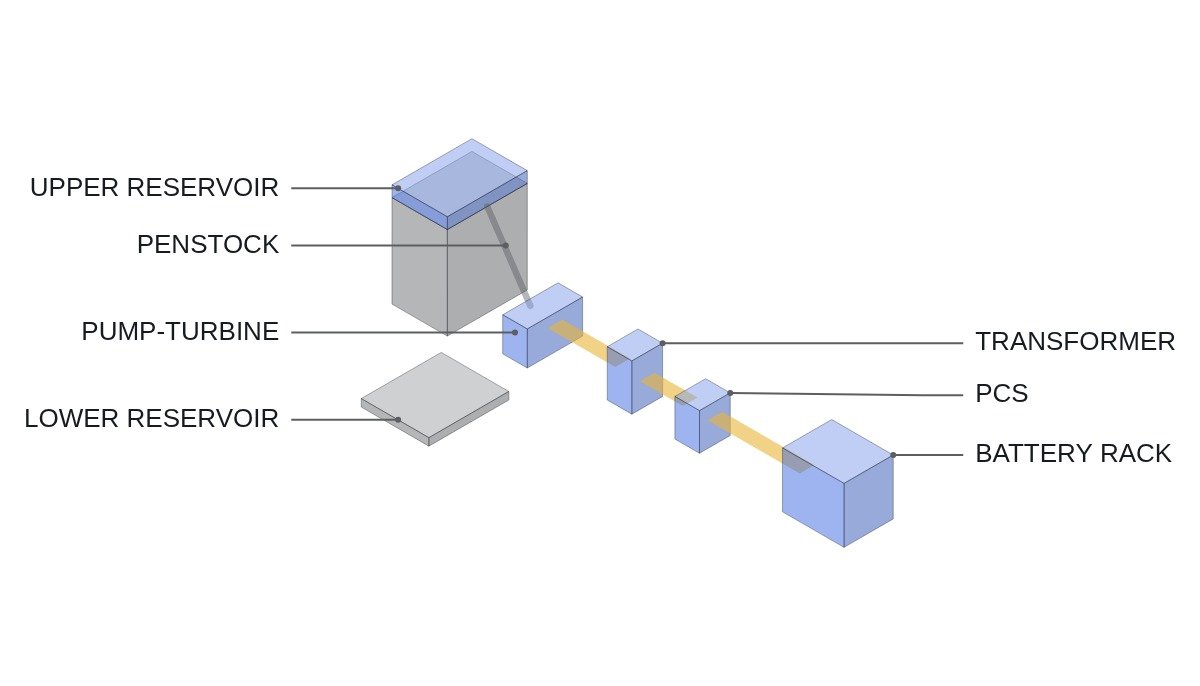
Here is the conclusion up front. What separates pumped hydro from battery ESS is not round-trip efficiency but how the cost behaves when you add one more hour of discharge. A battery ESS needs proportionally more cells for every extra hour, so its energy (kWh) cost stacks up almost linearly. In pumped hydro, power (kW) is set by the pump-turbine and motor-generator, while energy (kWh) is set by reservoir volume and head, so on a suitable site the marginal cost of extra duration rises far more gently. Short durations where response speed matters favor batteries; long durations over a multi-decade service life favor pumped hydro. The catch is that pumped hydro is only an option where the terrain allows it.
Where it wins, where it doesn’t
Where battery ESS wins
Start with the current conditions. If the system operator wants sub-second frequency response, a few hours of evening peak shifting, or smoothing of renewable output swings, the requirement is power and speed rather than energy. With a battery ESS, the PCS changes output through power-electronic control, so the delay from command to output is shorter than with mechanical plant, and the lack of siting constraints lets you place units near load centers and substations. The logic is simple: short durations need few cells, and in that range the linear kWh cost is not a weakness.
Where pumped hydro wins
If the conditions are multi-day surplus shifting, seasonal renewable surplus, or securing large synchronous inertia, the picture changes. Pumped hydro builds the reservoir once and gains long duration, and in generating mode its synchronous machine is physically coupled to the grid, supplying inertia and short-circuit capacity at the same time. The link is the way energy is added. A battery must buy electrochemical material for every added kWh, while pumped hydro simply runs water through the same machine for longer, so the gap widens as duration grows.
Where pumped hydro loses
If there is no terrain with enough head for upper and lower reservoirs, or the project cannot wait out permitting and civil works, pumped hydro drops off the list. A battery ESS has a comparatively short path from order to operation, which makes it close to the only storage option when a capacity shortfall is imminent.
Head sets the reservoir size
Stored energy in pumped hydro follows directly from potential energy: E = ρ × g × h × V × η. Assumptions: water density ρ = 1,000 kg/m³, g = 9.81 m/s², effective head h = 300 m, generating-side efficiency η = 0.9.
One cubic meter of water holds 1,000 × 9.81 × 300 = 2,943,000 J, about 0.8175 kWh, or roughly 0.736 kWh after the 0.9 generating efficiency. Delivering 1,000 MWh therefore needs about 1,000,000 ÷ 0.736 ≈ 1.36 million m³ of usable storage. Double the head to 600 m and the required volume halves to about 0.68 million m³. In other words, the economics of pumped hydro are decided first by the head at the site, not by equipment specification.
Batteries have no such lever. Assumption: 90% usable depth of discharge. Delivering 1,000 MWh needs about 1,111 MWh of nameplate cells, and doubling the duration doubles the cells. The PCS and transformer are tied to power, so they stay the same, which means the share of cells in total project cost grows with duration. That shifting share is what actually creates the crossover between the two.
Side-by-side comparison
| Item | Pumped hydro | Battery ESS |
|---|---|---|
| Adding energy | Reservoir volume, head | Proportional to cells |
| Power equipment | Pump-turbine, motor-generator | PCS, transformer |
| Siting | Head terrain required | Few constraints |
| Build time | Long (civil, permits) | Relatively short |
| Response | Mode change in minutes | Sub-second |
| Grid inertia | Physical synchronous inertia | Emulated (grid-forming) |
| Degradation | Mechanical wear, civil upkeep | Cycle and calendar aging |
Don’t read this table top to bottom; check the energy and siting rows first. If pumped hydro fails either of those, the rest of its advantages do not matter. If it passes both, the benefit of its energy-scaling structure outweighs its slower response more and more as duration grows.
Judgment by discharge duration
| Duration | Main use | Favored |
|---|---|---|
| Under 1 hour | Frequency, reserves | Battery ESS |
| Several hours | Daily peak shifting | Depends on site and cost |
| A day or more | Long surplus shifting | Pumped hydro (site permitting) |
The middle row is where projects collide most often in practice. The crossover there moves with site head, the option to reuse an existing dam, and cell price trends, so it should not be pinned to a fixed number of hours. In this band, the right method is to size both options to the same duration and put their lifetime costs side by side.
One point is often missed in the field. The two look like competitors, but within one grid their roles can be split cleanly. Let the battery take sub-second frequency response and short ramps, and let pumped hydro take the long energy shifts beyond the first minutes. The mode-change delay of pumped hydro then stops mattering, and the battery runs mostly shallow cycles, which slows its aging. Because the battery no longer needs a large kWh rating, its linear kWh cost shrinks as well. On a grid with new pumped hydro planned, decide from the outset whether the battery is sized as a bridge until the hydro plant is commissioned or kept afterwards as a dedicated fast-response asset.
Decision sequence
- Fix the required discharge duration first. If only power (MW) is set and energy (MWh) is left open, no comparison is possible.
- Confirm the effective head and storable volume at candidate sites, and use the formula above to calculate achievable MWh.
- Write down the response speed and the inertia and short-circuit contribution the grid requires. If synchronous inertia is a requirement, weight pumped hydro higher.
- Compare the target commercial operation date with the build time. If the date is close, there is no option other than batteries.
- Compare lifetime cost on the same duration basis, including the number of cell replacements over the service life.
Items to verify
- Effective head at each candidate site and the reservoir operating level range (the gap between minimum and maximum levels sets the real usable volume)
- Whether variable-speed pumped hydro applies (the adjustable pumping input range must be confirmed per machine specification)
- Supplier terms for guaranteed cell cycle count and replacement timing
- Whether the system operator’s inertia and short-circuit requirements are part of the equipment selection criteria
Boundary conditions
The advantage of pumped hydro flips under three conditions. First, when low head pushes the required reservoir volume beyond what the site can hold. Second, when a capacity shortfall arrives within a few years and a long build cannot be waited out. Third, when the actual operating pattern is dominated by short cycles of a few hours or less, so the long duration is never used. Conversely, the battery’s advantage shrinks as duration requirements lengthen and inertia requirements are written into the specification.
The single selection criterion: if head terrain is available and the required duration runs to a day or more, choose pumped hydro; if either condition fails, choose battery ESS.